
Castle Farms, Hour 3
Season 30 Episode 12 | 52m 25sVideo has Closed Captions
ROADSHOW found treasures in a castle during a stop in Charlevoix, Michigan.
ROADSHOW found treasures in a castle during a stop in Charlevoix, MI, including Tiffany Studios lily sconces, ca. 1905, a 1904 Philadelphia quilt and a Chinese & Japanese decorative art collection. One family heirloom is a whopping $75K!
Problems playing video? | Closed Captioning Feedback
Problems playing video? | Closed Captioning Feedback
Funding for ANTIQUES ROADSHOW is provided by American Cruise Lines and Ancestry. Additional funding is provided by public television viewers.
Support provided by:


Castle Farms, Hour 3
Season 30 Episode 12 | 52m 25sVideo has Closed Captions
ROADSHOW found treasures in a castle during a stop in Charlevoix, MI, including Tiffany Studios lily sconces, ca. 1905, a 1904 Philadelphia quilt and a Chinese & Japanese decorative art collection. One family heirloom is a whopping $75K!
Problems playing video? | Closed Captioning Feedback
Where to Watch Antiques Roadshow
Antiques Roadshow is available to stream on pbs.org and the PBS app.
Buy Now

ANTIQUES ROADSHOW's 2026 Production Tour
Enter now for a chance to win a pair of free tickets to one of the three stops on ANTIQUES ROADSHOW's 2026 Tour. Sweepstakes entry deadline is April 6.Providing Support for PBS.org
Learn Moreabout PBS online sponsorship♪ ♪ CORAL PEÑA: "Antiques Roadshow" has motored into Charlevoix, Michigan, to Castle Farms.
On the tube we have, "Save these, Janet!"
(laughs) Big exclamation point.
Wow, all right, yep.
Th-that, that blows right past what I was expecting.
(laughs) ♪ ♪ PEÑA: Castle Farms is ready for "Roadshow's" thousands of guests and their treasures.
Adding to the atmosphere are charming gardens... ...tranquil water features, and inside, a curious cluster of collectibles.
"Roadshow" certainly appreciates an eclectic collection, and we've got lots of amazing finds to share from Michigan today.
GUEST: This is a Civil War drum major's baton.
I got it from a history professor from Kalamazoo College.
He told me, "You're very lucky to get that because I could have sold that three or four times to different people."
(laughs) I don't recall the price anymore.
It couldn't have been more than several hundred dollars.
GUEST: This owl, I picked him up at a yard sale.
I just thought he was just very compelling and cute.
He is, I believe, silver.
I think he's Dutch.
But the cool part is his little head pops open... ...and it's some kind of shaker on the inside.
I paid two dollars for it.
GUEST: We had friends, a wonderful older couple who collected art and wine and beautiful things.
And on Christmases and birthdays, around their beautiful dining room table, they would come out and they'd bring a painting, or a piece of silver, or a piece of jewelry like this and gift it to us.
What year do you figure you got this from?
I would think about 1995.
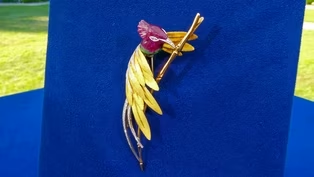
It's a clip brooch.
It's made by a gentleman called Pierre Sterlé.
He's born in a... ...somewhat wealthy family in Paris.
And World War I, around that time period, his father dies, and he goes to work and live with his uncle, who owns a jewelry store called Maynier-Pincon.
Soon after, he's working there and designing, his uncle realizes he's quite talented, and he works there and hones his chops, as they say.
But eventually, he moves on.
He works for Ostertag, Boucheron and Chaumet.
I mean, that-that's a, you know, that's the hit list.
I mean, three fabulous French jewelers.
But in 1934, he goes out on his own and he opens his first shop.
He's known for working with experimental gemstones.
Do you have any idea what the head of the bird is made out of?
I do not.
This is a type of rock gemstone that comes from the foothills of Kilimanjaro.
Really?
It's ruby zoisite.
It has another name called anyolite.
It's ruby crystals embedded in the zoisite matrix, which is the green portion.
It's not two stones that were put together.
Oh.
This occurs naturally when these stones were being formed under intense heat and pressure.
I called my dad, who's one of the original jewelry guys at the table.
He's 95, and without a hesitation, "It's a hummingbird."
So we kind of check it out.
We're going with hummingbird.
For anybody out there thinks it's not a hummingbird, let us know.
The next element, the bamboo.
Wonderfully, just curved and executed.
Then you have the feathers.
You notice how they have all this texture?
Yes, they do.
Then you have the accents of the diamond.
So it's done in 18 karat gold.
There's 66 tiny little stones.
They're probably two carats in total.
The white sections on top of the 18 karat yellow gold are platinum.
On the back, there's some French assay marks.
One of the marks is an eagle.
It tells us that it's 18 karat yellow gold.
It's also signed "Sterlé Paris."
And then it has some stock numbers there.
Birds were one of his specialties.
This is from around 1960.
These are highly desirable.
At an auction today, I would put this in for $30,000.
Really?
Really?
I can't believe it.
I'm not done.
That's the low.
$30,000... ...to $50,000.
I can't believe it.
It's just beautiful, isn't it?
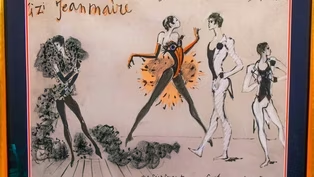
GUEST: It's a Yves Saint Laurent.
Zizi Jeanmaire, who happens to be the main character in the painting, was one of his muses and a famous ballerina, I think.
Her husband was Roland Petit, who produced a lot of ballets.
Purchased it in 2006 in Manhattan in someone's-- some gentleman's basement.
(chuckles) APPRAISER (chuckling): Okay.
And I paid $1,800 for it.
Well, Yves Saint Laurent needs no introduction.
Mm-hmm.
He's obviously an iconic 20th century fashion designer.
But what is perhaps less known is that he was a pretty prolific sketch artist, as he would have to be.
He was designing shoes and dress lines.
This is a pretty compelling example.
It's signed in the lower center, and as you mentioned, we have "Ballets de Roland Petit" and "Zizi Jeanmaire," who was indeed a famous ballerina.
And her husband was Petit.
Yves Saint Laurent associated with the two of them.
He was friends of theirs.
It's a pretty busy scene.
We have some dancers in costume.
It's pastel, gouache and charcoal.
So sort of a mixed media.
In all likelihood, this would have been around the 1960s or '70s, really at the height of his career, and after he had started his own fashion line.
On the back of the painting, there was a label that indicated that it had sold before.
I tracked that sale down.
It was in 1997.
Oh, cool.
And it sold for the amount of $2,700.
But we're-- that's almost 30 years ago now.
His work frequently comes up at auctions, his sketches and vast majority are portrait studies.
This is a little more substantial than most of what you see selling.
An auction estimate for the work would fall in the area of $10,000 to $15,000.
Okay, wow, yeah, good.
I'm pleased.
(laughs) It's a killer example.
Yeah, it is.
JESSICA ANDERSON: Castle Farms was built in 1918 by the former acting president of the Sears and Roebuck Company.
And he built it as a working dairy farm so he could advertise all of the farm equipment that he had for sale in the catalog.
And he loved castles, so he just built it to look like one.
In the '60s, a metalworking artist named John VanHaver named it Castle VanHaver and wanted to turn it into an artist's mecca.
In 1969, John VanHaver sold it to Art Reibel who was a local judge and tax attorney, and he turned this into Rock and Roll Central, nicknamed it Castle Farms and anyone that you can imagine from AC/DC to ZZ Top played here.
In 2001, our owner, Linda Mueller, purchased it, and she was able to get the blueprints from the original descendants of the family so that she could remodel this so it's now historically accurate.
And she decided to turn it into a wedding facility.
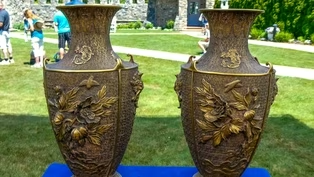
GUEST: Probably around 2005.
I had a good friend of mine that knew I loved Asian art.
He saw these two lamps at a house sale.
So he called me and he said, "I've got some lamps that have your name on 'em."
He shows up at the front door with these two lamps.
I went, "I'll take 'em, thank you, they're beautiful."
Mm-hmm.
So paid him a couple hundred bucks and he was on his way.
And I told my husband, I said, "Get this lamp stuff off of these beautiful vases!"
Somebody had converted these into lamps.
This guy came from an estate sale about, it's got to be almost 35 years ago.
I was sitting out in front of this house at 4:00 in the morning, waiting for the door to open, which didn't open till 8:00.
It was freezing cold out, and I only had a quarter tank of gas.
APPRAISER: That's dedication.
That was dedication.
And where did you get our final piece of the puzzle?
This fella?
That came out of the same estate sale.
I think I paid about $200 for it, that's it.
Okay.
And this fella?
And this, about the same thing.
There's one of these that I am most interested in.
Okay.
We'll start with the lamps.
(chuckles) Okay.
Oh, God.
Lamps.
(laughs) They are an archaistic form covered in these little designs.
Those are meant to symbolize baby dragons.
Oh, okay.
And they have objects on here, Buddhistic objects, and likely were produced in the 1920s.
And as odd as it may seem, shortly after their date of production, they were probably turned into lamps right about then.
These fellas are worth about $200 to $300.
Okay.
This is stylistically an 18th century Chinese box, a birthday gift box, lacquer.
Okay.
But it is not 18th century.
Okay.
It's 20th century, 1970s, 1960s.
Amazing.
Really?
Worth about $200.
Oh, my gosh.
Well, okay, I'm even Steven.
This one is what I find to be the most intriguing and most interesting.
It is a Japanese bamboo ikebana vase used to display flowers that has been beautifully decorated with menuki, which are sword fittings.
Every sword has a handle, of course, and the handles are wrapped with rope and that cord, you can stick little objects underneath it.
And that's what you would do with these to show off, to say, this is what I'm interested in.
Beside every single one of these, there's a little inscription.
Those inscriptions are the makers.
So what I suspect is that this was a family's collection of menuki, and they decided to display all of them in one way.
So they put them all together on this fantastic vase.
There's also an inscription on the base that says, "front left."
So that makes me think perhaps this was part of a set.
To really get the full value, I would have to sit down and translate each one of these names, find the makers, see who they are.
We do have some damage-- the bamboo is split.
Okay.
Oh, I'm sure.
There are some menuki that are missing.
Overall, though, the inscriptions are strong.
The coloring is good on the gilding and the silvering, and it's beautiful.
Okay.
This is the first time that I've ever seen anything like it... Really?
...and I showed it to my colleagues at the Asian art table.
We'd never seen anything like it.
Really?
I would estimate at auction, without having translated the makers, that this would sell for at least $5,000 to $8,000.
(laughing): Really?
I did okay.
I did okay.
You did more than okay.
(laughs) That's awesome.
Thank you.
That's amazing.
Wow.
Found a pre-World War I golf trophy from Marguerite Fahnestock.
Uh, I'm a high school music teacher, and I was actually looking for musical instruments.
Looking around for trumpets, I found a trumpet bell trophy.
It's from 1911.
That was her married name-- it was actually Marguerite Sawyer Davis, who was one of the wealthiest women in the United States in the early 1900s.
She had a major theft at her house in 1942, where all of her jewelry was stolen.
And this may have been part of the loot.
I paid ten dollars online.
I didn't get a trumpet, but I got this great trophy.
GUEST: We got it at a thrift store for five dollars.
It is authentic.
And there were about 500 of them made.
And Picasso did touch it.
He didn't make it, but he did come through and do something on it.
GUEST: I found myself on, uh, Rush Street about 2:00 in the morning, uh, in, uh, 1980, in October.
We were there for a print convention.
And I was walking along and my buddy kind of was lagging behind me.
So I went back to him, and he was standing in a doorway, and it was pretty dark.
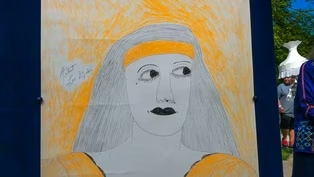
And there was this ragged older woman doing this drawing.
And I think he gave her, like, $20 or something.
We got back from the convention, he said, "Do you want this thing?"
I said, "Sure, I'll take it."
So I took it and I rolled it up and I put it in a tube in my closet.
When we got these tickets, I said, maybe this is something.
So the artist is Lee Godie.
And she was homeless, but more by choice than by necessity-- she preferred the outdoors to indoors.
She was born in 1908 to a family of 11 children, Christian Scientists.
All the girls had to sleep together in the attic.
She was married twice, had four children.
Two of her children died, and that seemed to be such a traumatic event that she decided to reinvent herself.
Her second husband had a chicken farm in Washington State, and she had hoped that he was going to support her career as a nightclub singer.
But instead, she found herself on a chicken farm.
So she ran away.
And then she showed up in Chicago in the '70s as an artist.
And she used to spend a lot of time on the steps of the Art Institute, where she would sell her work and she would introduce herself to people as a French Impressionist.
And she would also say that she was better than Cézanne.
So she was quite a colorful character.
And she would sell her works on the street for between five and 20 dollars.
At a certain point, she started to speed up the process by tracing older works of art and then reselling the copies.
So she could make as much as $1,000 a day.
Wow.
But she would only get a, a ten dollar room at night if it were really, really cold.
She loved everything French.
So at one point, one of the curators from the Art Institute decided she would take her inside to show her the French Impressionist paintings.
And the artist was so worried that she was going to be overwhelmed and faint at the sight of these wonderful paintings that she decided to give herself strength by eating a piece of cheese that she had stored in her armpit.
This one was a self-portrait.
The medium is pen and ink.
And this orange appears to be a colored marker.
This is sort of standard artist paper, but she would also paint on pillowcases, discarded window shades, whatever she could find.
She got a lot of publicity.
There were articles about her in "People" magazine and "Wall Street Journal."
Her daughter read an article in the "Wall Street Journal" about her mother-- she had no idea she was an artist.
And so they were reunited, and not too long afterwards, her mother started developing dementia.
So her daughter became her guardian.
And then she died in 1994.
I would say at auction, it might be worth about $2,000 now.
Really?
Wow.
Jeff's going to be really surprised.
(chuckles) Do you think he's going to reclaim his property?
No way.
(chuckles) That's great.
Thank you.
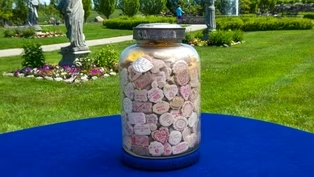
GUEST: It was in my great-great grandmother's possession.
My great-grandmother lived in Muskegon, Michigan.
Back in the 1800s, these candies were given out.
And she did not like the taste of them.
(laughs) So she would put them in the jar and started saving them.
And when people found out that they gave her more.
It's scary for me to even look at it.
Right.
Because I-I'm afraid after all these years, I will be the one to damage it.
(laughs) Oh, that's quite a pressure on your shoulder.
It is, yeah!
Well, first of all, I think it's fantastic.
It's cool.
We have a-a pretty basic glass jar with a metal lid... Uh-huh.
...that's full of this Valentine's candy.
Yeah.
Primarily heart-shaped, but some others, most likely by the New England Confectionery Company.
Oh!
And you may know the New England Confectionery Company by its acronym of Necco.
Or Necco Wafers.
Okay... So the New England Confectionery Company first introduced the candy to the country around 1866.
Okay.
And they were called conversation starters or conversation candy because they had these sayings on them.
Yeah... One of the more prominent pieces of candy's got Grover Cleveland.
Yeah.
So Grover Cleveland was president of the United States.
He was actually the first president to serve two non-consecutive terms.
Okay.
1885, and then again in 1893.
"Of course I will," is one heart.
(laughs) "No doubt of it."
"With all my heart."
And then, "Will you marry me?"
Yeah.
(laughing) No, no--- don't be shy there, right?
Yeah, right.
"Hope and smile."
"Keep your eye open."
So there you go.
Always be vigilant.
Maybe Mr.
or Mrs.
Right is out there somewhere.
It's really a-a snapshot in time... Mm-hmm.
...from the, like, turn of the 19th century of what the Valentine candy was like.
The collection was assembled fairly randomly.
Yeah.
But care was given into the final placement.
Grover Cleveland is kind of centered.
And the other ones with their sayings facing out.
It took a bit of energy in order to do that.
And then she carefully placed these other kind of candy roses at the top.
This is a tricky one because there's no collecting category of candy from the 1900s.
(chuckling): There's no... there's nobody that really has a lot of this... Yeah.
...because it's mostly eaten.
Or-or-or thrown away or whatever.
Or ate it, sure, yeah.
So to have this many collected is quite unique.
To the right person, of which that would be folk art collectors, candy people, Valentine's people.
There's a lot of people that would think this is really fun-- an auction estimate $800 to $1,000.
Okay, all right.
I can deal with that.
That's actually a relief.
(laughs) Okay!
Relief because?
Because I was afraid I was going you know, be too valuable, I'd be afraid to own it.
Precious-- but not so precious that you have to lose sleep over it, okay?
I love it, that is awesome.
Thank you.
(laughing) GUEST: I have a trench periscope from World War I. My dad, uh, found it cleaning out a basement in the mid-'60s and said they wanted him to throw everything away, but he thought it was cool, so he kept it.
So the top of your periscope is up over your trench or your entrenchments, your fortification allowing you to see.
And down here we've got our viewfinder that lets you stay nice and safe and not expose yourself to potential fire.
Really cool piece.
At retail, it's probably gonna sell in the $600 to $700 range.
Oh, really?
Obviously, it's militaria, but there are people that collect antique optics.
They might find it interesting.
Okay.
And also just from a sort of dec art standpoint, it looks really cool set up.
Yeah.
So you can almost picture having this in front of a big bay window with a view, allowing people to look out and see what's going on.
GUEST: My great-great grandmother won it in a raffle for church.
She spent a nickel.
And, um, it has the president Theodore Roosevelt and his wife, Edith Kermit Roosevelt and John Wanamaker, and it was in Philadelphia-- when she passed away, she gave it to her daughter, which was my great-grandmother.
Uh-huh.
And then when she passed away in 2003, it went up for an estate auction... Uh-huh.
...and my mom paid $1,000 to get it back into the family from the estate auction.
Oh, that's amazing.
This quilt was most likely made by the church group who had the raffle.
And I think a lot of these very involved squares with all of the signatures were church members who either contributed to piecing it together or cutting the fabric apart to make the quilt, and wealthy people in Philadelphia who might have contributed to have their name included on the quilt.
The most prominent names on the quilt would be Theodore Roosevelt and his wife Edith, and then John Wanamaker, who had the major department store in Philadelphia with a logo that turns out to be his exact signature, which is here on the quilt.
And we do have a date over here, yes.
Oh, yes, 1904.
It was 1904.
Mm-hmm.
As far as the value goes, it's very close to what your mother paid for it.
Okay.
Because the interest in these quilts is really narrow.
Right.
I would put a retail value on this piece of $1,000 to $1,200.
Okay.
You know, you also have a bit of fading, condition issues... Yes.
Yeah.
...but it's just a remarkable piece of Philadelphia history.
It is.
GUEST: These belonged to my great-uncle.
He was an antique collector.
I remember them as a child, sitting up on shelves, very high up.
You didn't touch them.
There was a built-in bookcase on top, and he had a mirror that was custom made.
And the mirror sat, like, vertically behind the vases.
That way you could see the backside of the vases, which are also very interesting.
Absolutely.
And then when he passed away, he gave them to my grandma, left a note that when she passed, they were to be passed on to me.
My grandma passed in 2012, so I've had them since she passed.
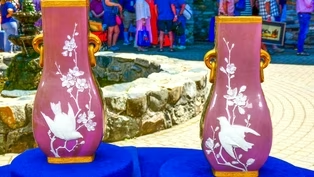
So what we have here is a matched pair of vases.
Now, many pairs of vases made by all kinds of manufacturers are exactly identical.
But these are companion vases.
Each one has a different scene on the front of similar birds facing in.
And this technique is really interesting, it's called "pâte-sur-pâte" which means paste on paste.
They originally was just a vase that was kind of this lavender color.
Uh-huh.
And then the decorations were added on top of that.
It was painted in layers with white slip.
And they were inspired by Japanese design, so we call them Japanism.
They were made by Minton.
Who was located in England.
Okay.
And this is something that Minton was known for.
Okay.
When they were new, they were very expensive.
This was a very tedious, time-consuming process.
We have the initials of the man who painted it, and his name is Henry Hollins, and he started working at Minton in about 1873.
There's raised, enameled flowers.
It's a repetitive pattern in these wonderful greens and turquoise blue.
And one color that Minton is especially known for is turquoise.
There's not a lot on here, but that's a really nice feature.
Then if we turn to the back, we have a completely different "pâte-sur-pâte" design of the same flowers Mm-hmm.
with a wonderful insect.
But my favorite part is next.
(chuckling): Okay.
So we turn this one around to look at the back.
And there's a wonderful spider web with a spider, and I'm crazy about that.
And that makes them so much more interesting... It does.
...than just flowers.
Flowers are good.
Birds are good, too.
The spider web definitely helps the value.
Really?
And they both-- the marks are a little hard to see.
Mintons with an S. Okay.
It went from Minton to Mintons in the 1870s.
And normally there is an impressed symbol for a date.
Okay.
And these just don't have it, but we still pretty much know where they're from.
Okay.
Mm-hmm.
Pretty much probably the 1870s or maybe very early 1880s.
There's a chip on the top edge.
Right.
It does affect the value some.
A retail price for the pair would be somewhere between $3,000 and $5,000.
Okay.
Wow.
If we didn't have this chip... Mm-hmm.
...I think we could add another $1,000.
Wow.
GUEST: I believe it's a sock knitting machine.
It belonged to my late husband's grandfather.
There's still some thread on it.
So I don't know for sure, but it's kind of cool.
GUEST: Family lore is that this is a relative of mine from long ago.
My middle name is Van Rensselaer.
And supposedly this guy comes through that lineage.
150 years in Michigan that I know of.
It's been in my life since I was a little boy and I'm in my-my mid-60s.
And my dad had it growing up.
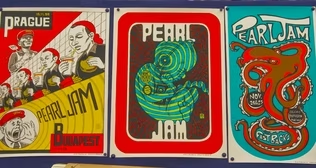
GUEST: I brought some Pearl Jam posters.
They were a gift from a friend that was in the rock and roll industry.
He said they are some of the first Pearl Jam concert tour posters ever created.
He, uh, was on tour with them.
They were given to him by the brother of Pearl Jam's bass player.
And apparently the brother was the one who produced all the posters.
How long ago did he give them to you?
Within the past ten years.
This poster was for the Prague November 15, 1996 concert.
And apparently they got into town, there was a massive snowstorm.
They were two hours late.
They threw everything up onto the stage and they just started playing.
Eddie Vedder climbed up on the scaffolding of the lighting and sat up there and sang the last song.
Oh, I'm trying to envision this in my head.
This is awesome!
There are not enough words to describe-- I feel I can't even do it proper justice, of how important Pearl Jam is when it comes to '90s rock, alternative rock.
I mean, that Seattle sound, grunge music.
They were part of the taste makers at the forefront of this movement.
They formed in 1990.
1991, their debut album, "Ten," I mean, that just shot them into the stratosphere.
And you are correct that these are some of the earlier concert posters for Pearl Jam.
What in the trade today, collectors call gig posters.
They weren't meant to survive.
I mean, they, you know, hang up in a college dorm, they'd be in a bar, they're meant to be tacked up... Yeah.
...rip 'em down, the show's over.
They were all by the Ames Brothers.
Coby Schultz and Barry Ament.
With the silk screening process and how these were made, they're highly limited.
They were printed in small batches.
And when you just look at the quality of the artwork, even outside of the connection to Pearl Jam, the graphics are just visually stunning.
And we only have three on the board here.
You have a total of ten?
And that's why I love this story, because on the tube we have, "Save these, Janet!"
Big exclamation point.
Pearl Jam, still performing today, has gone on for over three decades.
The only reason that I brought them here today was because my friend who passed away last year, Nick Scott, he loved music, he worked in the industry, he loved art.
He and his best friend would try to find the coolest things, and he loved this show.
We've kind of taken on celebrating things that reflect things that he loved in his life, kind of to try to keep his memory alive.
This is a big surprise that you liked these, and I'm so glad that you did, because they're really special to me.
Your friend Nick gave you something very special.
For the collection of the ten that you have here, it would easily be $10,000 to $15,000 at auction.
(tearfully): Wow!
(sniffles) They're phenomenal.
Thank you-- Nick was phenomenal.
(chuckling): It's amazing.
Thank you.
It was at my grandmother's house as long as I can remember.
I have really early memories of trying to climb up into it.
Um, and actually she lent it to my mom when she had me, so it predates my memory a little bit.
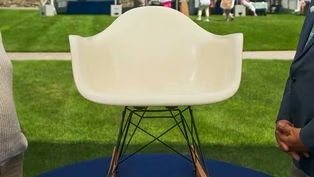
I know that it's an Eames rocking chair.
Mm-hmm.
Uh, my grandma gave it to me as a gift when she was moving out of her mid-century home.
And I've treasured it ever since.
So I'm excited to be here and learn more about it.
So as you said, this-this rocking chair was, uh, designed by the Eameses-- Charles and Ray.
Mm-hmm.
When you look at it, there's no doubt in your mind that Charles Eames made this chair.
Mm-hmm.
And the first ones were designed right after the war.
They are easy to tell if you look at the back of them, they have a rope that-that follows the outline.
We know for a fact that yours is a bit later than that... Mm.
...because yours is dated on the bottom 1960.
Mm-hmm.
We can take a look.
Well, it's upside down, but February 4, 1960.
Most of them are marked that way with a date.
So a lot of them are, especially early ones, are-are marked with a date, and this is considered to be an early piece of Eames Herman Miller furniture.
Right on.
And they've been made pretty much constantly.
They're well-loved.
And all the rest of the work Eames did from the end of World War II to about 1960, is so, so groundbreaking.
And it just pushes the boundaries back.
I like people that, that trespass on the future.
Usually red ones, or darker colored ones or colors that kind of reach out and grab you... Sure.
...tend to be worth a little bit more money.
The white ones are a little less valuable.
Mm-hmm.
Uh, but even with that, the condition, I think, offsets that somewhat.
And so I would, I would estimate at auction this chair to bring $800 to $1,200.
Wow, all right, yep!
Th-that, that blows right past what I was expecting.
(chuckling): That's awesome.
Yeah.
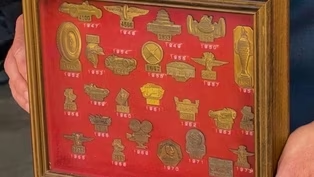
GUEST: When my father was a, uh, student at Purdue down in Indiana, he and his, uh, older brother ran into the guy who was a chief timer of the Indy 500.
And he asked, "Would you boys like to time the Indy 500?"
Well, yeah.
So, uh, each of them did it for almost 40 years-- every year, the timer would get one of these beautiful bronze badges.
And I timed for 37 years myself.
There's one timer for each car.
So there's 33 cars, 33 timers.
And we all sat with a number of our car pinned on our back, and we sit in rank order.
So in this great run of your father's pit badges, we have a 26-year consecutive run from 1947 to 1973.
Now, although they did make passes and badges earlier, it wasn't until 1947, which we have the first year, 1947, that they actually made a badge that branded all access.
And I would put a value for this collection at auction of $4,000 to $6,000.
(chuckling): Oh, my gosh.
Oh, I wish my dad was here to hear that.
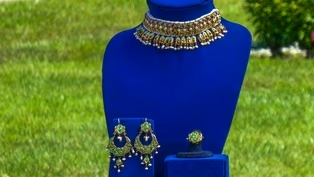
GUEST: I got the set from my mother on my wedding day.
It's a traditional Pakistani wedding set.
So girls, when they get married, get a full set of jewelry.
And I got this from my mother, who was Pakistani.
Her and my father immigrated here.
And so we were born-- my brothers and sister and I-- were born here.
But when I got married 30 years ago, I got this set.
They have two sides of jewels, so the first side is emerald.
The other side is multiple stones.
In Pakistan, the ceremonies are two to three days.
And so on the first day, you would wear one side, and then you'd be able to just flip it, and wear it with your different sari dress on the second day.
Um, and so that's traditional.
The emeralds appear to come from Swat Valley in Pakistan.
It's likely from the '40s to '50s.
We would consider this a Mughal style.
Okay.
And that's just a traditional Indian jewelry design.
Al-although this is, uh, Pakistani, it's derived from the same area art style.
Pretty close, yeah, same area.
Well, and in the '40s is when the country split.
So really, at that time, it was all intermixed.
Let's take a look at the... ...reverse side of the pieces.
It's a silver material with a gold plating overlay.
Here you can see all the colorful gemstones: rubies, turquoise, pearls, coral.
Let's take a look at the ring.
The way it spins over and the hinge design just allows it to spin freely.
So with the earrings here, you can really see the difference in gemstones and just the feel of the earrings and the entire set.
One's more playful, the other one's more traditional.
And actually, on this one, you can see where the pearl is missing.
So you can see the silver foil that was underneath the pearl.
We see a lot of traditional bridal sets like this, selling retail for anywhere from $200 to $300 to $400.
However, your set, because of the natural emeralds that really connect the culture with the history and the design... Uh-huh.
...your particular set, we would place a estimate of, retail value, anywhere from $3,000 to $4,000.
Oh, my goodness!
I can't believe that, wow!
Well, that's exciting, and it's news to us.
Obviously, it has a lot of special meaning to my family.
So it isn't something I would auction or anything.
And I plan on passing it forward to my kiddos.
GUEST: This is a sword from the Civil War era.
And she has a bayonet, also from Civil War, around late 1800s.
Our grandfather, uh, was kind of a history buff and he collected these from a friend's dad.
GUEST: This was my father's, I think it was purchased maybe '63 to '65, because he passed away in '66.
And it's a Gibson LG-1.
It sounds great.
(strums guitar) And it's close to in tune.
It hasn't been tuned for a long time, so.
(chuckles) GUEST: It's been in the family a number of years, maybe five, ten.
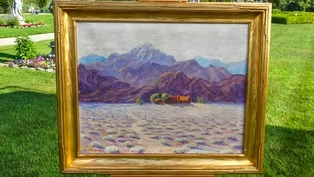
It came through my uncle who received it as a gift from a friend after he passed away, who received it from then the... ...daughter of the painter, who is Grace Hall Hemingway.
It's an original oil on canvas.
So as you point out, the artist is somebody from a pretty famous family.
Yes, this is Ernest Hemingway's mother, who's from the local area here in Charlevoix.
They have a place, had a place here in Walloon Lake.
So from where we stand today, we're about 15 miles from Walloon Lake, Michigan.
Right.
Where the Hemingways had their summer home and where young Ernest would go for the summers.
So the painting is clearly signed in the bottom left, "Hall Hemingway."
And Hall was Grace's maiden name.
She was born in 1872.
She lived till 1951.
I think it was probably executed around 1930.
A couple years earlier, some major events went on.
Her husband took his life.
Also in 1928, Grace, who had all of two years' training at the Art Institute of Chicago, traveled to the Southwest and began painting the local vista.
That same year, she had an exhibition at the Hemingway home.
There were 42 paintings.
Doing a little checking, this does not appear to have been one of them.
Okay.
But I think it's fair to say this would have been executed just a bit thereafter.
But Grace felt that, as a female artist, she had a hard go of things if she put the name Grace in the signature.
Okay.
So on the label on the back, which in my opinion, is in the artist's own handwriting, we have the title "'Sage Brush' by Hall Hemingway."
"Studio," with the address and the price, $500.
She's really captured the Southwest here.
And I think it's, I think it's a wonderful example of her work.
But I think we have to pay, really, attention to the fact that this is a Hemingway.
Right.
And on the one hand, her son, arguably one of the top American 20th century authors, if not figures.
And on the other hand, she wanted to not play that up too much, I think, and I think wanted to particularly not play up the fact that she was a female artist.
I think we have to play that up a little bit because I think there's a little bit of a celebrity factor here.
Right.
Fewer than five paintings have really come up to auction.
I think, at auction today, although her paintings don't bring a tremendous amount of money, I do think this is one that could be comfortably priced at $4,000 to $6,000.
Okay.
Wow.
PEÑA: Another part of the castle's collections, cake toppers.
From the 1880s through the 21st century, these decorations seem quite fitting for a venue that hosts about 150 weddings annually.
That's a lot of cake.
GUEST: This is a samovar that's been in my family for over 100 years.
My grandfather purchased it.
The characters on the bottom are the four horsemen of the apocalypse, and most of them have swords.
However, there's one that my father replaced.
It's more like a cocktail spear, and he swears that it's the original, but I know it isn't.
The last time I remember this being used was for my parents' 25th anniversary sometime in the '50s, if that long.
I have had it in my possession since '97.
There were some people in the East Lansing area who looked at this... Okay.
...and whoever looked at this said they think it's from Great Britain.
My sister thinks it's from Russia.
It does tip.
And the inside is grody.
(chuckles) I just love it.
It is, in fact, British.
The hallmarks are not Russian.
They're British hallmarks.
Thank you.
Instead of a samovar, it's a tea kettle that tips rather than a samovar with a spigot where you get the li-liquid out.
Ah, thank you.
It is sterling silver.
It has lots and lots of hallmarks on it.
Hallmarks for R.G.-- Garrard and Company.
They were jewelers and silversmiths to the crown.
They were appointed in 1843.
They've merged, but they're still in business making high-end luxury jewelry and silver.
British hallmarks are made up of different symbols that tell you the city, the date, the maker.
The rampant lion stands for sterling.
The body has a date letter of 1872.
And the top up here has a date letter of 1871.
So perhaps it took a while to make this.
It's pretty monumental, we think it's more than likely a presentation piece.
Up here we have, um... figures of victory, Winged Victory, and they're all holding laurel wreaths, and that's a symbol of victory.
And we come around the bottom, it's all supported by these sort of tortured figures.
You call these the Four Horsemen of the Apocalypse?
I'm not... That's what I was told.
(chuckles) That's what you were told.
They look more like anguished harpies or furies.
I do think it's a presentation piece.
More than likely to like a returning general.
The sword that you pointed out, you said that your, your dad placed this little metal... Well, yeah, at some point the sword got lost and he put that in there.
Yeah, well.
That and then this.
There's a trumpet up here... Ah.
...that this one's holding that has been broken off.
Okay.
It's so much silver.
It has so much going on.
For insurance value, we'd insure it at $75,000.
Okay.
Wow.
Yeah, it-it's pretty amazing.
GUEST: I brought a powder horn from the Revolutionary War owned by Levi Greene.
Mm-hmm.
He was a patriot in the Revolutionary War.
Belongs to me right now, but it's part of the Greene heritage.
My late husband, it was his great-great-great grandfather, Levi Greene.
He was born in the 1700s.
He came in from Massachusetts, but he settled right in this area, West Bloomfield, Michigan.
They developed a farm there.
1832 is when they came and settled into Michigan.
The farmhouse is still there, and the barn, but everything else is developed.
He died in 1851.
Yeah, 94 years old.
Levi Greene was cousin to General Nathanael Greene.
Who most people who study the Revolutionary War know.
So it says "Levi Greene, his horn, who enlisted in the Continental Service"-- all the great misspellings it should have-- "to range in the county of Albany in the year 1776.
Under Lieutenant Jackson."
I looked up his pension records and he left a great description of his service.
Oh, yeah.
Yeah.
He came through Rhode island... Mm-hmm.
...and then into Massachusetts.
Mm-hmm.
And he lived in Lanesborough, Massachusetts, which is out by the New York border.
In July of '76, he went into service as a ranger and he was around Albany.
And it says that they were searching for Tories and protecting property.
So what they were doing is they were looking for people who were loyal to the king still and arresting them.
Oh... And then because Loyalists were-- Tories were raiding the area, so they wanted to protect the area from those people.
In the early stages of 1777, he was drafted into the Massachusetts militia and he ended up in Vermont.
And at the Battle of Bennington on August 16, 1777, um, he fought in the battle.
And during that battle, they killed and captured a bunch of Hessian German troops.
And he mentions helping the dead and dying off the battlefield that day.
He helped take the prisoners back towards Lanesborough, Mass.
He ended up living in New York after the Revolution, and as you said, he moved out this way.
I didn't expect to see something like this.
I'm from Massachusetts... Oh!
...and I didn't expect to see a horn carried by a guy from Mass here, which is fantastic.
It's made from cow, um, with a pine plug.
And as far as it being carved by Levi, it's hard to say-- it could have been, but there were people in the camps who were paid to carve horns for people that had artistic skills.
And the size is kind of small.
Oh, okay.
The regulations in Mass Militia were that they were to hold a pound of powder, and this one couldn't hold a pound.
Probably didn't.
Probably didn't.
It has the perfect patina.
Is that right?
Yes.
The color, the carving, everything is beautiful on it.
Now, it does have a little bit of damage.
You can see the cracks here on the spout.
And this screw was added at a later date.
You can also see two little nubs right here.
Those are from an iron wire loop which would have been on here originally to hold a strap so he could sling it over his shoulder.
The value of these horns is based upon, um, where they fought, who the person was.
Even with the condition issues, it has a value at auction of $4,000 to $6,000.
That's awesome.
Yeah, it's-it's-it's really good.
Wow.
I would insure it for $8,000.
Oh, I will do that, thank you, I appreciate that.
GUEST: This is a Griswold cast-iron Bundt pan.
I bought it at auction, an estate auction, for a couple hundred dollars.
I assume it's over 100 years old.
It's got a stamp mark on the bottom, I believe from England.
It's been in our family for years and so I just brought it to figure out what it's... what it is and what it's for.
My daughter looked it up.
She thinks it might be a biscuit holder from England.
GUEST: This was a toy from my father's collection.
He was an avid toy collector for many, many years.
Following his passing in 1993, I took approximately 50 or 60 of his toys.
His collection was several hundred toys.
Wow.
And I focused predominantly on the holiday theme.
Christmas and the Disney themes.
Mm-hmm.
Mm-hmm.
And what happened to the rest?
They're, uh, they went to auction.
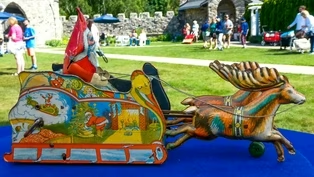
This is a classic lithograph tin toy from the 1920s and 1930s.
It was made by a company called Ferdinand Strauss.
Two major makers of tin wind-up toys of that era, '20s and '30s was Louis Marx and Ferdinand Strauss.
They were the best of the best of that era.
Marx was the much more prolific.
But Ferdinand Strauss's toys were to my mind much more inventive, much more colorful.
One of the great things about Strauss toys, his toys had some of the greatest lithography and some of the greatest artwork.
And the colors are really vibrant.
Here he is being pulled by the reindeer, and here he is putting out his toys, and it's just a fantastic piece.
The golden era of the lithograph tin toys in America were the '20s and '30s.
You see it has the patent dates of '21 and '23.
The market on these values have sort of softened up, which is a generational thing.
Yes.
Right.
You made a good choice in keeping with the holiday stuff because that market is quite strong.
In today's market, the run of the mill example of this is in the $400 to $500 range.
But this is not run of the mill-- this is an exceptional example.
It has the, even-- I've never seen this-- the original reins.
There's no question, you can see the little knot here.
I mean, it's extraordinary.
Mm-hmm.
I think this example on today's market would easily sell for $800 to $1,200.
(chuckles) So you kept the right one.
(chuckles) But, let's see.
(chuckles) What's the best part of these tin wind-ups?
For me, it's the sentimental value of my father.
But I mean in general.
In general, whether they work or not.
(laughs) Yes, and that's one of the key elements of, of popularity in a toy.
Mm-hmm.
Mm-hmm.
Yeah.
And so we're going to have to make a, make this work.
Okay.
We're gonna give it a good wind to get it going.
So let's see what happens here.
And now he's coming back.
(chuckles) GUEST: These were in my parents' home.
It was a historical home that was in The National Historical Society.
And I was told that my father and his first wife, uh, brought them over from Europe.
Uh, they used to go over and collect antiques.
And I know they hung in our house for about 50 years.
It was my childhood home.
Um, and when I closed the house, um, about a year ago, um, I pulled them off the wall and-and took them with me.
I think that they might be Tiffany's, but I'm not sure.
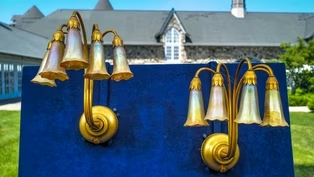
Yes, these are Tiffany Studios sconces.
Okay.
They were made somewhere between 1900 and probably 1905.
I think that these are on the early side particularly because they're just very delicate and maybe even a little smaller than the shades that you see produced a little later.
They're all hand-blown.
Wow.
And they-- while they look similar, they're always just a little bit different.
These came in different finishes.
The gold finish meant it cost a little more, because the metal is actually gold plated.
Okay.
And what is lovely about these is that you have the original switches.
(chuckles) I love to see those.
There are some screws missing on the sconce plates.
Yeah, I actually, I do have them at home.
I'm sorry, I didn't think we would be displaying them today.
But I do have all the original pieces with it.
Well, it's great that you have them because they're really hard to get, the originals.
Mm-hmm.
Don't lose sight of them ever.
I won't.
(chuckles) Now, as for the shades, the shades are pretty dirty.
Yes, they are.
I was scared to clean them.
I don't blame you.
I was scared to take these out of their holders.
I was tempted because I wanted to see if there were any signatures on the ends.
Mm-hmm.
Because if there are signatures on the necks of the shades, then they're obscured by the cluster that's holding them.
Okay.
Frankly, I always say the signature is not how you determine whether something is real.
I look at these shades and I know they're real.
Mm-hmm.
I don't need to look for a signature.
Okay.
If the signature's there, great.
Yeah.
But it's not critical to the value of the sconces.
Okay.
You do have one shade that... Yes, right here, yes.
...has cracks.
(chuckles) Yes.
And someone way back when put two pieces of scotch tape there.
It's very old and dirty.
(chuckles) But it's, it... you know, something that didn't cause any further loss, so.
Mm-hmm.
It was actually a good solution.
Okay.
If these were in a retail shop, these would be very sought after because they're five lights.
Okay.
Usually, they came in three lights.
Um, sometimes they come in different configurations.
Sometimes the metalwork is more detailed.
Mm-hmm.
But because these are five lights, they have more value.
Okay.
And I would put a retail price on these of $45,000 to $55,000.
(chuckling): Oh, my gosh.
Really?
Wow.
That is incredible.
Wow.
That, that's amazing.
I was told they were valuable, but not by any means that kind of value.
So that's amazing.
If you were to replace the shade, it could cost as much as $3,000 to $4,000, but it would increase the overall value of the sconces to as much as $65,000.
Okay.
PEÑA: And now it's time for the "Roadshow" Feedback Booth.
Today, we brought in our hideous clowns.
They told us that, uh, they were pretty much worthless, but if we went to the right shop, we could sell them.
But we had a good time at the "Antiques Roadshow."
I brought this print from 1969.
Um, he said that I didn't look old enough to own it.
And turns out that compliment was worth more than the print itself.
(chuckles) I brought a family menorah, um, that is passed down from my mom.
He told me that it was from a tourist trap's shop in Israel.
So, uh, very touristy, very fun.
(chuckles) And we had a great time.
And we love "Antiques Roadshow."
Whoo!
And we came here today to find out about our grandmother's jewelry and to see if this painting, which I purchased for five dollars, would make us rich enough to go on a trip together.
But we didn't.
It's only a worth about $15 bucks, and it might not be going on a family trip, but this was the best girls trip ever.
Ever.
Molly had me stand 45 minutes in line and spend $50 on this horse, uh, charcoal drawing that we just got appraised for $3,000.
(chuckles) So, as usual, my wife is always right.
We came to "Antiques Roadshow" to celebrate our friend Nick.
Nick was a rock star husband, father and friend.
And after an unimaginable day in Charlevoix, it looks like we'll be celebrating a little longer.
Thank you, Nick, and thank you, "Antiques Roadshow" for swingin' by the Mitten.
PEÑA: Thanks for watching.
See you next time on "Antiques Roadshow."
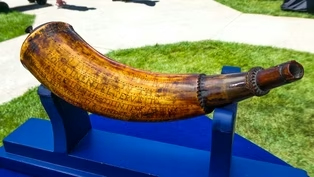
Appraisal: 1776 Identified Revolutionary Soldier's Powder Horn
Video has Closed Captions
Clip: S30 Ep12 | 3m 23s | Appraisal: 1776 Identified Revolutionary Soldier's Powder Horn (3m 23s)
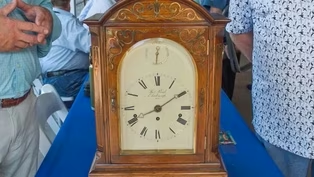
Appraisal: 1795 Thomas Reid Edinburgh Bracket Clock
Video has Closed Captions
Clip: S30 Ep12 | 1m 4s | Appraisal: 1795 Thomas Reid Edinburgh Bracket Clock (1m 4s)
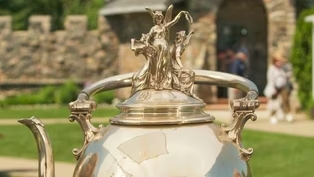
Appraisal: 1872 R. & S. Garrard & Co. Silver Tilting Teapot
Video has Closed Captions
Clip: S30 Ep12 | 2m 54s | Appraisal: 1872 R. & S. Garrard & Co. Silver Tilting Teapot (2m 54s)
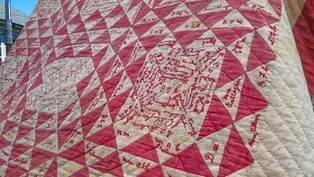
Appraisal: 1904 Philadelphia Quilt
Video has Closed Captions
Clip: S30 Ep12 | 1m 51s | Appraisal: 1904 Philadelphia Quilt (1m 51s)
Appraisal: 1947 - 1973 Indianapolis 500 Pit Badges
Video has Closed Captions
Clip: S30 Ep12 | 1m 8s | Appraisal: 1947 - 1973 Indianapolis 500 Pit Badges (1m 8s)
Appraisal: 1960 Charles & Ray Eames Rocking Chair
Video has Closed Captions
Clip: S30 Ep12 | 1m 54s | Appraisal: 1960 Charles & Ray Eames Rocking Chair (1m 54s)
Appraisal: 1980 Lee Godie Self-portrait
Video has Closed Captions
Clip: S30 Ep12 | 3m 21s | Appraisal: 1980 Lee Godie Self-portrait (3m 21s)
Appraisal: Ames Bros Pearl Jam Posters, ca. 1996
Video has Closed Captions
Clip: S30 Ep12 | 3m 21s | Appraisal: Ames Bros Pearl Jam Posters, ca. 1996 (3m 21s)
Appraisal: Chinese & Japanese Decorative Art Collection
Video has Closed Captions
Clip: S30 Ep12 | 3m 44s | Appraisal: Chinese & Japanese Decorative Art Collection (3m 44s)
Appraisal: Ferdinand Strauss Santee Claus Toy, ca. 1925
Video has Closed Captions
Clip: S30 Ep12 | 2m 41s | Appraisal: Ferdinand Strauss Santee Claus Toy, ca. 1925 (2m 41s)
Appraisal: Grace Hall Hemingway Sage Brush Oil, ca. 1930
Video has Closed Captions
Clip: S30 Ep12 | 3m 3s | Appraisal: Grace Hall Hemingway Sage Brush Oil, ca. 1930 (3m 3s)
Appraisal: Mintons Pâte-sur-Pâte Vases, ca. 1880
Video has Closed Captions
Clip: S30 Ep12 | 3m 8s | Appraisal: Mintons Pâte-sur-Pâte Vases, ca. 1880 (3m 8s)
Appraisal: Pakistani Wedding Jewelry Set, ca. 1940
Video has Closed Captions
Clip: S30 Ep12 | 2m 45s | Appraisal: Pakistani Wedding Jewelry Set, ca. 1940 (2m 45s)
Appraisal: Pierre Sterlé Bird Pin, ca. 1960
Video has Closed Captions
Clip: S30 Ep12 | 3m 27s | Appraisal: Pierre Sterlé Bird Pin, ca. 1960 (3m 27s)
Appraisal: Tiffany Studios Lily Sconces, ca. 1905
Video has Closed Captions
Clip: S30 Ep12 | 3m 26s | Appraisal: Tiffany Studios Lily Sconces, ca. 1905 (3m 26s)
Appraisal: Valentine's Candy Jar, ca. 1890
Video has Closed Captions
Clip: S30 Ep12 | 2m 53s | Appraisal: Valentine's Candy Jar, ca. 1890 (2m 53s)
Appraisal: Yves Saint Laurent Mixed-media Sketch, ca. 1970
Video has Closed Captions
Clip: S30 Ep12 | 2m 13s | Appraisal: Yves Saint Laurent Mixed-media Sketch, ca. 1970 (2m 13s)
Video has Closed Captions
Preview: S30 Ep12 | 30s | Preview: Castle Farms, Hour 3 (30s)
Providing Support for PBS.org
Learn Moreabout PBS online sponsorship

- Home and How To

Hit the road in a classic car for a tour through Great Britain with two antiques experts.

 New Episode

 New Episode







Support for PBS provided by:
Funding for ANTIQUES ROADSHOW is provided by American Cruise Lines and Ancestry. Additional funding is provided by public television viewers.