
Taylor Rooks Talks NBA, Interview Techniques and Finding the Person Behind the Athlete
Special | 28m 54sVideo has Closed Captions
Sports journalist Taylor Rooks has built her career asking athletes the questions that no one asks.
Taylor Rooks has built her career asking athletes the questions that reveal who they are beyond the game. As a journalist and the host of NBA on Prime, she’s become known for her curious approach to her work. For Taylor, “everyone is more than one story.”
Problems playing video? | Closed Captioning Feedback
Problems playing video? | Closed Captioning Feedback
Support for American Masters is provided by AARP, The Rosalind P. Walter Foundation, Thea Petschek Iervolino Foundation, Burton P. and Judith B. Resnick Foundation, The Philip and Janice Levin Foundation,...
Support provided by:

Taylor Rooks Talks NBA, Interview Techniques and Finding the Person Behind the Athlete
Special | 28m 54sVideo has Closed Captions
Taylor Rooks has built her career asking athletes the questions that reveal who they are beyond the game. As a journalist and the host of NBA on Prime, she’s become known for her curious approach to her work. For Taylor, “everyone is more than one story.”
Problems playing video? | Closed Captioning Feedback
Where to Watch American Masters
American Masters is available to stream on pbs.org and the PBS app.
Buy Now
A front row seat to the creative process
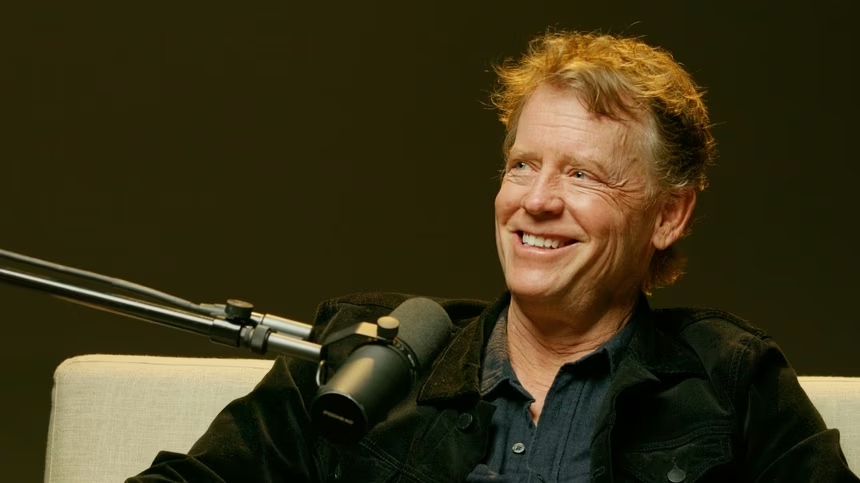
How do today’s masters create their art? Each episode an artist reveals how they brought their creative work to life. Hear from artists across disciplines, like comedian Chris Fleming, actor Greg Kinnear, sports journalist Taylor Rooks, and more on our video podcast "American Masters: Creative Spark."Providing Support for PBS.org
Learn Moreabout PBS online sponsorship(gentle music) - It's just interesting to know who people are when they go home.
That's like what I'm most interested in, in life.
And it isn't even just like athletes that I'm interviewing.
I think that about everyone.
Like who are you when you go home?
And what, you know, what are the things that you tell yourselves and what are the stories that you tell yourself about yourself?
And like, are they true?
(upbeat music) - This is "American Masters Creative Spark," and I'm your host, Joe Skinner.
Our guest today is sports journalist, Taylor Rooks.
If you watch the NBA or the NFL, you've seen Taylor as a sideline reporter or long-form interviewer getting unusual vulnerability from athletes in conversation.
As a big basketball fan, I've seen a lot of Taylor this past season as host of the newly minted, "NBA on Prime."
I appreciate Taylor's enthusiasm for the art of the interview, and I wanted to learn more about what drives her work.
Even if you don't watch sports, Taylor has a really thoughtful perspective on how we shape our own narratives and why the stories we tell about ourselves matter.
(gentle music) - PBS was so disformative to me.
Like I loved watching Zoom and Arthur and all of those shows.
And I think it taught me a lot about, you know, wondering and curiosity.
So doing something that is a part of like the PBS family means a lot to me.
So thank you for having me.
- Oh, that's so great to hear.
You know, PBS is going through some tough times right now, so we need all the love we can get.
- Yeah, I mean, I think that PBS and all, you know, just like public media should be a necessity.
I think it really is important for kids and adults to learn about the world, but also themselves.
So I think it is very unfortunate that it is a hard time because this is something that everybody should be behind and care about the existence of.
And also the flourishing of.
- Wow, I got to clip that and just put it right to the fundraising team.
(Taylor laughs) - Hey, I got you.
Call me.
(Joe laughs) - So you interview people for a living.
That's a big part of your job.
And so the first thing I'm curious about is how do you kind of match the energy of your guest?
How do you prepare for and anticipate that energy and kind of deal with the.... It's, you know, I think interviewing is not too far off from sports in that you have to kind of understand your opponent, so to speak.
- Completely.
- [Joe] You kind of match that energy and you come into it.
So how do you do that?
- Yeah, that's a great way to put it that I do believe interviewing is like, you know, a sport.
For me, I think the difference is I approach interviews wanting it to be mutually beneficial for both people.
You know, I want to make sure I ask a question that reveals something so that I look good and the audience likes it and they feel like they learn through the conversation.
But I also want, you know, my counterpart to feel like they were able to enter into the space and be themselves and talk about something that they wanted to talk about, but maybe didn't know how to.
And so, maybe it's less of a sport in the way that you have an opponent and more that it's a game, you know?
I do feel like interviews are that way.
And I would say, I don't know if I try to match their energy.
I think I maybe try to get them to match mine.
- Oh, interesting.
- You know, and it's not that I'm wanting them to change who they are, but I definitely want them to understand like what they signed up for.
And I think that that sort of starts with me and how I ask the questions and how welcome I maybe make them feel just so that they can feel free enough to speak.
And to speak differently than maybe they have in other places.
And I think maybe sometimes the reason that they don't is because somebody is matching their energy.
Like I always say that athletes' perception comes into the room before they do.
And when you approach the interview only using things that you think about them or know about them, I think that it is almost like a self-fulfilling prophecy when it should actually be almost a clean slate.
Like it should almost be that they are coming there and giving you something that you haven't seen before.
And I think that's able to happen because you're wanting them to, like I said, buy into what is happening in this specific interview, if that makes sense.
- Yeah, that makes sense.
I feel like what you're saying is treat them like a human almost like rather than this kind of icon who appears on our screens all the time.
- Yeah, completely.
I always remember when Anthony Edwards was being drafted, a lot of the story around him was sad, and rightfully so.
There have been sad things that happened to Anthony Edwards.
He's had people in his family that he loves, people that he is so close to, women in his family pass.
And that was a lot of the story around his draft.
You know, we care about these athletes' journey.
We care about what has happened to them.
I completely understand why in many ways it did monopolize the story of his draft.
But what you realize when you talk to Anthony is that he's actually very charismatic and outgoing and vivacious.
But because we let just that one thing be the story, I didn't feel like he really had enough room to also show how he has, you know, joy through the pain that he has gone through.
That he is, you know, a person who has been molded by it, but is different because of it.
And that is more so what I mean when it's like, when you are telling one story, you forget about all of the others.
And it's like people are many, many, many stories.
Like that is a story about Anthony, but there's also so many other stories about Anthony too, that I think through time people have understood.
But I don't know.
I think there was a time when everyone wanted it to be just a sad story.
But nothing is just in any story.
But it's because it's all we were, we were seeing of him.
But that's just one example I think that there are countless, you know, figures that have gotten put into that category.
- Right, and then like the on court persona too, like as a Warriors fan, I think of Draymond as on court persona shapes so much of our narrative about him, but then there's, I know you've interviewed him.
There's such a difference when you're speaking to the man off the court.
- Completely, yeah, because if I'm only asking him questions that fulfill this though out there, you don't give it someone a chance to be anything other than that thought.
And I think it's really important to get the fullness of people.
And I think some of that is because I don't think the fullness of myself is always explored.
I don't think really the fullness of a lot of women is explored.
So I just think I understand that everyone is more than one story.
And we're only seeing some of it.
And that can't be the story all the time.
- And so as a woman in a very male dominated field historically, what kind of pressures have you faced towards arriving at this kind of principled approach to your work?
- I think that being a woman is how I have arrived at that approach.
You know, I think I have a warmth that I think is very... I think I have a warmth that is a woman's trait.
I think that there is a... I think that there is a curiosity.
There is an empathy.
There is an understanding.
I think that women kind of make you want to tell the truth in a way that maybe men don't.
I think women can make you feel comfortable in a very specific way.
But I also think it's just my experience as somebody who has been, you know, maybe seen before they're heard or somebody who has been misunderstood or somebody who has been labeled and put into a box and all of these things.
I understand, I just understand the want to not want to be those things.
And to me, I know that this applies to everyone, of course, but a lot of them feel like very specific to women.
Like a lot of that to me feels specific to women.
And living life as a woman I think has informed my skill as an interviewer.
And it's an approach that I was able to accumulate through my life as a woman, if that makes sense.
- Yeah, that makes sense.
Do you think that there are wrongs to be righted in sports culture more generally too?
Or I guess like what I mean to say is that sports more than a lot of other fields seems very steeped still in certain sort of like regressive behaviors or like traditional ways of thinking.
- Yeah.
I mean, I definitely agree with that.
I think male is like the default in society already.
But when you have something like sports, it feels just like very concentrated in that same idea.
And for me, I think a lot of sort of change would just be about appreciating women for what they are, you know?
And not feeling like you then have to like make them something that they are not.
And I know just my experience of being a woman who is a host, who is an interviewer, who has been an anchor, who is in all of these things.
And I know what it feels like to be talked about.
And I know that a lot of the times those discussions begin with the fact that I am a woman.
And being a woman is a thing that sometimes I think makes people erase some of the things that I have done because they make women the resounding trait, the resounding characteristic.
They make appearance the resounding trait and the resounding characteristic.
And that, to your point though, is very much so rooted in like patriarchy.
It's rooted in, you know, the maleness of sport.
And so of course that is something that I think should be changed, but I believe that that begins with seeing men as the default and incorrectly feeling like women are niche, you know?
So when you think that something doesn't belong somewhere, its otherness becomes the prevailing story.
But you wouldn't feel that way if you understood that we do belong there.
Then you would just see, you know, the women in sports media as a necessary part of the ecosystem, you know?
And that, and to be clear, by the way, because I think this is important, this is not something that I think all men do.
I have been hired by men in sports.
I have been, you know, many of the opportunities that I have earned in sports have been because men trusted me to tell their stories.
Men felt like I was the right person for the job.
I am not of the belief that it's like men are holding everyone back, you know?
I think that I have gotten many opportunities from men.
(gentle music) But I also understand that it is going to take like an overhaul of how we think about women.
And I don't always think that those are the same thing.
(gentle upbeat music) - "Inside the NBA" just ended and has transitioned into what is now, you know, "NBA on Prime."
That's a big sort of legacy to kind of, you know, be passed on.
You just wrapped the first season of "NBA on Prime."
What did you learn from that experience?
- I learned so much.
It was truly the joy of my career to be like on the desk and hosting a show with legends of the game.
You know, Dirk and Steve and Blake and UD and Dwayne would've come to the desk and John Wall and Candace Parker and Rudy Gay.
It was just this revolving door of greatness.
And it was cool that I got to, you know, pass them the ball and like lead the conversation and just really get to understand people that were very formative and like why I love basketball and like get to call them, you know, my friends and my work family and all this.
So that was really, really, really fun.
They were a joy, like truly a joy to work with, the best team that I've ever been a part of.
I told them, you know, for them, like they have played in big games and they've won championships and they've done all of these things.
And so they have been on teams.
But like this is my team, you know?
And it has been like so rewarding for me and the best team that I've ever been on.
So I feel very thankful.
I also feel like I proved a lot to myself.
I learned a lot about myself throughout hosting this year.
Doing it for the first time.
And I think that there is a difference between like knowing that you can do something and then like showing that you can do it.
And so I was able to do both which I think was big for me.
And just the way that it boosted my confidence was really important as well.
So this was like my favorite year of my career ever.
- What's the difference in process between the more long form interviews that we discussed.
And this switch to hosting?
- Well, you know, for the long form interviews, you know, you know, you're gonna sit with somebody for, you know, 45 minutes or so.
You can spend weeks, days prepping on an individual.
You know, I want to know everything about them.
I want to know their story.
I want to watch every interview they've done.
I want to read every article that they've been a part of.
I want to watch their big games.
I want to talk to people that know them.
It's very specific.
And I think for the show, obviously, I'm prepping for the games that we have that week, which is, you know, one of the most important things.
But as the host, I'm also prepping for my desk, you know?
It was the first time I had done it, so I wanted to make sure I understood Dirk and I understood Blake and I understood UD and I understood Steve because my job at the end of the day, my number one job as the host is to make them look good.
So I want to know like when I should go to them, when they'll have a good comment, when they'll have a good joke, when they're going to have good perspective.
When they've been in a game like the one that we are going to be broadcasting now, have they been into game seven?
What happened in it?
Have they had a rivalry?
Have they been down 3-1?
Like I needed to know all of these sort of things about them.
So when the opportunities presented themself, I pass them the ball and they hit a three, you know?
And it's a game winner.
Like that's essentially at the end of the day what my job is.
And I love it.
I think there's something kind of liberating about it not being about you.
And I think sometimes interviews maybe can feel a little bit more about you because you're asking the question.
And then so if you get the good answer from the person, it's kind of like a pat on your back because you ask the good question and they say to you, "Oh, that was such a good question."
And so it's still sort of about you, even though it's about them, you know?
The trick is making sure everybody knows that it's about the guest.
But with hosting, I'm like, it's not about me at all.
And I think that the best hosts don't make it about them at all.
That's what makes them a good host.
If the guys had a great show, that means I had a great show.
And I've also just, I love watching them kill it on TV.
Like that's what has made it so rewarding.
So to me, that's the biggest difference between prepping to interview somebody and prepping to do a show where you are on a desk with people that know the game better than anybody in the world.
And so yeah, it's very... It's liberating and it's rewarding, I would say.
- That's so interesting.
I mean, it sounds to me like the long form interview requires a certain level of pride and almost ego to a degree, but then- - Yeah.
And I have a lot of pride and a lot of ego.
Yeah.
(both laughing) - But then with hosting- Maybe wish I had a little less.
(both laughing) - But then with hosting, you know, conversely, humility, right?
- Yeah.
Completely.
- Like you're running a point guard and need to just let everyone else be in the spotlight.
- Yeah.
I remember when I, you know, when I was... Knew I was gonna host, I obviously wanted to intake as much information as I could.
And I spoke to one of my colleagues, Malika Andrews who hosts on ESPN.
She's great.
And we went to eat and I was asking her all these questions about hosting.
And she said, "You are the most important, least important person on the desk when you're hosting."
And I though that was the perfect way to say it because it's absolutely true.
It's absolutely true and exactly what you're saying.
- So you grew up in a sports family too, right?.
- Yeah.
Yeah.
I mean, my mom loved sports, loved football.
She, to me, is one of the bigger reasons why I'm such a football fan.
My dad was a football player, so of course he is a big reason.
He played at University of Illinois, was an outstanding running back there.
My great uncle is Lou Brock, who was a baseball hall of famer with the St.
Louis Cardinals.
So I just grew up around it.
It was very much my air.
I say I'm also Southern where football is just you eat, breathe, sleep football.
So yeah, I've just been around it for most of my life.
- And so what drew you to the journalism side of it then?
- I like being on TV.
(both laughing) If I could be as honest as possible, I like being on TV.
I like people.
I like talking.
But I've always loved like the camera.
I've always loved... I would sit with my mom and I would watch like the nightly news.
And I loved the way that the women like spoke.
Like their cadence of talking was so interesting to me.
So I would always try to mimic it.
And I always say I have these videos of me just like setting up the camcorder and like interviewing myself.
I was obsessed with e-true Hollywood story.
I watched it all the time.
I just though it was so cool to like, I don't know, live a life that people wanted to talk about, you know?
And then other people were saying all these things that they though about you.
And like, I don't know, I just, I loved it.
And I also, I think when I talk about like loving people, I had an understanding that like how people saw my Uncle Lou was like much different than how I saw him.
I mean, like to me, he was just my Uncle Lou.
But we'd go somewhere and people were like freaking out because they saw him.
But to me, the person I saw was so much more interesting, you know?
And I wanted to sort of like blend all of those things together.
And of course, you know, sports journalism is the way to do that.
And I kind of just like decided that that's what I wanted to do and who I wanted to be.
And I of course had many privileges and advantages in I grew up in a way where nothing felt unattainable to me.
Like I just thought I was going to be able to do what I wanted to do.
And that's a privilege within itself, you know?
I had the advantage of having, you know, advocates and opportunities.
And I think that when... Sometimes when we talk about representation, of course we are talking about like race and that is a big, big part of it.
Or, you know, gender and that is a big, big part of it.
But it is also just this idea that you're around people that their life went the way they wanted it to.
And so I saw a lot of people whose lives went the way that they wanted it to.
So I felt like mine could too.
And so I decided and I went to school and I majored in broadcast journalism.
And I just said, "This is who I'm going to be and this is what I'm going to do."
And I also had the advantage, again, of knowing early what I wanted to do.
A lot of people are figuring it out, which there's absolutely nothing wrong with that.
That is the common path.
But I was just able to make decisions that all went towards that trajectory.
- It's just interesting, you know, to meet people who have been doing the thing that they've been thinking about since they were little.
And it's just... Your Uncle Lou was so different at home than how the public was seeing him.
I think it's really interesting that that was something that you were able to kind of carry on over the years and kind of hold in your back pocket.
- Yeah.
Yeah.
Just really wondering like who people are, you know, and what drives them.
And like with sports specifically, it's obviously changed a little bit more now because social media is so present and athletes have production companies and they tell their own stories and they have podcasts so that you're hearing them so much more.
But also a lot of it is, okay, you're seeing them in a press conference, you're seeing them after the game, and it's a very specific way.
And it's just interesting to know who people are when they go home.
That's like what I'm most interested in, in life.
And it isn't even just like athletes that I'm interviewing.
I think that about everyone.
Like who are you when you go home?
And what, you know, what are the things that you tell yourselves?
(gentle music) And what are the stories that you tell yourself about yourself?
And like, are they true?
(gentle music) - What can be so powerful about the universality of sports?
- It's so many things.
It's what it means to work hard, first of all.
You know, if you want to reach the top of the top, you had to have dedicated your entire life to doing so.
And it is relentless work.
And so just that in itself is inspiring to see people that dedicated themselves to something.
And so much so that they have made a living out of it, you know?
They are the best and they had to work to be the best.
So I think that that is universal, that drive.
The wanting to see somebody accomplish something I think is really important.
I also like the finality of sports.
I like that somebody wins and somebody loses.
I think that there are a lot of things that feel gray, but sports are like black and white in that sense.
And I think people like cling onto that, that it feels certain.
Like it feels certain and it feels fair, you know?
It feels like the team that was supposed to win that day, they won because they won.
Like if you win, that means you were supposed to win, you know?
In sports, it certainly feels that way.
I also think sports are something that are... They are in you.
Like people have teams that their great-grandpa liked and then their grandma liked and then so they like, you know?
Sports are passed down, which I think is really cool.
I think sports can be so ingrained in you and in your blood that it determines if you have a good day or a bad day if your team won or lost.
And I think that that is, that is really cool.
I think that it does unite when you think about cities being behind a player, being behind a team, and that there's this institution that has the ability to make every person, regardless of how different they are, root for the same thing, I think is really special.
And Bomani once was talking about this, Bomani Jones.
He's like, "Sports are entertaining, but they aren't entertainment."
And I completely agree with that.
Entertainment feels, you know, it's like it's a movie or it's a TV show.
There aren't real stakes that feel like you're a part of.
But like sports you feel like you are a part of.
So yeah, I think there's so many universalities to sport that are what makes it really special.
- Sports are so popular in America in particular.
What does it say about America that, that what you just said is so popular and important here?
- Yeah.
I think that Americans like pursuit.
You know, I think that Americans like competition.
The idea of working hard, the idea of being the best.
You know, the... But to your point though, it's like sports are so... It feels like tradition.
Like it just feels so ingrained, you know?
I think, honestly, I think that Americans like sides, you know?
And it is like you are, you're watching a game and you're picking a side and you want your side to win.
And so I think that I've never, really never had that though until right now, but I think that that also plays a role into one of the reasons it's so big.
But to be fair, I think people like sides.
You know?
Sports are big everywhere.
I mean, soccer is the largest global sport.
I mean, if you are a soccer player, you're like the most famous person in the world.
It's actually staggering.
Like in America, we feel like NBA and NFL stars are the biggest.
It's nothing compared to Messi, Ronaldo.
Like those are... It's just not.
It's not even close.
So yeah, I think people like sides and people like to win.
And people like to see the side that isn't theirs loose.
And that's why not just Americans, that's why everybody likes sports.
But also people like the fantastic, right?
They want to see something that feels otherworldly.
Because I don't care what the sport is, what they are doing is crazy.
Like it's crazy to be able to kick a soccer ball into a net from that far.
It's crazy.
It's crazy that they can get the ball from 30 feet out into the little hoop.
Like that's crazy.
It's crazy to watch a quarterback throw this spiral right on the dot to somebody that is a touchdown.
Like all of that is crazy.
And we see it so much, we maybe get desensitized to it, but it's also cool just to watch the fantastic happen in front of you.
So I think it's a lot of little things that make it so special.
- Well, we're drawn to the exceptional, I guess.
- Completely.
We're very drawn to the exceptional.
(gentle upbeat music) - That's our show.
A big thank you to Taylor Rooks for taking the time to talk.
"American Masters Creative Spark" is a production of the WNET Group, media made possible by all of you.
This episode was produced by me, Joe Skinner.
Our executive producer is Michael Kantor.
Original music is composed by Hannis Brown.
This episode was mixed and mastered by Josh Broome.
Funding for "American Masters Creative Spark" is provided by the Rosalind P. Walter Foundation, the Anderson Family Charitable Fund, the Marc Hoss Foundation, Sue and Edgar Wachenheim III, The Charina Endowment Fund, The Ambrose Monell Foundation, The Kate W. Cassidy Foundation, the Philip and Janice Levin Foundation, and by PBS viewers like you.
Thanks.
See you soon.
(gentle music)












Support for PBS provided by:
Support for American Masters is provided by AARP, The Rosalind P. Walter Foundation, Thea Petschek Iervolino Foundation, Burton P. and Judith B. Resnick Foundation, The Philip and Janice Levin Foundation,...