
Transformation & Times Square
Clip: 9/22/2026 | 4m 45sVideo has Closed Captions
In this bonus scene, explore how a bold plan to pedestrianize Times Square transformed New York.
In this bonus scene, explore how a controversial plan to pedestrianize Times Square went from a “stupid idea” to a defining transformation of New York. Hear Mayor Michael Bloomberg and former transportation commissioner Janette Sadik-Khan recall the effort to rethink city streets, prioritize pedestrians and sustainable mobility, and reclaim public space from cars.
Problems playing video? | Closed Captioning Feedback
Problems playing video? | Closed Captioning Feedback
Corporate funding for NEW YORK: A DOCUMENTARY FILM "Shadows of the Past" and "The Future of Cities" was provided by Hudson River Trading. Major funding was provided by the American...
Support provided by:

Transformation & Times Square
Clip: 9/22/2026 | 4m 45sVideo has Closed Captions
In this bonus scene, explore how a controversial plan to pedestrianize Times Square went from a “stupid idea” to a defining transformation of New York. Hear Mayor Michael Bloomberg and former transportation commissioner Janette Sadik-Khan recall the effort to rethink city streets, prioritize pedestrians and sustainable mobility, and reclaim public space from cars.
Problems playing video? | Closed Captioning Feedback
Where to Watch New York: A Documentary Film
New York: A Documentary Film is available to stream on pbs.org and the PBS app.

Ric Burns Talks to THR
Director and co-writer Ric Burns speaks with The Hollywood Reporter about the two new installments in his NEW YORK: A DOCUMENTARY FILM series, which have been in the works for more than a decade.Providing Support for PBS.org
Learn Moreabout PBS online sponsorshipNarrator: By the end of 2009, profits on Wall Street, hanging on for dear life only 12 months earlier, had soared to $61 billion, tripling in little more than a year.
The federal government had helped, pumping nearly $200 billion in bailout funds into the city's financial institutions.
But major changes in the city had helped, too.
After eight years, Michael Bloomberg's sweeping efforts to reshape New York's economy had begun to bear fruit, with the city's surging creative industries, tourist sector, and burgeoning tech industry more than offsetting losses elsewhere.
Vishaan Chakrabarti: The fundamental thing was investing in our infrastructure.
Under Mayor Bloomberg, we saw the extension of the number 7 line, the construction of the High Line, a massive re-envisioning of our park system.
Amanda Burden: We were able to provide public access to the water in so many places for recreation, for transportation.
And it just was a complete transformation of how you saw the city.
Janette Sadik-Khan: Our streets had largely been hidden in plain sight, and for 50 years the goal had been to move cars as quickly as possible from point A to point B. I was the transportation commissioner for New York City and changing how people use the streets -- looking at our streets as more than just tarmacs for cars -- that was the big challenge.
And so that change meant we're going to prioritize sustainable mobility.
We're going to make streets a platform to build out 400 miles of on-street bike lanes, to build in red carpet lanes for buses, to create community plazas, community spaces, where New Yorkers can get to easily enjoy the beauty of the city, the democracy of the city, the wonder of the city.
And we were able to actually use the foundation that Robert Moses laid -- and repurpose it, and really bring a kind of Jane Jacobs veneer to a Robert Moses platform.
When I went to Mayor Bloomberg about closing Times Square and pedestrian-izing this critical part of the city-- you know, 350,000 people you know, go through Times Square every day.
And yet, 90% of the space was allocated to cars.
Michael Bloomberg: I'll never forget that she came in to see me and said, you know, I got this idea.
I want to close Broadway for 10 or 15 blocks, through Times Square and Herald Square.
We'll make a pedestrian parkway.
And I thought that was the stupidest idea I've ever heard.
But I sat down, I listened to her.
And I remember walking in the next day to the staff meeting of all the senior people and said... "Guess what we're going to do?"
Thank you, Mayor Bloomberg, our outstanding mayor, and welcome everyone to the new Times Square.
Uh... Yay!
[Laughing] Wesley Morris: Times Square... You know, New Yorkers know that you never want to be in Times Square.
But I actually feel most proudly "New York" going through Times Square.
No other city really has a Times Square, the way New York City does.
Sometimes, I will be in Times Square and I will just see the wonder in people's eyes.
I'll just look at their faces and they can't believe they're there.
They can't believe they're in Times Square!
They made it!
From Poland, from Argentina, from Japan, from China, from Iowa, from Arizona, from Nigeria, Angola.
You just -- pick a place.
Pick a place.
Everybody comes to Times Square and they're just like... Well, I'll be damned.
We're in New York.
This really is the beacon of this city.
New Yorkers, we've seen the light already.
Y'all are seeing the lights for the first time.
And may you stay transformed.

Preview | The Future of Cities
Video has Closed Captions
Follow New York's transformation since the terrorist attacks on September 11, 2001. (30s)
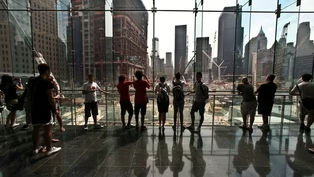
Rebuilding Ground Zero: How NYC Rose from the Ashes
Video has Closed Captions
Witness the decade-long rebuilding of Lower Manhattan after the September 11th attacks. (7m 30s)
Providing Support for PBS.org
Learn Moreabout PBS online sponsorship











Support for PBS provided by:
Corporate funding for NEW YORK: A DOCUMENTARY FILM "Shadows of the Past" and "The Future of Cities" was provided by Hudson River Trading. Major funding was provided by the American...