
Capturing America: The Carol Highsmith Story
7/4/2026 | 56m 5sVideo has Closed Captions
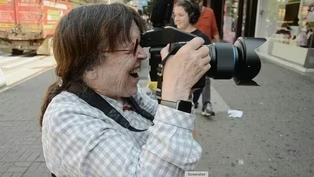
Go on the road with photographer Carol Highsmith as she completes her study of America.
For more than 40 years, Carol Highsmith wakes up every single day with one mission: to document every nook and cranny of the United States, from its majestic mountains and quirky roadside attractions to its most unforgettable characters, known and unknown.
Problems playing video? | Closed Captioning Feedback
Problems playing video? | Closed Captioning Feedback
Capturing America: The Carol Highsmith Story
7/4/2026 | 56m 5sVideo has Closed Captions
For more than 40 years, Carol Highsmith wakes up every single day with one mission: to document every nook and cranny of the United States, from its majestic mountains and quirky roadside attractions to its most unforgettable characters, known and unknown.
Problems playing video? | Closed Captioning Feedback
Where to Watch Capturing America: The Carol Highsmith Story
Capturing America: The Carol Highsmith Story is available to stream on pbs.org and the PBS app.
Providing Support for PBS.org
Learn Moreabout PBS online sponsorship(car rushes by) (water sloshes) (road sounds) CAROL HIGHSMITH: Look how gorgeous that is... MAN: Yeah.
CAROL: Oh, man.
♪ Man, I mean it's just one shot after another.
It's like nothing I've ever seen.
♪ When I was a child, we couldn't wait to get out on the road trip!
That's where I first saw America... with my great big eyes... the backseat... the whole backseat was mine... and there was America.
♪ And that's really kind of where I became a nomad.
♪ Somebody called me the other day and she said, "You're 79..." And I'm still going on the road trips.
(waves crashing) ♪ (waves crashing) ♪ Forty-three years ago, I started documenting America... (waves crashing) ♪ and it's- it's really almost hard to believe that here I stand... and then in about three days, I'm going to be finished with my study.
(wind gusting) (waves crashing) ♪ I'm always fascinated by everything.
Grand Canyon!
You should be in American history because this is a moment.
I might have to take a photo.
(laughs) I'm so fascinated by where we live and how we live and- and the terrain... And how could I do something this interesting... ♪ across America for 43 years... ♪ ...and stop?
There's no way this is the end.
(camera shutter clicks) ♪ ♪ When I get on the road, I'm on the road trip that I've had all my life.
(car passes) ♪ If I came out today- now the problem is, we're in Flagstaff, so we're three hours away- if I came out today, 'cause- we need to get under cover.
We can't just go out there and it rains on us and that's a problem.
We- we had some issues, but I think... well, look at it!
It's supposed to be pouring rain... Ok, so just know: we... are... coming.
I don't know how to get to you once I get there.
Will my phone work out there?
Uh, Ted, where's the orange Phase bag?
I don't see it here.
TED: Uh, it's in here.
CAROL: Ok, so I need the orange Phase bag and the other... here... wait a minute... Let's see.
Here.
And then I need- compact flashcards.
Oh, wait a minute, here it is, Ted.
Good.
Good.
You found it.
Yesss.
Yay.
K, so we have two Phase cameras.
We have one Canon... but I don't where the... chargers are out.
And that's it.
We're just about ready.
Let me just think it through... Ah, here it is, ah... (kisses the phone) Ok, let's do it, let's do it!
Mwah!
You feel better, ok?
You look like a million dollars.
TED: I know... (Carol laughs) CAROL: Ah, can you believe it snowed last night?
Isn't that incredible?
(road sounds) ♪ DR.
HAYDEN: I first learned about Carol Highsmith's work when I became the 14th Librarian of Congress.
In the Library of Congress' main cafeteria, Carol's photographs that capture food and signs of restaurants from around the country are surrounding people.
There is a photograph that would always give me comfort and it was a sign that just said- beautiful color- café.
And it drew me because it's just striking visually and I finally one day went over there and it's this small town.
I thought, oh my goodness!
I wondered what the café looked like... definitely what they were serving... The understated beauty of... people and places and you get that appreciation... wow, this is our country, look at that.
I already knew about the collections at the Library of Congress.
Mainly, that they had the largest collection of this, the largest collection of that.
And I knew about the fact that they had the largest collection of photography in the United States and possibly the world.
What I didn't know was that they had copyright-free, wonderful, photographs for the public to use by Carol Highsmith.
Who is this person who would give such an archive to, really, the American people?
ANNE: Ansel Adams claimed the landscapes.
Others have claimed people or professions, but Carol's sheer ambition and the work ethic to approach reaching that ambition are unique.
MALE HOST: Carol has been visually documenting the last 20th and early 21st century America on behalf of the Library of Congress.
Her archive at the Library includes all of it.
People.
Small towns.
Urban sprawls.
National Parks.
Rural landscapes and roadside curiosities.
You get the picture.
ANNE: I worry that all the cell phones and the computers are going to the dumpster.
And we don't have scrap shot albums and it will be harder to know about American life.
Pictures find their audiences.
There will be people who are not interested in Carol's work.
She doesn't care about contemporary art aesthetics.
They are documents.
They are not aesthetic creations in the way that much of contemporary art is.
Her pictures are optimistic.
There are negative aspects of America that she is simply not going to cover.
Other people are covering them.
If they weren't, it would be a bigger problem.
She is preserving her perceptions of what the United States has been and is over a 40-year period.
And historians will find that useful.
CAROL: Now, the reason I did this... why did I go into photography?
'Cause that's me and my dad photographed me from the time I popped out.
I mean it was constant.
24/7.
Mo- Super 8 movies...dada do... Everything you can imagine.
♪ CAROL: Look how proud he was of us though... SARA: Oh, I know.
(Carol laughs) CAROL: Look at the car in the background.
Oh, how fun!
(Carol laughs) SARA: Oh, this is such a great, such a great picture and I so remember dad this way.
You know, he had on his dress coat and... CAROL: Oh, yeah.
SARA: ...and his galoshes CAROL: He did.
And to have snow in Minneapolis... Dad took photographs of me and my sister, Sara, from the time we were born.
We never moved without him taking our photograph.
(film shutters) Never.
♪ And the Super 8 movies of me with my mother and my mother playing the ukulele.
And me in my little cowboy outfit.
I was the black sheep because I had straight hair.
♪ And I was a tomboy.
♪ And I was always in trouble.
♪ I listened to no one.
♪ My sister was a movie star... ...and I was a black sheep.
SARA: I loved to play cowboys and Indians, but Carol was the- wanted to always be the cowboy.
My parents would give me the shadow of the doubt because I was older.
And then, Carol would do it and she would just be the kid and... My parents didn't let her grow up maybe.
Carol was always the underdog.
I think she dealt with that all through her years.
CAROL: I didn't want to be like my sister.
I was just this carefree oddball.
♪ My dad sold bus systems to cities.
One time, he had this bus that he brought home... ...and they took me to Billings, Montana in the bus!
And I had the entire backseat.
It was utopia.
I loved it!
We went to Mt.
Rushmore and to Wall Drug.
The scenery and the excitement of leaving Minneapolis and then all that we saw along the way... I would look out over America and to me, it was a dream.
I was just hooked.
I was a nomad from the moment go.
♪ ♪ I've been doing this 42-year study of America for the Library of Congress.
♪ There is no question that this project needs to be done.
♪ We're lucky to be Americans and we need to have a record of our times.
Oooo... ah, thank you!
Yes!
Oh!
♪ But I think the story needs to be told that it was- it was not just this little kid just- oh, I'm gonna go out and do America and it all worked.
It didn't.
♪ I was absolutely a child of the '60s.
No question.
Never interested in school.
Are you kidding me?
How boring!
It was going to be hopeless for me to get into college.
So I kind of applied myself a little bit my senior year and we got me in.
Now, the problem was that the school I went to, the college?
Only the wettest and wildest school in America at the time.
Life Magazine did an article about it.
But it was wonderful!
♪ Mark, I met at Parsons College.
And he was an artist and I think he loved me because I was so carefree.
♪ Then about two years later, we married.
(bells chiming) Mark went to Vietnam, I believe, in 1967, 1968.
He regretted it.
He never really should have gone.
And we probably could have gotten out of it.
We toyed with going to Canada.
So it was a very difficult decision.
(gunfire and explosions) It was a terrible thing.
I think there were things that Vietnam Veterans saw that changed them.
They were never the same.
They never were.
(explosions) ♪ I got a letter from him saying, "I'm confused.
I don't know what to do.
"I'm not sure where to turn, but I will always love you."
♪ And I knew from that letter that he was- he was in trouble.
♪ And, uh... ♪ so when I heard the news, I- (sniffles) I knew.
(sniffles) ♪ They said Mark Highsmith committed suicide at the Pennsylvania Academy of Fine Arts.
♪ SARA: She called me and she just was broke down and told me about it and it was just so sad.
CAROL: He was a child of the '60s and he went to the Vietnam War and it destroyed him.
♪ I could have just taken my own life that day and just said, "Ok, it's over."
My dad said, "You can come home.
I'll put you through college."
I didn't want to do that.
I wanted to be my own person.
Yeah, it's a Hawaii tour but I don't want anybody else but the two of us in the helicopter.
It's going to be a documentary about me photographing America.
We are in Hana on Maui.
Seeing things from the ground is one thing, but then seeing it, especially with an island, ...that's 100% surrounded by the ocean.
It's just a whole 'nother thing.
♪ ♪ ♪ ♪ (helicopter whirring) We went up 10,000 feet!
It was unbelievable!
So many more waterfalls than I've seen anywhere else.
And they all were just fantastic.
I love it!
And I don't care if I'm 150 years old, I'm gonna go up in the helicopter.
I know it's dangerous.
I get all that.
(laughs) But what you see.
Oh!
♪ Ke hea nei ku'u lei 'ala onaona ♪ ♪ E ho'i mai kaua la e pili ♪ (wind gusts) (horns honking) (wind gusts) CAROL: Sometimes I'm out shooting and I forget why this all came to be.
(camera shutter clicks) But then I get in front of the Willard Hotel and all of this comes back to me.
And I think oh my Lord, of course, how could I not be here?
I was pulled in.
I was sucked in.
I couldn't leave it alone.
All I thought about was Frances Benjamin Johnston, the Willard Hotel, Washington, D.C., the importance of this.
♪ Finally, I started dating this man and he was going to move to Washington, D.C.
and I thought, "Well, I'll go and see if I can find a job down there.
I started working in sales.
I did so well because I was a little personality and was always on the sunny side.
I won trips to China, to Russia.
This was in the '70s, so it had just opened up.
It's so different than anything I'd ever seen.
And a client, when I went to Russia, gave me a camera.
Pentax K1000.
Kind of a... the basics.
I didn't know anything about the camera.
You know, I just clicked.
(laughs) There were no techniques.
Of course, you couldn't see what you were shooting.
You had no idea.
♪ I came home a changed person.
♪ I just thought, ok, this is it.
This is what I want to do forever.
I went to the Corcoran School of Photography at night.
And they gave us an assignment.
Come in with some interesting project that you've done and submit it.
I thought - whoa - what about getting in to the Willard Hotel?
That's what I'll do!
The Willard Hotel is located about two blocks from the White House and it was originally the "Hotel of Presidents."
Various Presidents have stayed there before their inaugural.
Lincoln stayed there.
I knew that it had fallen into disrepair.
So I asked Elizabeth, my pretty friend, to go in with me and she just kind of hid in crevices and I took photos of her in the rubble.
I didn't know how bad it was until I got in there.
♪ We were- we were shocked.
♪ All natural light.
I brought in no lights.
It was learning how to bleed something in... I got that A plus.
Professor just couldn't stop taking about it, so I thought, why don't I ask if I can just continue on in here and teach myself the lessons of photography.
Light and dark and art.
Teaching myself how to see.
I'd go there every weekend and then I'd come home and look at everything.
It was all on film.
And I would go into the dark room and I would develop, so I learned all about the darkroom.
I spent, I don't know, two years before I saw a soul in there.
♪ One day, I saw this man walk through.
John Barianos.
And he said, "Well, I'm going to restore the Willard Hotel."
And he had this little mitt full of prints in his hand.
♪ It was very unusual that there were any interiors because interiors were difficult and not really taken very often back then.
And there they were.
All they had to put the Willard Hotel back together again was Frances Benjamin Johnston's images.
He said, "You know, these photographs are down at the Library of Congress."
Well, I knew very little about the Library of Congress.
He said, "Why don't you and I meet tomorrow morning and we'll go and see these photographs."
BETTINA: Frances Benjamin Johnston was an America original.
She was born in 1864.
She went to the Académie Julien in Paris to learn painting.
It was one of the few schools that accepted women.
Frances got her first camera from George Eastman.
One of her big moments was the Chicago Exhibition.
She made these beautiful photographs.
♪ (camera shutter clicks) And her presidential portraits were important.
Johnston photographed McKinley just before he was shot and assassinated.
(camera shutter clicks) Her portrait of Mark Twain with his hair kind of looking like a halo... incredible.
It's true that there was a subculture, especially in photography, of women who were gay.
It was a scene Johnston was very familiar with.
(camera shutter clicks) She's in partnership with Mattie Hewitt.
(camera shutter clicks) CAROL: She defied all norms.
That's what Frances Benjamin Johnston did.
No woman was carrying around an 8 by 10 camera.
A woman smoking?
A woman drinking?
BETTINA: The self-portrait that Johnston made- I used it for the cover of my biography of her because it's so iconic.
She's got her beer stein.
She's got a cigarette in the other hand.
She was a big smoker.
You know, if you don't like it, it's your problem, not mine.
I think that's a wonderful summary of how she wanted to live her life.
♪ One thing about Johnston is that she needed to make a business out of everything.
She's hustling.
She has to hustle.
Most of the men, they were wealthy.
She's always finding a way to make a living at it.
♪ C. FORD: Johnston wasn't making an archive.
She was making a business.
And creating wonderful photographs, but Carol, in retrospect, could see the legacy she left.
♪ I remember Carol coming in looking for the Willard Hotel photographs.
I remember her expressing, "I want to do what Frances Benjamin Johnston did."
That's what really grabbed her.
Johnston did architecture.
Interiors.
She did gardens.
She did people as well.
She was a portraitist.
CAROL: I looked at her photographs and I realized what she had captured of her time in America was what we needed to learn all over again.
How valuable all of that was.
C. FORD: The light in her eyes was clear and bright that this was where she wanted to head.
♪ (street sounds) CAROL: We're in New Orleans!
In the French Quarter!
On Bourbon Street!
1132, where Frances Benjamin Johnston lived.
This is enormous to be here, oh!
There's no cars!
None.
Ok, I'm ready.
About three blocks up, maybe two... her bar!
Where she hung out every day.
(laughs) I come to New Orleans and because it still looks the same as when she was here... I'm close to Frances Benjamin Johnston.
I really am.
I just- the minute I hit this city, I'm here.
BETTINA: Frances would love the way Carol has this can-do attitude.
I'll get that photograph.
♪ PILOT: Ok, guys, we got full clearance... MAN: Wow.
PILOT: ...from Newark to do everything we need.
CAROL: Ahh!
(helicopter rotor noise) C. FORD: One of the most remarkable stories is her funding herself, hiring a helicopter, and photographing Lower Manhattan a month or so before 9/11.
Absolutely pristine view of Lower Manhattan, on the most perfect day in the history of the world, and, a month or so later, it's gone.
♪ Is this not something the Library of Congress should have?
♪ ♪ (helicopter rotor noise) I don't think Frances Benjamin Johnston ever set out to create an archive for the nation.
That came very late in her life, when she was trying to decide what to do with her life's work.
But that provided a good model for Carol.
Once we got the foothold in the Library of her collection and the acceptance that her archive was going to come there, and a key thing in that was that it was rights-free, which was absolutely unprecedented, that made it doable with the Library, which does have limited resources.
There were no photographers around that I had ever encountered who were willing to give up their rights.
You rub the little lamp 18 times and the genie never comes out, and then the ge- genie walks into your office!
♪ This is her gift to the nation.
♪ HELENA: We do prioritize rights-free because, as a library, our purpose is... share the pictures.
We also understand that, for most contemporary, living photographers, their copyright matters.
It's how how they make their living.
Along comes Carol Highsmith, and her mission in life is to find funders and sponsors who will support her work but make it possible for the pictures to come straight into the public domain.
♪ By documenting the present, she's making sure that people can know the past in a way that only photography can communicate because it freezes time.
People aren't telling you what to think.
They're showing you how it looked and let you make your own conclusions.
♪ CAROL: Somebody the other day said, "You know, y- you really shouldn't have done that.
You know, you should have kept all your images."
(camera shutter clicks) I said to her, "What would that have brought me?"
Money?
Probably not.
Mm-mmm.
Because, you know, images are great, but thousands of people are taking them.
You know?
What i- So, what do I have in this wonderful little plate of goodies?
The Library of Congress.
Hello!
I have a way to get across America.
A fascinating job.
Could anybody've done this?
Probably.
Maybe.
But you better damn well be ready to really push.
♪ I'll do something.
I'll research it to see if I can bring in something that's gonna give me some boost.
Some real boost.
SARA: It's been a constant up and down for Carol to get the funding... to- to watch her dream develop.
♪ ♪ (traffic sounds) Ted's just been an absolutely wonderful, wonderful soulmate for Carol.
I think Carol's where she is today having Ted hold her hand as she's done it.
TED: I had an opportunity to work at the Voice of America, I was the Americana reporter, and a friend, mutual friend, said, "Well, you ought to have a drink with a friend of mine, Carol Highsmith."
And we sat across from each other and she was at a point in her life where she also was looking for someone to spend her life with.
It was a match made in heaven because we complement each other so much, and we knew that instantly.
CAROL: He is, ah, godsent.
What would I do without him?
He goes everywhere with me.
We've been married about 30 years.
He's fabulous.
He drives the car because, if I drove the car, we'd still be back in Washington, D.C., waiting for the light to change.
(laughs) ♪ (road sounds) TED: We spend two-to-three-hundred nights a year in hotels.
♪ In our lives together, we've had some real valleys.
♪ We've come near bankruptcy.
We've come near lost our home.
The Library has found money to help support this effort, but it's not assured.
We lose some sleep and the bills keep coming.
♪ C. FORD: An easy life?
(laughs) I mean, that's the American dream.
That's Carol's nightmare.
(laughs) ♪ CAROL: You have to be bold and believe in yourself.
I'm gonna make it work if it's over my dead body.
TED: Those who doubt me.
Those who don't think that my work is significant.
By God, I'm gonna show it to you.
(camera shutter clicks) ♪ CAROL: It is much like climbing the mountain behind me.
You go a little bit at a time.
You're not gonna just go, okay, I'll just run up it and everything will be great.
Well, no!
It's complex.
Life is complex.
♪ ♪ (traffic sounds) ♪ (water rushing) ♪ ♪ ♪ (camera shutter clicks) ♪ DR.
HAYDEN: Carol's photographs help you love the country in its complexity because you get an understanding when you see Native people in Arizona next to a photograph of people in Washington, D.C., at the restaurant and you start looking at the fact that this is a big country, but a diverse country.
And she captures that.
And there's a beauty in that.
(wind blows) (wind blows) (gravel shifting) (camera shutter clicks) CAROL: I love this country and this is my very favorite park because it's still run by the Navajo.
I just adore it.
We are so lucky we still have this.
I mean, this is where they filmed most of the Westerns.
When you get something like this... in your very favorite park, you can't describe it... there's no- you can't- there's no description for this... I mean, here I am in my very favorite place in the United States... and it's magnificent.
And it's not raining!
(laughs) That's incredible!
It was supposed to rain all day.
(laughs) And now, instead, (camera shutter clicks) we have shafts of light, we have magnificent clouds... they gave it- that give the image great dimension.
(laughs) So, let's get a little closer to the edge.
Kinda go to where you need to go to get the best sunlight situation over here... MAN: Okay.
(indistinct) CAROL: Look how beautiful this is.
Aww, oh, oh, and you're gorgeous, too!
This is fabulous!
Thank you for waiting for us.
Look at you... Aww.
Oh, I'm indebted to you for this.
(woman giggles) Oh, how beautiful!
Yes, say, "I know I'm going to have my photo taken for history's sake."
Now, let's hope the light stays on y'all.
Where's the light?
Yeah, it's going to be ok.
It's gonna come back out.
Hi!
Hi, little one.
Oh, you baby.
(camera shutter clicks) Yeah.
No, you have to be this way... (woman laughs) Hold on.
(indistinct) (Carol laughs) (camera shutter clicks) And y'all were there- here originally and you're still here... (woman laughs) and it's not owned by the Park Service.
And you still own it and, to me, that is fabulous.
I love that.
That's the whole reason that it's so emotional for me to be here.
Is that- that it still belongs to you, and that's huge... to me... Well, maybe not to everybody, but to me it does... (laughs) ♪ (road sounds) Ted always drives.
I'm in the backseat working on the computer... looking out the window... and I see just the shot... and it's maybe just one shot, (laughs) but it's the best shot on Earth and I have to get there.
♪ I was told that there was a fire station in Ridgway, Colorado, that John Wayne... they made a movie there, and he put a little cupola on top.
(camera shutter clicks) I thought, aww, I have to go photograph that.
Well, I did!
They said, "There's a man down the street.
He makes Grammy Awards in his basement."
I thought, well, that'll be kind of fascinating, I'll go see what he does.
Just beautiful.
(camera shutter clicks) Make sure your face- yeah, your face is getting totally lit.
It's the white cloth that's that- coming back to reflect on your face, so it's just gorgeous.
How long have you been making these Grammys?
JOHN: It's going on, well, it's been 40 years.
CAROL: Been 40 years, ...and you, I believe, were an apprentice?
JOHN: I was an apprentice to the original Grammy maker.
CAROL: Isn't that something.
JOHN: I worked in his shop when I was a little boy.
CAROL: My question is... do you have an apprentice?
JOHN: What I do, there's no more need for it... I mean, seriously, I'm a master moldmaker.
CAROL: Yes.
JOHN: And I just made a mold for the Dragon V2 Space Capsule that will carry astronauts to the Space Station.
I used 200-year-old techniques to make this "Back to the Future" space capsule.
CAROL: Oh!
JOHN: The rocket engines on this space capsule are 3D printed.
They weren't cast.
They weren't machined.
They were printed.
CAROL: I see.
JOHN: There's... there's not going to be a need for me... CAROL: Okay.
That's even more reason why you should be in American history.
Because this is a moment... JOHN: This is... CAROL: ...that's going to be gone.
JOHN: Yes.
CAROL: Just like so many things you and I have both seen, because we're the same age, in our lifetime.
JOHN: I'll be obsolete.
CAROL: But at least... JOHN: ...I'm saying.
CAROL: ...at least in a place of preservation like the Library of Congress, it will be able to be seen.
JOHN: Yeah.
CAROL: And people can look at this and say, (gasp) "That's what they looked like."
CAROL: Wow.
Oh, just beautiful.
MAN: That's gorgeous.
(camera shutter clicks) CAROL: It is gorgeous.
You get people that can work with their hands and show you what- where they come from.
And they're proud of their heritage and we are proud that they're proud 'cause we are, too.
We're all Americans.
(traffic sounds) Hi, how're you doing?
I'm Carol Highsmith.
CHIEF MILLER: Carol.
Pleased to meet you.
I'm Chief Howard Miller.
CAROL: Yes, and... CHIEF MILLER: Creole Wild West Mardi Gras Indian Tribe.
Well, this is one of the Mardi Gras Indian suits that we have here.
CAROL: Right.
CHIEF MILLER: It takes 9 months to a year to make one of these.
CAROL: Ohh!
CHIEF MILLER: Yeah, every bead you see on here, every rhinestone you see on here, goes on a needle one at a time.
CAROL: What does this K stand for?
CHIEF MILLER: Ku Klux Klan.
CAROL: Ohh!
CHIEF MILLER: You know, here's what happened here... CAROL: (gasps) Ohh!
CHIEF MILLER: ...is that these dogs were sent out for the runaway slaves that ran away.
CAROL: Oh!
CHIEF MILLER: And as you can see this warrior here is defending his lady.
And you also see the tears coming out her eyes from her crying from being hunted down.
CAROL: So, how many of these outfits have you made over time?
CHIEF MILLER: (chuckles) Let's say... about 52.
I've been a master since 1969.
CAROL: Oh!
CHIEF MILLER: Far as I recall, since I was a kid.
CAROL: Oh!
So you even did 'em when you were young?
You made them?
CHIEF MILLER: Well, the first one- first one I made didn't look like this, but I was about 13 years old.
CAROL: Would you mind putting on the suit for us?
I know that's a lot to ask, but it would sure mean a lot.
(laughs) CHIEF MILLER: Okay, I mind, but I'm going to do it.
(laughs) CAROL: Okay!
Yay!
Ha!
(traffic sounds) Look at this... oh they're all... in respect, they're stopping... Oh ho ho!
Oh!
(traffic sounds) (camera shutter clicks) (traffic sounds) Oh!
(camera shutter clicks) Oh, it's gorgeous.
(camera shutter clicks) Oh, look at that!
I'm just... floored.
(camera shutter clicks) (cars honking) (laughs) ♪ I like that.
Ooh, I like that a lot... let's take (indistinct) Ahh, excellent, little smile, oh!
Oh, Lord... Look at this man!
This amazing neighborhood.
JOHN: Yes.
CAROL: Treme.
JOHN: Yes.
CAROL: Tell me about it... because you grew up here.
JOHN: It's an old neighborhood.
It's so full of tradition and color and culture.
As you can see here like with the Mardi Gras.
♪ Church bells are ringin' ♪ ♪ Choirs are singin' ♪ ♪ While the preachers groan ♪ ♪ And the sisters moan ♪ ♪ In a blessed tone ♪ JOHN: This is a church that I- I invoked when I say there was a- the choir is singing.
CAROL: Yes.
JOHN: And a preacher is groaning while the sisters moan in a blessed tone.
CAROL: Oh!
JOHN: I used to pass this church on Sundays and it would be rockin'.
CAROL: Oh, how fun!
JOHN: It'd be rockin' in this one and another one down here on St.
Phillip.
CAROL: I'm surprised it's still standing and hasn't fallen, yet.
JOHN: Well, the steeple's- the steeple's not doing so well.
(Carol laughs) CAROL: Well there's so much shaking going on.
JOHN: Yeah, they rockin' man.
♪ And there's a saxophone ♪ ♪ ♪ Down in the Treme ♪ ♪ It's me and my baby ♪ CAROL: Oh!
Oh!
♪ We're all goin' crazy ♪ ♪ Buck jumpin' and having fun ♪ CAROL: And that voice!
JOHN: And look, the buck jumpin' and having fun.
People was always - what's buck jumpin'?
And well, buck jumpin' is like a horse that's buckin' and jumpin' right?
CAROL: Oh!
JOHN: And that's one of the- like when people are dancing they're buck jumpin' that's basically... CAROL: Oh, how fun!
JOHN: This is- this is... CAROL: You can't help it, this is amazing.
JOHN: Wow, last time I was up on these steps, God knows.
CAROL: It makes me amazingly sad.
JOHN: I was sitting here, drinking coffee when the- the brass band passed in front of my door the morning I wrote the Treme song.
♪ Past my steps ♪ ♪ By my porch ♪ ♪ In front of my door ♪ CAROL: There's real mixed emotions about this.
JOHN: Days... it breaks my heart, man.
Because there's- there's a lot of people who never returned back to New Orleans.
CAROL: Oh, I know... JOHN: We're just permanently displaced.
CAROL: Yes.
JOHN: And that's climate change displacement.
And this is what it looks like.
CAROL: Yeah.
Oh, gosh.
JOHN: But there's still a lot of music, a lot of culture, and a lot of Black people still here.
CAROL: I do, however, I must admit... just adore this neighborhood.
JOHN: See this place, here?
CAROL: Yeah.
JOHN: Clark Terry, the most incredible trumpet player, came in here, right in here.
This is where Tuba Fats used to live.
But we had a session with Clark Terry and every trumpet player in New Orleans.
Nicholas Payton was in here.
CAROL: No... JOHN: James Andrews.
CAROL: Oh... JOHN: Trombone Shorty was in a onesie with a plastic horn.
Tomb of the Unknown Slave, yeah... CAROL: Oh my lord!
Is that where you're going to put, oh... JOHN: Yeah, is that ok?
CAROL: That's incredible!
JOHN: I think this is a good idea.
They- they put this up after Katrina.
CAROL: Now, remember, this is going down in history.
(camera shutter clicks) Yeah, thousands of years on this image.
♪ (camera shutter clicks) ♪ ♪ Buck jumpin' and having fun ♪ Wrong key!
(both laughing) DR.
HAYDEN: Her humanity and her willingness to see people - to actually see them and talk with them and be interested in them and that- that warmth would just come through.
By the end of a session with- talking with Carol, there are hugs.
And her images were hugs.
♪ Down in the Treme ♪ ♪ It's me and my baby ♪ ♪ We're all going crazy ♪ ♪ Buck jammin' and having fun ♪ (street sounds) (street sounds) ♪ I'm the Naked Cowboy ♪ ♪ Naked here for you ♪ ♪ I'm the Naked cowboy ♪ ♪ You gotta do what you gotta do ♪ ♪ I'm the Naked Cowboy ♪ NAKED COWBOY: Say, again?
It's the Library of Congress shooting a photo, what's your problem?
MAN: Thank you.
MOS #1: ... take a picture?
Sure... CAROL: That's great!
Come on... Nice.
Hold on... MOS-#2: Whoa, whoa, whoa, whoa.
CAROL: Ok, now... MOS-#2: All right, my turn, my turn, that's great.
Let's go.
CAROL: Now, wait a minute.
MOS-#2: (indistinct) CAROL: Ok, hold on... (laughing) Ok, ready?
Woooo... Ok ready?
Waaa.
(indistinct) Yes!
That's it!
MOS-#2: With the LeBron?
CAROL: Yes!
Perfect!
One more!
The more I travel across America... obviously, we all have various walks of life, but I see a huge similarity between all of us.
This is us.
At our best!
♪ (road sounds) Yaaaay!
Grand Canyon!
The shafts of sun... (camera shutter clicks) and they cause shadows everywhere and that makes it even more impressive.
This is an American masterpiece.
Ha!
Looking at the Grand Canyon and dying is what I'm doing.
(laughs) I would have died if I had not come!
Are you kidding me?
This is the point!
You want to show it uniquely.
You don't want to show some ol' blue sky thing.
I've been there, done that.
(laughs) You want to see the weather.
(thunder claps) Life happens.
I mean here we are traveling, what 200 days a year?
You think it's not gonna rain?
You think it's not gonna be 150 degrees?
This is the life of a nomad who travels throughout America.
That's what we do.
I mean, look at this, it's fog!
Well you die for fog.
Are you kidding me?
You can't buy fog!
So now you know what we have to do?
We have to run down there as fast as we can because it's not raining.
It's fog.
And now we have to go into the fog because fog is what it's all about.
Oh!
Maybe it's raining a little bit.
Oh my gosh.
Look, the Sun... (gasps) Look at that gorgeous rainbow!
I can bring that out.
(camera shutter clicks) Yes, I can... (camera shutter clicks) Regarding photography, it's very hard for me sometimes, but you have to tell the truth, even if it hurts.
Maybe you want that sky from Nebraska that was out of this world that you captured to bring it into a Wyoming shot or Arizona shot, just to make it, you know, wow.
This is what I see and this is what you should see a hundred or a thousand years from now.
And that's really important and sometimes, you know, some of my shots are maybe not as rich or amazing as they coulda been had I added something or changed something.
♪ You should just cook, all the time, for me!
Forget the people out there.
TED: Let's see here... I want to take a- CAROL: What?
TED: I want to take a measurement.
CAROL: I could not have won the jackpot more than I did when I met Ted Landphair.
Uh-oh, here comes Tuxy.
(laughing) Yeah, Tuxy's kinda seen better... better days maybe... there ya go, Tux!
We're at the exact same spot that we realized it's time to quiet down just a touch.
Not because I'm going to be 80 or he's 82, but because maybe we need to stop and enjoy some life.
I don't know the last day I've had off.
I can't remember.
Maybe 20 years.
One day.
My birthday.
Christmas.
Nothing.
(Ted singing) CAROL: There we go!
TED: Here's the- here's the thing about our cats that is kind of remarkable, of our eight cats, one of them weighs less than two pounds.
This guy weighs 22 pounds.
(Carol laughs) (door closes) (footsteps) CAROL: When I first started my career, I worked mainly in film, and so there's not only loads of film in the Library of Congress, but they're also in my archives.
This is one of my archives.
What my plan is is to probably spend the next ten years going through all of this... every single image and making sure it's all preserved.
And it really needs my hands on it, so I can tell you what you're looking at, what the time period was.
All of it will be eventually scanned and made into digital files.
But right now, it's gonna be just what you see and that is 4 by 5 film.
At least I have it.
That's the important thing.
C. FORD: She wants to leave a legacy like Frances Benjamin Johnston, which is a good model, but hers becomes more.
It becomes the whole country.
I think Carol's archive - and working with Carol to help make it - is one of the most satisfying and rewarding things I've done for Carol and for myself and for the Library of Congress.
DR.
HAYDEN: At a time when we are thinking about what history means... how can it help us in the future... we like to say there's hope in history.
To have a national library that is tasked basically with preserving and making accessible collective stories and histories of the people of the country means even more because you have an historical record.
(road sounds) (rustling sounds) ♪ CAROL: I think while we're at it, we should go out fishing.
(laughs) Yeah.
So... ♪ Woo!
Ok, I'm overloaded with clothes.
Man!
♪ (door closes) (plane engine rumbles) ♪ (plane engine rumbles) ♪ (plane engine rumbles) ♪ (plane engine rumbles) ♪ (plane engine rumbles) ♪ (plane engine rumbles) ♪ I don't particularly care for small planes.
That kinda is where I draw the line, but I have to get the shot.
So... you take a chance.
♪ ♪ (clacking sounds) Oh... come on!
Oh.
Hmm.
(camera beeps) (camera shutter clicks) ♪ (camera beeps) (camera shutter clicks) I think the emotion I feel is proud that I've come this far.
A little caught up in emotion, yes, but that I actually continued no matter how hard it got.
(footsteps squishing) I was young when I started all this and ran like the wind.
(gulls calling) I'm still young, because I think young.
How fun is that!
Oh man!
So that- I have all of that behind him.
Oh man.
Come on.
("Country Roads" plays on the radio) ♪ Country roads ♪ (Ted singing) ♪ Take me home ♪ ♪ Take me home!
♪ ♪ To the place ♪ ♪ To the place ♪ ♪ I belong ♪ (both singing) ♪ West Virginia ♪ ♪ West Virginia ♪ ♪ Mountain mama ♪ ♪ Mountain mama ♪ ♪ Take me home ♪ ♪ Take me home ♪ ♪ Country roads ♪ ♪ I hear her voice ♪ ♪ In the mornin' hour, she calls me ♪ ♪ The radio reminds me of my home far away ♪ ♪ Drivin' down the road ♪ ♪ I get a feelin' that I should've been home ♪ ♪ Yesterday, yesterday ♪ ♪ Country roads ♪ ♪ Take me home ♪ ♪ To the place ♪ ♪ I belong ♪ ♪ West Virginia ♪ ♪ Mountain mama ♪ ♪ Take me home ♪ ♪ Country roads ♪ ♪ Country roads ♪ ♪ Take me home ♪ ♪
Video has Closed Captions
Go on the road with photographer Carol Highsmith as she completes her study of America. (30s)
Providing Support for PBS.org
Learn Moreabout PBS online sponsorship












Support for PBS provided by: