
Iran protests ease after brutal crackdown, activist says
Clip: 1/14/2026 | 5m 52sVideo has Closed Captions
Iran protests have eased after government's brutal crackdown, activist says
For days, the Middle East has been on edge, witnessing unprecedented protests in Iran, a deadly crackdown by Iranian authorities and threats to intervene by President Trump. But now, Trump says Iran’s crackdown has eased and suggested his focus is no longer a military strike. Nick Schifrin reports.
Problems playing video? | Closed Captioning Feedback
Problems playing video? | Closed Captioning Feedback
Major corporate funding for the PBS News Hour is provided by BDO, BNSF, Consumer Cellular, American Cruise Lines, and Raymond James. Funding for the PBS NewsHour Weekend is provided by...
Support provided by:

Iran protests ease after brutal crackdown, activist says
Clip: 1/14/2026 | 5m 52sVideo has Closed Captions
For days, the Middle East has been on edge, witnessing unprecedented protests in Iran, a deadly crackdown by Iranian authorities and threats to intervene by President Trump. But now, Trump says Iran’s crackdown has eased and suggested his focus is no longer a military strike. Nick Schifrin reports.
Problems playing video? | Closed Captioning Feedback
How to Watch PBS News Hour
PBS News Hour is available to stream on pbs.org and the free PBS App, available on iPhone, Apple TV, Android TV, Android smartphones, Amazon Fire TV, Amazon Fire Tablet, Roku, Samsung Smart TV, and Vizio.
Providing Support for PBS.org
Learn Moreabout PBS online sponsorshipAMNA NAWAZ: Welcome to the "News Hour."
For days, fears and tensions have racked the Middle East.
And we're witnessing unprecedented protests in Iran, a deadly crackdown by Iranian authorities and threats to intervene by President Trump.
GEOFF BENNETT: But, tonight, President Trump said Iran's crackdown had eased and suggested his focus was no longer a military strike.
Nick Schifrin is here following all of this for us.
So, Nick, what did the president say this afternoon?
NICK SCHIFRIN: The president said that the killing in Iran is -- quote -- "stopping" and that Iran would not follow through on the first execution of a protester, which we expected today.
And this is crucial, Geoff, because the president for days has been warning Iran, threatening Iran that, if Iran killed protesters, which Iranian forces have done by the thousands, and that if Iran went through with that execution that we expected -- quote -- "We will take very strong action."
So, by saying this today, the president at least appears to be no longer focused on a military strike.
QUESTION: Does this mean military action is now off the table against Iran?
DONALD TRUMP, President of the United States: Well, we're going to watch and see what the process is, but we were given a very good statement by people that are aware of what's going on.
QUESTION: Are you still considering military action?
Is that still a threat?
DONALD TRUMP: Well, if there are no executions -- everybody was talking about a lot of executions were taking place today.
We were just told no executions.
I hope that's true.
NICK SCHIFRIN: The president even went so far as to say that protesters in Iran have been shooting back.
That is a point that the Iranian government has been making, that hundreds of security forces have been killed during these protests.
So what's actually happening on the ground, Geoff?
Last night, we spoke to an Iranian inside Iran who said that there have been fewer protests over the last few days, but only because the crackdown has been so ruthless.
Activists say at least 2,500 people, perhaps many times that, have been killed.
And, simultaneously, Iran launched an unprecedented Internet crackdown.
So take a listen now to human rights activist Roya Boroumand, who leads the Abdorrahman Boroumand Foundation.
ROYA BOROUMAND, Abdorrahman Boroumand Center for Human Rights in Iran: They have been very brave, but there is a point where they ask themselves, OK, we are going out and, each time, one-third of us is not coming back.
They have used either machine guns or similar arms to kill in numbers.
So that means that people who have come out have seen a lot of deaths.
I don't think this is over, but I think that it will calm down for a while.
NICK SCHIFRIN: As Boroumand put it tonight, Geoff, people are focused on counting and burying the dead.
GEOFF BENNETT: And, Nick, what have you learned about the military preparations for this moment and how the U.S.
perceives the threat?
NICK SCHIFRIN: Yes, so let's talk about short term.
The short term for the U.S.
has been the protests, of course.
And a U.S.
official tells me that the military response that they have been considering really goes from a range of light to heavy.
Light could be an attack on the security forces that are specifically targeting, specifically killing these protesters.
The idea would be to send the message to these protesters, we know who's killing you and we have got your back.
The medium option would be to expand that.
And that would -- to go after all security forces in Iran, clearly trying to destabilize the regime and the security forces themselves.
And the heavy, that would be to target Iran's nuclear and missile program.
That would go well beyond the protests, of course.
A U.S.
official also tells me tonight that the U.S.
believes that Iran's response to a U.S.
military strike would be heavier than what we have seen in the past.
Iran's attack last June on the U.S.'
largest base in the Middle East -- you see that there last June, Al Udeid in Qatar -- all of those missiles were shot down, Geoff.
And that's why you saw the U.S.
acknowledge today that they partially evacuated Al Udeid because of that threat.
But, again, long term, there are other considerations that the U.S.
is really focused on, same goals as before, an Iran without a nuclear program, an Iran without ballistic missiles, an Iran without funding terrorism across the region.
And on those missiles, recently, the DIA said that, by 2035, Iran could have 60 intercontinental ballistic missiles.
Today, it has zero.
And so, in the long term, that is what the U.S.
is focused on.
And, clearly, if the president has taken military action off the table, at least for now, right now, that is still what the U.S.
is going to focus on, making a deal over nuclear weapons and missiles.
GEOFF BENNETT: Meantime, Nick, U.S.
officials announced they're moving to phase two of the cease-fire between Israel and Hamas.
What does that look like in real terms?
NICK SCHIFRIN: Yes, very quickly, senior U.S.
officials just got off the phone with reporters announcing tonight that they had technical governance set up for Gaza and that the president was going to be sending out invitations to join the Board of Peace.
That's what will oversee Gaza's reconstruction.
The vague idea, taking a look at the map for how this would work, you have this yellow line in Gaza, which you see right there.
Phase two, the idea is to rebuild Eastern Gaza.
On the right there, you see in the red allowing Palestinians to cross over from the west to the east.
And the idea is that, as they cross, they would be handing their weapons over through some kind of gun buyback.
But that is very far where we are now -- from where we are now.
The reconstruction of Gaza, you look at that.
Rafah, that looks like a moonscape right now.
The other challenge, of course, Hamas has not agreed to demilitarize.
U.S.
hoping that today's announcement at release will show they have got momentum toward governance, even if they don't have a final deal to demilitarize Hamas.
GEOFF BENNETT: Nick Schifrin, our thanks to you, as always.
NICK SCHIFRIN: Thank you.
FBI search raises concerns about intimidation of free press
Video has Closed Captions
Clip: 1/14/2026 | 4m 55s | FBI searches reporter’s home, raising concerns about intimidation of free press (4m 55s)
GOP senators flip votes to squash war powers resolution
Video has Closed Captions
Clip: 1/14/2026 | 4m 58s | GOP senators flip votes to squash Venezuela war powers resolution (4m 58s)

A look at the strategic importance of Greenland
Video has Closed Captions
Clip: 1/14/2026 | 8m 42s | A look at the strategic importance of Greenland as Trump escalates threats (8m 42s)

Minnesota AG says ICE raids eroding trust in government
Video has Closed Captions
Clip: 1/14/2026 | 7m 11s | Minnesota AG says 'destructive' immigration raids are eroding trust in government (7m 11s)

Small law change could have a huge impact on hemp industry
Video has Closed Captions
Clip: 1/14/2026 | 8m 29s | How a small law change could have a huge impact on the U.S. hemp industry (8m 29s)
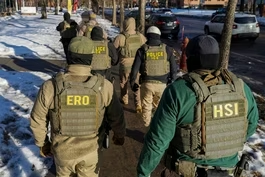
Twin Cities on edge as ICE raids ignite fear and protests
Video has Closed Captions
Clip: 1/14/2026 | 7m 8s | Twin Cities on edge as ICE raids ignite fear and protests (7m 8s)
Providing Support for PBS.org
Learn Moreabout PBS online sponsorship
- News and Public Affairs

FRONTLINE is investigative journalism that questions, explains and changes our world.

- News and Public Affairs

Amanpour and Company features conversations with leaders and decision makers.












Support for PBS provided by:
Major corporate funding for the PBS News Hour is provided by BDO, BNSF, Consumer Cellular, American Cruise Lines, and Raymond James. Funding for the PBS NewsHour Weekend is provided by...