
October 1, 2026 - PBS News Hour full episode
10/1/2026 | 57m 46sVideo has Closed Captions
October 1, 2026 - PBS News Hour full episode
October 1, 2026 - PBS News Hour full episode
Problems playing video? | Closed Captioning Feedback
Problems playing video? | Closed Captioning Feedback
Major corporate funding for the PBS News Hour is provided by BDO, BNSF, Consumer Cellular, American Cruise Lines, and Raymond James. Funding for the PBS NewsHour Weekend is provided by...
October 1, 2026 - PBS News Hour full episode
10/1/2026 | 57m 46sVideo has Closed Captions
October 1, 2026 - PBS News Hour full episode
Problems playing video? | Closed Captioning Feedback
Where to Watch PBS News Hour
PBS News Hour is available to stream on pbs.org and the PBS app.
Providing Support for PBS.org
Learn Moreabout PBS online sponsorshipGEOFF BENNETT: Good evening.
I'm Geoff Bennett.
AMNA NAWAZ: And I'm Amna Nawaz.
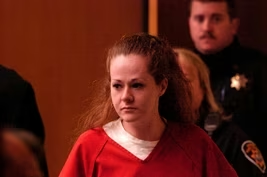
On the "NewsHour" tonight: A Tennessee woman convicted of a 1995 murder survives a botched execution, renewing questions about the way the death penalty is carried out.
GEOFF BENNETT: Israel's prime minister says the pilot who allegedly tried to crash an airplane flying to Israel underwent Islamic radicalization, the latest on the investigation.
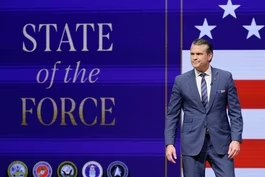
AMNA NAWAZ: And a look at Defense Secretary Pete Hegseth's latest effort to transform the U.S.
military, plus the increasingly close ties between the Pentagon and tech companies.
SHARON WEINBERGER, Author, "Valley of Death: How Big Tech is Fueling the Future of War": The entire argument of Silicon Valley was, we can contribute to defense.
Let's build.
Let's reindustrialize.
We're more innovative.
We move faster.
We're cheaper.
We have AI.
And yet we're seeing very, very limited examples.
(BREAK) GEOFF BENNETT: Welcome to the "News Hour."
Tennessee halted executions today after officials failed to carry out the lethal injection of death row inmate Christa Pike last night.
AMNA NAWAZ: It was the second time this year that officials in Tennessee botched an execution attempt.
GOV.
BILL LEE (R-TN): It's a tragedy.
And it's deeply disturbing to me that that has happened in this state.
The people deserve better than that.
And we're going to make sure that happens.
GEOFF BENNETT: Her attorneys say she remains alive and in critical condition after the state administered two doses of pentobarbital intended to execute her.
AMNA NAWAZ: A media witness described the scene last night.
CATHERINE SWEENEY, Media Witness, WPLN: They went through two rounds and she was still breathing at the end.
It was very ragged.
She lifted her head up and was looking around at one point.
She said that -- she said that there was a spot that was burning and hurting, and asked if that was normal.
None of it was normal.
I covered all the executions last year and most of the ones this year.
We haven't seen anything like it.
AMNA NAWAZ: The state's Department of Corrections said in a statement it -- quote -- "followed every step of the state's lawful established execution protocol approved by the attorney general's office."
Pike was sentenced to death for the gruesome murder of her classmate Colleen Slemmer in 1995.
Pike does not deny committing the murder as an 18-year-old, but her lawyers argued the state should have considered her age, mental illness, and trauma from alleged sexual abuse.
Slemmer's family supported the execution and have called last night's failed attempt -- quote -- "a mess."
For more, we're joined now by Deborah Denno, a professor at Fordham School of Law.
Professor, welcome to the "News Hour."
Thanks for joining us.
DEBORAH DENNO, Fordham University Law School: Thank you.
AMNA NAWAZ: As someone who's been following this case, let me just start with your reaction to the news that Christa Pike has survived this failed execution attempt.
DEBORAH DENNO: Well, first of all, I was shocked.
But then, after a moment, I wasn't surprised, given that this had just happened months before in Tennessee.
AMNA NAWAZ: And tell me a little bit, for context here, about how unusual it is to have a botched or a failed execution like this.
What do we know?
DEBORAH DENNO: Well, I have been looking at executions for over 30 years.
And there's a lot -- there's always been a very high failure rate with lethal injection, but it's actually gotten worse.
And one indicator of that are these, what you could call these failed survivors.
These are people who have survived an execution.
Christa Pike is the eighth person who's done that, but no one has been so tormented as she has been.
AMNA NAWAZ: We know that Pike's lawyers say they'd warned that officials that she had a blood condition and it could be difficult to administer the medication.
Should some of that been taken into account?
I mean, was this foreseeable in some way?
DEBORAH DENNO: Absolutely.
This was foreseeable.
And given what her attorneys had described, and perhaps what the potential executioners themselves could see, they should have better prepared or perhaps changed execution methods.
I mean, Christa Pike and her attorneys had asked either that she be executed by the firing squad or by hanging.
And given her medical condition, those methods would have been much more viable.
And this is -- this is how things turn out.
AMNA NAWAZ: So, as we speak now, it's reported that she is in hospital in critical condition.
We know her lawyer is urging the governor to reduce her sentence to life in prison.
What do we know about what could happen next in her case?
DEBORAH DENNO: Well, several things could happen to her.
First of all, the -- she could get life in prison, even though nobody else has gotten that when this sort of failed execution has occurred.
But, again, her case is very different.
No one has suffered to the extent that she has.
Indeed, we don't really know what has actually happened to her.
That's number one.
Number two, if she were re-executed, or attempt, there could be -- simply use a different -- a different kind of method.
I mean, that could happen as well.
Number three, depending on her mental condition, she may not even be viable for another attempt at executing her.
We understand the United States Supreme Court has held that somebody has to be fully aware of the type of punishment they're receiving.
AMNA NAWAZ: We know, as a result of last night's events, the state of Tennessee has now paused executions for the rest of the year.
They have launched an investigation.
As someone who studies this closely, from your perspective, is that enough to address whatever went wrong?
DEBORAH DENNO: I certainly don't think that's at all enough.
This is a method that we have had for 45 years.
It has been consistently problematic from the very first lethal injection execution in 1982 up to this point.
And not only that, it's only gotten worse.
I think one mantra or that's been fueling the use of lethal injections is everybody seeing this as an accident or a one-off.
But over the decades, over and over, we have seen these problems, and Christa Pike's execution attempt has been the worst of all of them.
AMNA NAWAZ: I want to underscore here, she's admitted to participating in a brutal murder, and the victim's family supports capital punishment in this case.
But as we reported earlier, her case is unique.
She would have been the first woman in Tennessee executed in over 200 years, and there were those extenuating factors her lawyers argued should have been taken into consideration.
How do you look at that and think about those factors in a capital case?
DEBORAH DENNO: I think those factors are critically important to take into account.
We know that Christa Pike, if she were sentenced today, would never get the death penalty, given her age and the other kinds of conditions she was facing.
Number two, I mean, this is -- no one else even in her years -- who was on of that age, all those people ended up getting life in prison.
So there's just a number of circumstances where she ends up on death row.
She was isolated for so many years that she has received a kind of treatment that nobody else in this country has ever received.
AMNA NAWAZ: That is Professor Deborah Denno from Fordham School of Law joining us tonight.
Professor, thank you for your time.
DEBORAH DENNO: Thank you.
GEOFF BENNETT: Tonight, investigators across the Middle East are hunting for answers after a co-pilot stabbed his captain and allegedly attempted to crash a Flydubai aircraft bound for Israel with 174 passengers and crew on board.
The plane, traveling from Dubai, plunged 16,000 feet in roughly 60 seconds.
Passengers were ultimately able to subdue the co-pilot after the injured captain, now hailed as a hero, managed to open the cockpit door.
Today, President Trump said the attack could be linked to Iran, without providing evidence.
The suspect has not been publicly identified.
Israeli Prime Minister Benjamin Netanyahu said this morning on FOX News that the suspect was an Omani national.
But many major questions remain unanswered.
To help us unpack what we do and don't know, we're joined again by Juliette Kayyem.
She's a former assistant secretary at the Department of Homeland Security and is now a senior lecturer at the Harvard Kennedy School.
Thank you for being with us.
JULIETTE KAYYEM: Thanks for having me.
GEOFF BENNETT: So, as you know, there are now competing claims about motive.
Israel's prime minister says the co-pilot underwent what he called Islamist radical indoctrination.
President Trump has pointed to Iran.
Neither has provided evidence.
The UAA -- UAE, rather, says it's investigating possible terrorist activity or prior planning.
What can we responsibly say, if anything, about the motive at this point?
JULIETTE KAYYEM: Right.
So and I'm glad you say that about responsibly say.
After every crisis, terror incident, disaster, there's a narrative that forms very early that is often pushed for political reasons.
I think we should just put those to the side aside right now, that that just happens.
There are elections.
What we do know is this, that there was - - that the leading theory has got to be that this was a terrorism incident, not because there's strong evidence, but just given that the totality of the circumstances.
You have a pilot who tries to essentially kill another pilot, down a plane that's filled with Israelis en route to Israel.
So any rational person would say that would be my leading theory.
What we don't know and the suspicion or allegations that this is related to a terrorist organization or even Iran is what that radicalization process was like.
It's important for us to get this right, because if it was self-radicalization, that's one thing.
If it was radicalization because of a group that was pushing it on, that's a different kind of remedy.
If it's state-sponsored terrorism, like Iran, a country that Israel and the United States have started a war against, that is a very different consequence.
And so those of us who are looking at the evidence would rationally say this is going to be the leading theory is going to be some sort of radicalization, but there are others, mental health issues that may have occurred in the pilot.
So that's where we are right now on the facts.
GEOFF BENNETT: And pilots already operate inside one of the most tightly controlled security environments in aviation.
Does this incident expose a particular vulnerability, when the potential threat comes from inside the cockpit?
JULIETTE KAYYEM: Yes, it's the catch-22 of sort of securing the cockpit.
So, just to explain the process, there is a U.N.
body called the International Civil Aviation Organization, 193 member nations, and we do that because the global aviation transportation system is shared.
And so there are minimum standards.
There are standards about who can fly, about what airplanes can fly.
There are then individual country standards.
And so that is what is going to be examined, either in terms of what kind of review is done in terms of mental health, physical health.
So you have two different systems that are supposed to complement each other.
On the inside of the airplane, you, of course, have the secure cockpit door or the secure cockpit area.
I have to say, even given what happened and the luck and fortitude of that pilot, who knew he had to open the cockpit door, there have been millions of flights with secure cockpits.
It's two pilots versus potentially 200, 300, 400 passengers.
And I think that any review of this will probably or hopefully still keep the cockpit secure, while also understanding that we need to maybe better screen pilots and screen what pilots bring into the cockpit.
GEOFF BENNETT: Well, yes, given your experience at DHS, what will DHS and the FAA be looking at here?
It's still early days, but could this lead to potential changes in domestic aviation?
JULIETTE KAYYEM: It could.
I think it will be mostly felt by the pilots.
Again, the secure cockpit -- and all of us experienced in it with the food tray coming out in front when a pilot leaves the cockpit is -- has worked very, very well.
This -- there have been a few incidences of a pilot trying to be bring a plane down and violence within the cockpit.
So I don't think there's enough evidence to change that primary post-9/11 rule.
It's just -- it has worked very, very well, given the number of flights that are going on.
I think where -- and hopefully you will see a push is, just a few days ago, the Senate passed a mental health for pilots piece of legislation.
It needs to be taken up in the House.
That would provide the services needed for pilots here in the United States if they're exhibiting stress or signs of stress.
GEOFF BENNETT: Juliette Kayyem, our thanks to you, as always.
JULIETTE KAYYEM: Thank you.
AMNA NAWAZ: We start the day's other headlines in Washington, D.C., where the Supreme Court agreed to review the Trump administration's mandatory detention policy for migrants.
The justices will consider whether the government can legally deny bond hearings to immigrants who've been living in the U.S.
after crossing the border illegally.
The court's new term will kick off next week.
Separately, the family of Renee Good, the 37-year-old who was shot and killed by an ICE agent in Minneapolis, is suing the U.S.
government.
At a press conference, Good's loved ones, including her partner, Becca, said they're seeking accountability and change.
BECCA GOOD, Partner of Renee Good: What happened to us should never happen to any family.
No child should grow up without a parent.
No one should lose their sister or their daughter.
No one should have to live without their soul mate.
BRENT GANGER, Brother of Renee Good: Since Renee's death, no meaningful change has occurred.
The deaths of innocent Americans by taxpayer-funded government agents should not be a partisan issue, and it should alarm every American.
AMNA NAWAZ: The two lawsuits also name former and current Trump immigration officials, as well as the agent himself.
Renee Good was killed back in January amid massive protests sparked by the Trump administration's immigration crackdown in Minneapolis.
President Trump is traveling to Texas and Oklahoma today as part of a midterms push to rally his party.
But broadcast outlets are choosing not to show footage of his travels after the White House abruptly removed CNN from its press pool duties for the trip.
Just days earlier, CNN was also barred from flying on Air Force One for a visit to Tennessee.
Last week, a judge blocked the administration's ban on CNN and two other media organizations from covering Mr.
Trump, but only on the White House grounds.
In a statement provided to the "News Hour," the lawyer representing the outlets said -- quote -- "The White House is persisting in unpredictably and inconsistently implementing the president's unconstitutional ban on the free press."
Driving storms across the center of the country broke daily rainfall records, and flash floods prompted water rescues and evacuations.
What was Hurricane Polo has combined with a massive storm system trudging east, stretching from Colorado to Iowa.
Roughly 40 million people were under flood alerts today, including in Texas.
Floodwaters overnight in Abilene submerged cars, and at least one person had to be rescued, while, in Nebraska, harrowing moments as a tractor trailer jackknifed in the driving rain.
Some downpours, like in Omaha, dropped more than five inches of rain in just 24 hours.
Forecasters say a considerable flood threat will last through tomorrow.
In the U.K., police say they have arrested a British-Iranian citizen on suspicion of planning a terror attack following a security incident at an air base.
Authorities say the 27-year-old was taken into custody today in Central London.
Another British national was also questioned by police, but not arrested.
Five men who were detained near RAF Fairford this past weekend were later released on bail.
The air base has been used by American bombers in the war against Iran. '
Yesterday, Prime Minister Andy Burnham said he sees -- quote -- "strong indications" that Iran is linked to the incident, though Tehran has denied this.
In Ukraine, a Russian drone slammed into a school in Kyiv today as the capital endured yet another day of aerial attacks.
Street camera footage shows the moment the drone hit the building and knocked out part of its wall.
Students and staff were sheltering in a bunker and no injuries were reported.
The school's principal says it's the second time the building has been damaged in a strike.
VALENTYNA CHORNA, School Principal (through translator): The Russians spare no one.
In order to destroy a nation, of course they need to destroy children.
That is why they keep striking educational institutions.
But we are holding on.
We are working.
We are teaching children.
AMNA NAWAZ: Meantime, President Volodymyr Zelenskyy posted a video on social media today saying it shows the first combat use of a domestically made ballistic missile.
And in a separate post, he said that Ukrainian forces struck a Russian ship in the Black Sea, while, in Moscow, President Vladimir Putin renewed threats to use, as he put it, "all weapons in our country's arsenal" if European nations attack Kaliningrad.
That is Russia's exclave between Lithuania and Poland.
His comments follow an earlier warning by Russia that nuclear weapons could be deployed.
On Wall Street today, stocks largely held steady amid the latest swings in the bond market.
The Dow Jones industrial average added just 20 points, so basically flat.
The Nasdaq also ended little changed, and the S&P 500 managed to break a three-day losing streak.
And, in Florida, SpaceX launched four astronauts to the International Space Station this morning.
MAN: Three, two, one, ignition, and liftoff.
AMNA NAWAZ: Their 230-foot-tall Falcon 9 rocket powered off the ground for an estimated eight-hour journey to the ISS.
That is faster than any prior U.S.
journey to the station.
The crew is made up of two Americans, a Canadian and a Russian cosmonaut.
And it's led by Commander Jessica Watkins, the first Black woman to lead a crew to orbit.
Their six-month mission is meant to focus on human health and performance while in space.
Still to come on the "News Hour": a new book details how tech companies are working to replace traditional defense contractors; an on-the-ground look at the U.N.
peacekeeping mission along the Lebanon-Israel border that's set to expire;and two former presidential advisers from two different parties, David Axelrod and Karl Rove, weigh in on the upcoming midterms.
There are new revelations about how authorities handled an alleged gang rape at Cornell University in 2024.
The case has sparked national outrage after a woman identified only as Jane Doe filed a civil lawsuit against Cornell and others.
In it, she alleged that she was sexually assaulted by multiple men at a party thrown at the Chi Phi fraternity house, where she was given alcohol and pressure to snort ketamine.
The woman says authorities failed to do enough in light of the allegations.
Criminal charges were never filed.
But Cornell has said it investigated and took disciplinary action, including suspensions, expulsions, and banning the Chi Phi chapter.
This afternoon, the Student Assembly at Cornell had a special meeting to discuss the anger over how the case was handled.
WOMAN: Survivors need to know that when they come forward with their story, somebody will listen and the broader institution will act upon it.
Through this event, we have witnessed the complete opposite.
AMNA NAWAZ: For his part, the Tompkins County district attorney said details in Jane Doe's original statement did not support criminal charges at the time.
But new reporting out today finds Cornell police left out key information in a statement given to local law enforcement.
That includes Jane Doe's statement saying -- quote -- "I can say with 100 percent confidence I was raped."
Sharon Otterman is covering the story for The New York Times and joins us now.
Sharon, welcome to the show.
Thanks for being with us.
SHARON OTTERMAN, The New York Times: Thank you so much for having me.
AMNA NAWAZ: So, you and your team obtained more than 1,000 pages of documents, texts, and photos and e-mails from Cornell's internal inquiry.
That includes transcripts of original interviews with the then 20-year-old undergrad now known as Jane Doe.
Tell us more about who the interviews are with.
And what's key to understanding this case and what you read?
SHARON OTTERMAN: So this is the entire investigative file.
It's really the appendixes, but it's about 1,100 pages of interviews, both with the woman, with six of the seven men who she accused, and with about 20 witnesses.
And then there's also screenshots of various social media interactions, photographs, and other evidence that they compiled internally for their own investigation to figure out, were these students guilty of what she's accusing them of, and, if so, should they be expelled or otherwise punished?
AMNA NAWAZ: So it's the first time we're learning some of these details.
They do reveal a lot, as you report, about Jane Doe's response to the alleged incident.
What did you take away from the messages about how she was processing and her sort of evolution of thought?
SHARON OTTERMAN: We don't often, I think, get to have this kind of window into somebody who has gone through an incident like this and get to watch her processing in real time.
When she first comes out of the incident, she -- one of the men contacts her and sort of apologizes, says, oh, I'm so sorry that got out of hand.
And her impulse is to be like, oh, no, don't worry about it.
It's OK.
And then, over the course of about two or three weeks, she starts to realize that the only people she's really protecting here are the people she's accusing.
And she herself is starting to get painted in her own community as somebody who did this willingly and was kind of a whore, is what the word she used for doing it.
And then, ultimately, she sees a comment.
Somebody says, oh, there's gangbanging going on at this fraternity house.
And somebody anonymously comments back, dudes, like they raped a sophomore.
Like, we need to report this.
And I think that's like the first time that she told investigators that she was like, oh, my God, that is what happened to me.
AMNA NAWAZ: The documents also reveal the accounts of the men involved in this alleged incident, interviews conducted with six of the seven men who were accused.
What do those interviews tell us about how they viewed that night?
SHARON OTTERMAN: They all deny that there was anything but consensual sex.
Some of them deny that they were even in the room.
And I want to say, in fairness to the men, there are some that do have sex with her, and others are just present.
So she's not accusing all of them in these original documents of actually intercourse, although she knows that she is very under the influence of ketamine, which she'd never tried before and was sort of pushed on her.
She's not quite sure.
That's why she says, I'm 100 percent certain I was raped, but she doesn't exactly remember everything.
AMNA NAWAZ: I need to say, in your reporting, you include that the lawyers for at least three of the men have broadly denied any criminal wrongdoing, and others have yet to make public statements.
The key question here, though, Sharon, in terms of accountability, is, what do we know about how all of these documents and the transcripts and the text messages did not make it to the district attorney?
How did that happen?
SHARON OTTERMAN: Only a six-page summary of what was a 120-page-long transcript made it to the district attorney.
He made his determination based on that.
I think that that is probably standard in these cases, that the district attorney is not going to pore over a transcript.
There is a lot that was left out of that transcript.
We also have a very narrow definition of rape under New York state law.
And if she was willingly intoxicated, it makes the bar to prove sexual assault much higher.
And he just, at that moment, just seeing that one document didn't think that it met the bar and wasn't curious enough, for lack of a better word, to ask for more details.
AMNA NAWAZ: As we have reported, prosecutors are reopening the case.
Is there any sense of how these documents might impact that case moving forward?
SHARON OTTERMAN: We know that, obviously, he will have access to this file.
He has reached out to her lawyer to reinterview her.
He has -- he told my colleague that he does have new -- quote -- "evidence" of some sort, but he wouldn't say what it was.
So there may well be something new there that will allow him to bring the case before a grand jury.
AMNA NAWAZ: That is Sharon Otterman of The New York Times joining us tonight.
Sharon, thank you so much.
SHARON OTTERMAN: Thank you for having me.
GEOFF BENNETT: Defense Secretary Pete Hegseth says he is fundamentally reshaping the culture of the U.S.
military, removing senior officers, dismantling diversity initiatives, and putting a new emphasis on religious faith and what he calls a warrior ethos.
In a speech to military leaders yesterday, Hegseth offered a blunt description of the Pentagon he says he's building.
PETE HEGSETH, U.S.
Defense Secretary: We are no longer the woke department or the weak department.
Simple translation of that, no fanny -- no fatties, no trannies, no beardos, no weirdos, no wimps, no radicals, just warriors, just tough, ready, committed troops.
The War Department, as you know, is colorblind, gender-neutral, and merit-based.
The ideological clowns are out.
The patriotic cowboys are in with testosterone testing on top.
GEOFF BENNETT: Beyond the cultural changes, Hegseth is pushing a broader effort to prepare the military for the wars of the future with autonomous weapons and other technologies.
He's also changing how the Pentagon develops its next generation of officers.
For insight and analysis, I spoke earlier with Peter Feaver, a professor of political science and public policy at Duke University.
He's also a specialist in civil-military relations.
Peter Feaver, welcome to the "News Hour."
PETER FEAVER, Duke University: Thanks for having me.
GEOFF BENNETT: Let's start with what we just heard.
Secretary Hegseth says he's building a military that is colorblind, gender-neutral, and merit-based.
But he's describing that vision with explicitly political and culture war language.
What happens when a defense secretary brings that kind of rhetoric into an institution that has traditionally tried to remain above partisan politics?
PETER FEAVER: Well, it presents a test to the audience.
They have to listen respectfully.
He is their boss, of course, just like you see at a State of the Union address where the president's giving comments and the members of Congress cheer, but the Supreme Court and the chairman of the Joint Chiefs of Staff sit quietly.
That's what the audience needed to do, and that's what they did do.
GEOFF BENNETT: Hegseth has also moved aggressively against the senior officer corps.
He wants to cut the number of generals and admirals by 20 percent.
He's already removed a number of senior levels.
And there is an argument that the military has become too top-heavy.
Is there merit to what he's doing, in your view?
PETER FEAVER: I think that a lot of experts would agree that you could reduce the number of senior military three- and four-stars, and still maintain military effectiveness, provided that those reductions were done carefully, transparently, so people knew why the billets were going away and it was done gradually over time.
That's really the test, not whether there's a reduction, but whether it's being done wisely and transparently and with congressional buy-in.
GEOFF BENNETT: Is that presently happening?
PETER FEAVER: Well, it's not transparent enough, I think.
There's a lot of questions that were raised about the 30 or so senior military officers that have already been relieved.
Many of them were considered the finest in the force, including some that were most aggressive about modernizing and doing the kinds of initiatives that the secretary announced later on in his speech.
And so it was hard to square what he was advocating in the second part of the speech with his claim that he got rid of the poor performers in the first part of the speech.
GEOFF BENNETT: And for all of the attention on Hegseth's rhetoric, there is part of his agenda that you could argue is ultimately more consequential than that.
He's creating a new four-star autonomous warfare command focused on drones, robotics, artificial intelligence.
Is that the kind of structural change the Pentagon really needs?
PETER FEAVER: Well, once you got past the partisan part of the speech, he announced six policy initiatives, and each one of those is debatable, but is part of the kind of change that a transformational secretary would aim for.
You mentioned the Autonomous Warfare Command.
Ironically, that will be creating a new four-star billet, so that's going to be adding, rather than subtracting.
And I do think there needs to be a national debate about autonomous warfare.
I think the secretary's announcement will help move that debate along, maybe make it a little more prominent than it has been.
A lot of questions about whether we want to fight fully autonomously.
That would be an ethical challenge.
GEOFF BENNETT: Secretary Hegseth says he wants to broaden the officer pipeline through these new partnerships with LSU, Liberty University, Tuskegee, Mississippi State, Hillsdale.
Is there a legitimate argument that the military should recruit officers from a wider range of institutions?
PETER FEAVER: Yes, that's absolutely a concern.
That's what's known as the gap problem, the gap between the 1 percent who serve and the 99 percent who do not serve.
I think it's very important that you recruit from elite universities.
Harvard, the Ivies, Duke, my own university, not just because you're getting high-caliber men and women in uniform, but because you're buying into different friend networks.
The more people who have friends who serve in the military, the better it is for America, the more that they will have -- feel like they have skin in the game.
GEOFF BENNETT: So put all of this together for us.
We have got the personnel changes, the religious emphasis and evangelical Christian emphasis coming from Hegseth, the overhaul of military education, the push toward autonomous warfare.
Is there one coherent theory of how to make the military more effective, or do you see several different agendas being pursued simultaneously?
PETER FEAVER: I see a secretary who wants to be very transformative and who has launched quite a large number of initiatives, but what I don't see is the secretary who has worked closely with Congress to make those initiatives last.
And so that's the real challenge.
He made six bold announcements yesterday, but does he have the relations with Congress to turn those aspirations into reality?
Because every single one of them will require strong congressional buy-in.
GEOFF BENNETT: Peter Feaver, thanks so much for being with us.
Great to speak with you.
PETER FEAVER: My pleasure.
Thank you.
AMNA NAWAZ: Efforts to transform the military include modernizing the technology that soldiers use on the battlefield and the further integration of AI.
For perspective on how the biggest names in Silicon Valley are reshaping the Pentagon and cashing in, I spoke with Sharon Weinberger, author of the new book "Valley of Death: How Big Tech is Fueling the Future of War."
Sharon Weinberger, welcome to the "News Hour."
Thanks for being here.
SHARON WEINBERGER, Author, "Valley of Death: How Big Tech is Fueling the Future of War": Thanks for having me.
AMNA NAWAZ: So your book really documents how deeply bound and intertwined the U.S.
government is with what you call the arsenal of the broligarchy.
I love this term.
What does that mean?
Who does that -- who comprises that broligarchy, as you put it?
SHARON WEINBERGER: So it refers broadly to the entrepreneurs, the investors, the CEOs that are part of this new wave of defense company out of Silicon Valley.
And when I say Silicon Valley, it's not just the geographic area.
It's the whole ecosystem of Silicon Valley.
AMNA NAWAZ: You talk about how Silicon Valley has basically come to replace or supplant what used to be sort of the industrial -- military-industrial complex that was previously defined by really big defense contractors working with the government.
How did that shift happen?
SHARON WEINBERGER: So it's happened in a couple fronts.
So we still have what are called the five primes.
These are the large defense companies that people have probably heard of, Northrop Grumman, Lockheed, Boeing, and the others.
But what has happened is you now have these new companies, again, out of Silicon Valley who are becoming part of those primes, meaning they're handling large contracts, they're contracting directly with the Pentagon.
How that happened really goes back to two companies, SpaceX and Palantir, that came out of the PayPal mafia around 2003-2004 and fought very, very hard and rather successfully to break into the Pentagon market.
AMNA NAWAZ: You talk about the PayPal mafia.
Who are you talking about here?
Because a lot of these companies are incredibly powerful and people don't know who's behind them.
SHARON WEINBERGER: So the PayPal mafia is a number of the people who were high-level in PayPal, but in this case it was Elon Musk, who founded SpaceX in 2003, and then Peter Thiel, who around that same time founded Palantir along with Alex Karp, two names that people now recognize.
AMNA NAWAZ: One of the biggest trade-offs in this new system seems to be that it's big tech investing its own money in the development and in the production.
What does that mean for who has a say in how these systems get used when you're talking about defense systems for the U.S.
government?
SHARON WEINBERGER: So that's the biggest shift that has happened.
One thing is, people will say, well, we have had defense industry for a long time, since World War II, and the standing armaments industry that President Eisenhower talked about.
But the big difference is, is that during the Cold War and even up until today, the weapons that those companies developed were paid for and in fact ordered up by the Pentagon, by the U.S.
government.
So you don't have the Pentagon or the secretary of defense or war calling the CEO of Lockheed Martin saying, may I use your F-35 for this military operation?
So a lot of the technologies that these Silicon Valley firms developed, they used their own money, venture money, private capital money, and they own the underlying technology.
And so what that means is, in the case of Elon Musk, as we saw during the early days of the Ukraine war, the satellite Internet system was the backbone of the Ukrainian military.
They asked if they could use it for an operation in Crimea, and Musk said no.
And this sort of freaked out the Pentagon that one CEO, one tech billionaire could make decisions on how things were and weren't used.
AMNA NAWAZ: And you meet with venture capitalists, a lot of the folks behind some of these investments.
Is the soldier, are the troops who are on the front lines of a lot of these conflicts that they're designing for and producing weapons for, are they part of the conversation at all?
Is anyone talking about them?
SHARON WEINBERGER: So, sort of.
I mean, the sad part is, that's the conversation in part that should be happening.
Are these technologies really better?
The one thing I will say, perhaps not in defense of these new companies, but I think is important to acknowledge, is, there was a lot of frustration from troops on the ground in places like Afghanistan that their iPhone, their smartphone could do so much more than the technology the military was providing.
And so you had companies like Palantir that actively sort of promoted their technologies, showed their software with soldiers who were deploying to Afghanistan, and that did create some demand, where soldiers were like, oh, this is point and click.
It's kind of what I'm used to.
It's better than what the defense companies are offering.
AMNA NAWAZ: So bring us up to speed in terms of what this means for where we are now.
You saw at the second inauguration of Donald Trump many of these big tech leaders sitting right up there with him on the stage as he was sworn in.
He made it very clear there's going to be close ties between his government and Silicon Valley.
He's also made it clear that he doesn't want any limits or any regulation on the development of artificial intelligence technology.
What does that mean for all of these firms and the relationship with the U.S.
government?
SHARON WEINBERGER: I mean, right now, it's kind of boom times for this industry.
Of the things that people I think were so surprised by at the beginning of the Trump administration was that Silicon Valley, which had the reputation of being to the left, of supporting Democrats, really fell behind Donald Trump.
First Trump administration, Peter Thiel was the outlier supporting Trump.
Second time around, you had all these tech CEOs showing up the White House praising Trump.
And there's two parts of that.
One is that Silicon Valley at the end of the day is going to do what's good for its business.
And if supporting the administration, whether it's Republican, whether it's Democrat, that they're going to do that if they need to.
But the other part is, they genuinely saw an opportunity to shape the administration.
They -- MAGA is not 100 percent behind AI or behind the tech -- behind the tech bros.
But certainly Silicon Valley has done a good job of convincing Trump of their interests, and that's what we're seeing with this push against regulation.
He's doing a lot of the things that Silicon Valley is, frankly, pretty happy about.
AMNA NAWAZ: I mean, at the end of the day, all of this is being done in the name of national security.
Do we know if it's making us safer?
SHARON WEINBERGER: You know, one of the open questions when I started writing the book was, I didn't want to be too harsh, in the sense of Silicon Valley was making big claims.
Silicon Valley tends to make big claims, the fake it until you make it.
But I thought maybe it's too early to really say.
SpaceX has been important.
Palantir, they have certainly modernized software.
They have had some contributions.
But the more and more I reported through the book, especially through the war in Ukraine, and now with military operations in Iran, I'm not buying the argument.
The entire argument of Silicon Valley was, we can contribute to defense.
Let's build.
Let's reindustrialize.
We're more innovative, we move faster, we're cheaper, we have AI.
And yet we're seeing very, very limited examples in the Middle East and in operations in Iran where Silicon Valley is really helping.
If anything, you have seen some indications that some of the AI, the Palantir smart system, may have contributed to errant strikes in Iran.
We're seeing it's -- we're not seeing this miraculous technology solving warfare.
That is what's been pitched.
AMNA NAWAZ: Well, the book is the "Valley of Death: How Big Tech is Fueling the Future of War."
The author is Sharon Weinberger.
Sharon, thank you so much.
SHARON WEINBERGER: Thank you for having me.
GEOFF BENNETT: After 48 years, the U.N.
peacekeeping mission in Southern Lebanon is nearing the end of its mandate.
Its planned withdrawal comes at a volatile moment, with the Israeli military occupying roughly 6 percent of Lebanese territory following years of fighting with Hezbollah and amid the broader fallout from the U.S.-Israel war with Iran.
Special correspondent Simona Foltyn and videographer Adrian Hartrick gained rare access with the peacekeepers traveling south of Israel's so-called Yellow Line.
SIMONA FOLTYN: We are embedding with U.N.
peacekeepers headed towards Israel's occupation zone in Southern Lebanon.
This is one of the few ways journalists can access this border region where the Israeli military has been consolidating its control.
We passed the Israeli checkpoint some four miles inside Lebanese territory, crossing the Yellow Line that demarcates Israel's areas of control.
The United Nations Interim Force In Lebanon, known as UNIFIL, was set up in 1978 to ensure the Israeli army's withdrawal after its first invasion of Lebanon.
Israel ended up staying for 22 years, leaving in 2000.
Now the U.N.
Security Council has told UNIFIL to pack up, even as Israel has once again occupied parts of the country, seizing a strip of land along the border where the Iran-backed Shia militant group Hezbollah used to hold sway.
Along our route, the Israeli army has destroyed almost every village, pushing out the civilians who used to live here.
there is no presence of the Lebanese state, only the Israeli army and UNIFIL.
Our destination is a U.N.
outpost near the town of Bint Jbeil.
French peacekeepers are manning this remote position.
What is the importance of this particular outpost for UNIFIL's role in Southern Lebanon?
CAPT.
GIRARD, UNIFIL: So this is a really strategic position.
We are the eyes for UNIFIL and basically for U.N.
and maybe as, I would say, the world.
SIMONA FOLTYN: France is the only nation to have deployed advanced radar systems, which allows UNIFIL to detect artillery and rocket fire.
CAPT.
GIRARD: Basically, we can see, detect what's happening in this particular area.
I think we are doing quite a strategic mission in here.
SIMONA FOLTYN: What was that just now?
CAPT.
GIRARD: Oh, there's an explosion here on the side.
They're destroying some houses to make sure that the population will never come back.
SIMONA FOLTYN: There has been little active fighting following a June cease-fire, but the Israeli military has continued to demolish civilian infrastructure as part of its stated plan to create a depopulated buffer zone on Lebanese soil to keep Hezbollah away from its northern border.
CAPT.
GIRARD: So my platoon in this pretty isolated outpost has been able to monitor every destruction, every fighting and every artillery shellings and airstrikes.
SIMONA FOLTYN: With the help of that outpost, UNIFIL has recorded more than 11,000 violations by the IDF since June this year, including airspace violations, airstrikes, artillery strikes, as well as the IDF's illegal presence in Lebanon.
One violation has been attributed to Hezbollah.
And so, when you leave, when you essentially hand over this outpost, nobody is going to be monitoring what's going on in this area, right?
CAPT.
GIRARD: That's why France is pushing to make sure that we won't give up our position and, even if we have to give up on UNIFIL, France is pushing to get a multinational force in the southern part of Lebanon, maybe with other European countries.
SIMONA FOLTYN: Around 40 French U.N.
peacekeepers have been holding down the fort here.
Corporal Alexander has been deployed for four months.
CPL.
ALEXANDER, UNIFIL: Well, it's been kind of challenging because we're in a base that's kind of isolated with the -- what's going on around, the impacts, the GBU that's falling, the difficulty to get resource But we're trained for it, so it's been all right.
SIMONA FOLTYN: Israeli troops have set up close to the U.N.
post.
CPL.
ALEXANDER: Sometimes they give us a hard time to get the convoys here or just to do a switch between personnel.
SIMONA FOLTYN: On our way out, we get a small taste of these obstructions.
There is a lot of Israeli military presence surrounding this U.N.
position.
We're not allowed to film them, but we have seen Merkava tanks.
We have seen jeeps loaded with explosives, and we have seen Israeli soldiers occupying Lebanese homes.
Before long, our convoy comes to a halt.
So there's another Merkava tank that's blocking the road.
So the convoy has stopped, and we're waiting to see if they will let us pass.
A GoPro camera mounted to our vehicle captures the scene.
The Israeli tank moves deeper into the road, momentarily cutting off our path.
Eventually, it backs up and lets us pass.
Such incidents are not isolated and are considered by UNIFIL to be a denial of its freedom of movement.
Israeli officials have made it clear that they want UNIFIL to leave, saying it has failed to ensure Hezbollah's disarmament since the 2006 war.
Last year, amid Israeli and U.S.
pressure, the U.N.
Security Council voted to end UNIFIL'S mission by the end of 2026.
But, on the ground, it appears that UNIFIL is leaving with its work left unfinished.
At its headquarters in Naqoura, the "News Hour" spoke to UNIFIL's force commander in his first interview with an American broadcaster.
MAN: In this moment, the UNIFIL troops, the presence is essential.
I believe in that, and my soldiers, they believe in that.
SIMONA FOLTYN: UNIFIL currently deploys more than 7,000 uniformed personnel from nearly 50 countries.
At the end of the year, they will start withdrawing.
The plan is to hand over to the Lebanese army.
MAN: The solution for us is just to create the best condition for Lebanese armed forces.
SIMONA FOLTYN: Do you think it's realistic that the Lebanese army will take over, given that at the moment they're not even allowed by the Israeli army to enter south of the Yellow Line?
MAN: Yes, but I think that, day by day, we are continuing to support them, to increase our combined operation.
But I think that it's very important for international community to support them, not only about equipment, but also about training to create a very strong army.
SIMONA FOLTYN: While the IDF says it must maintain what it calls a security zone inside Lebanon to protect communities in Northern Israel, many here fear that the U.N.
's departure will allow Israel to further tighten its grip over areas it already occupies.
Because the Israeli army restricts civilian traffic here, the few Christian communities who've been allowed to stay now depend mostly on humanitarian convoys.
For the people of the town of Rmeich, UNIFIL has been a lifeline.
MICHEL SHOUFANY, Rmeich, Lebanon, Resident (through translator): We want UNIFIL to stay.
They help our security, society and our economy.
If someone is sick, if someone needs anything, they help escort them.
UNIFIL does the permission so that people can come and go with them.
If UNIFIL weren't here, I don't know if there would be any convoys.
SIMONA FOLTYN: The U.N.
peacekeepers will soon be gone, and, with them, the small semblance of security for the last civilians holding out here.
For the "PBS News Hour," I'm Simona Foltyn in Southern Lebanon.
GEOFF BENNETT: The "News Hour" requested comment from the Israel Defense Forces.
They responded, saying in part that Hezbollah's presence south of the Litani River is unacceptable.
The IDF also said it disagrees with how UNIFIL classifies the reported incidents as violations and that the IDF works to prevent friction and help safeguard the security of UNIFIL and IDF personnel.
GEOFF BENNETT: Turning now to the upcoming elections here in the U.S., Republican Karl Rove is known for his hardball politics promoting the GOP,but he recently announced this year he's voting for a Democrat.
AMNA NAWAZ: Our Lisa Desjardins sat down with him, along with another architect of modern politics.
That's Democrat David Axelrod.
Their conversation at The Economic Club of Chicago covered election security, whether Rove will vote for Republican Senate candidate Ken Paxton, and their midterm predictions.
LISA DESJARDINS: If the election were today, what would this election look like for Democrats?
DAVID AXELROD, Former Senior White House Adviser: Yes.
Well, the election isn't today.
And you have been following the weather.
It's very unpredictable.
But there are certain things that I think are true and will hold here.
My guess is, it will be around with a kind of 15-seat majority, in that neighborhood.
LISA DESJARDINS: Karl?
KARL ROVE, Former Senior Adviser to President George W. Bush: Yes.
LISA DESJARDINS: You think the Democrats will take the House?
KARL ROVE: Oh, yes.
LISA DESJARDINS: Not the Senate?
KARL ROVE: Well, look, the Republicans have got a three- or four-seat majority, depending on how you count it.
And there are 37 seats that are up for grabs in The Cook Political Report lean Democrat, lean Republican, toss-up.
But I think David's right that it's going to be relatively modest.
The Senate is what's going to be interesting, because there the national number is going to have a bigger impact on the generic ballot.
But I think it's odd that the last couple of weeks that has gone slightly in the Republican area direction.
LISA DESJARDINS: The Republican nominee for the Texas railroad commissioner has never gotten so much national attention.
LISA DESJARDINS: Posted a photo of some University of Texas students celebrating a football win.
That included some of South Asian descent, and he called them the problem.
What's happening in and to your party because of bigotry?
I mean, that photograph was unbelievably wonderful, because it's entirely a crowd of burnt orange clad undergraduates at U.T.
going completely insane over the victory over Ohio State.
It was -- can you imagine the rest of your life as an undergraduate saying, I was there?
Well, how the hell did that guy know that those Asian Americans and the Hispanics and Blacks were foreigners?
And what the hell did that matter?
(APPLAUSE) KARL ROVE: If you're not from a white Christian country, he wants you out of the United States of America.
And that is a bigot.
And I did not become a Republican, the party of Abraham Lincoln, to associate with bigots.
(APPLAUSE) KARL ROVE: So I'm voting for my second Democrat in my entire life.
LISA DESJARDINS: Where do you all think we are in terms of the security of this election?
And are you concerned about after this election should the Republicans lose both chambers?
DAVID AXELROD: Look, this is a concern of mine because I sort of sold my, oh, he'd never do that stock like five years ago.
I worry about an attempt by the Justice Department or even the military, if he were to call a national emergency.
So, I mean, I hope I'm wrong about all of it.
He will say I'm paranoid, but I think this is an environment where, if you're not paranoid, you're kind of crazy.
KARL ROVE: Yes.
LISA DESJARDINS: Is David a paranoid conspiracy theorist?
KARL ROVE: I have confidence in the administration of our system, in large measure because it's not done at the federal level, where the president can jack around with it.
It's done at the state level.
And the idea that the U.S.
military would stand up and say we're going to step in and stop the insurrection by unseating these people and seating those people is ridiculous.
We should not be sort of overwrought in that respect.
DAVID AXELROD: But I will say that the election authorities all over the country have sounded an alarm, and they're less confident than Karl that their processes won't be interfered with, and I take them seriously.
KARL ROVE: Do I hear what the state election officials are saying?
Yes.
And what I hear from them is they're worried about people not showing up to work the polls, and because our system depends upon a lot of... LISA DESJARDINS: Yes.
DAVID AXELROD: That's one issue.
KARL ROVE: ... good-natured Americans who step forward for two or three days during the election process, or in some cases in the mail-in-ballot heavy states, several weeks before the election and then a week or so after, and volunteer their time.
And I worry about that.
LISA DESJARDINS: I want to wrap this up with a lightning round.
Will the war in Iran end before the next Congress begins?
KARL ROVE: Yes.
DAVID AXELROD: Yes, I think so.
LISA DESJARDINS: Oh, you do?
OK.
In the House, will Democrats gain a net of more than 10 seats?
KARL ROVE: Yes.
DAVID AXELROD: Yes.
LISA DESJARDINS: Wow.
Will Karl vote for Ken Paxton?
(LAUGHTER) DAVID AXELROD: Absolutely not.
LISA DESJARDINS: No comment.
KARL ROVE: I defer to my conscience.
(LAUGHTER) (APPLAUSE) LISA DESJARDINS: Three words that describe this moment in American politics.
I can give you a second to think about that one.
KARL ROVE: Bitter, divided, polarized, and we have been here before.
We have survived worse.
LISA DESJARDINS: OK.
OK, good.
DAVID AXELROD: So I think this is really a unique moment in history and a really challenging moment, when we have to prove to the world that our democracy is agile enough to function and solve these problems.
LISA DESJARDINS: Thank you all for really a wonderful in-depth conversation.
DAVID AXELROD: Thank you.
(APPLAUSE) LISA DESJARDINS: Karl Rove, David Axelrod.
And thank you to all of you.
GEOFF BENNETT: And that's the "News Hour" for tonight.
I'm Geoff Bennett.
AMNA NAWAZ: And I'm Amna Nawaz.
On behalf of the entire "News Hour" team, thank you for joining us.
 New
NewCornell's handling of rape allegations faces more scrutiny
Video has Closed Captions
New details intensify scrutiny of Cornell's handling of gang rape allegations (6m 12s)
 New
NewHow tech firms are replacing traditional defense contractors
Video has Closed Captions
'Valley of Death' reveals how tech companies are replacing traditional defense contractors (7m 32s)
 New
NewInside the UN peacekeeping mission on Lebanon-Israel border
Video has Closed Captions
On the ground with UN peacekeepers as Lebanon-Israel mission nears its end (7m 39s)
 New
NewInvestigators search for motive after pilot's alleged attack
Video has Closed Captions
Investigators search for motive after alleged attack by FlyDubai co-pilot (5m 58s)
 New
NewKarl Rove and David Axelrod give their midterm predictions
Video has Closed Captions
Karl Rove and David Axelrod give their midterm predictions (5m 52s)
 New
NewA look at Hegseth's attempts to reshape the Pentagon
Video has Closed Captions
A look at Hegseth's attempts to reshape the Pentagon (6m 22s)
 New
NewNews Wrap: SCOTUS to review mandatory detention for migrants
Video has Closed Captions
News Wrap: Supreme Court to review mandatory detention policy for migrants (6m 6s)
 New
NewWhat we know about the botched execution of Christa Pike
Video has Closed Captions
What we know about Tennessee's botched execution of Christa Pike (6m 27s)
Providing Support for PBS.org
Learn Moreabout PBS online sponsorship
- News and Public Affairs

Today's top journalists discuss Washington's current political events and public affairs.
 New Episode
- News and Public Affairs

FRONTLINE is investigative journalism that questions, explains and changes our world.
 New Season

 New Episode

 New Episode

 New Episode

Support for PBS provided by:
Major corporate funding for the PBS News Hour is provided by BDO, BNSF, Consumer Cellular, American Cruise Lines, and Raymond James. Funding for the PBS NewsHour Weekend is provided by...