
Scammed
Season 2026 Episode 9 | 1h 23m 53sVideo has Closed Captions
How online scams steal billions of dollars and ruin victims’ lives.
FRONTLINE and The Associated Press investigate how online scams steal billions of dollars and ruin victims’ lives. The documentary traces the rise of a global criminal industry, the people and technology enabling it, and the efforts to shut it down.
Problems playing video? | Closed Captioning Feedback
Problems playing video? | Closed Captioning Feedback
Funding for FRONTLINE is provided through the support of PBS viewers and by the Corporation for Public Broadcasting. Major funding for FRONTLINE is provided by the Ford Foundation. Additional funding...
Support provided by:

Scammed
Season 2026 Episode 9 | 1h 23m 53sVideo has Closed Captions
FRONTLINE and The Associated Press investigate how online scams steal billions of dollars and ruin victims’ lives. The documentary traces the rise of a global criminal industry, the people and technology enabling it, and the efforts to shut it down.
Problems playing video? | Closed Captioning Feedback
Where to Watch FRONTLINE
FRONTLINE is available to stream on pbs.org and the PBS app.
Buy Now
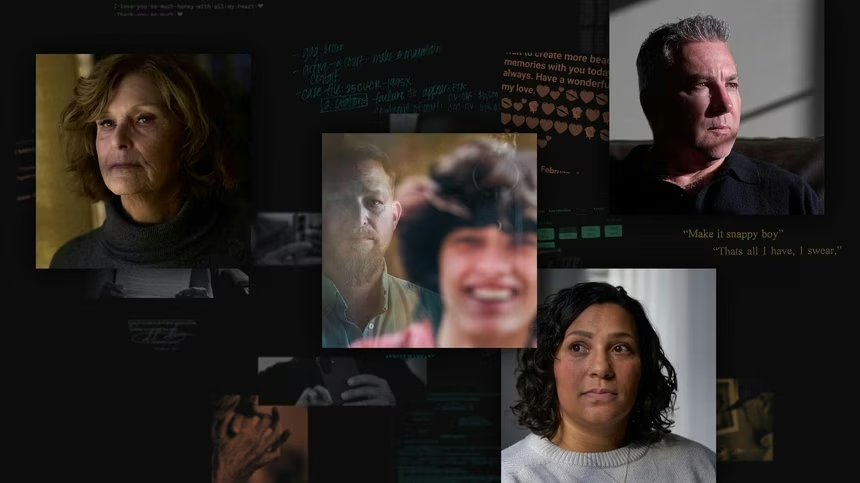
Inside the Scam
Follow scams as they unfold — and examine tactics used to manipulate victims. A collaboration between FRONTLINE and The Associated Press.Providing Support for PBS.org
Learn Moreabout PBS online sponsorship>> They stole 25,000... >> ...$13,500... >> ...$50,000.
>> Almost a million dollars.
>> NARRATOR: In collaboration with the Associated Press.
A global investigation.
>> Victims are getting hit with romance and cryptocurrency and then losing all of their money.
>> Every single person is vulnerable to scams in a different way.
>> ...Long-con crypto-based investment scams... >> A police impostor... >> He promised to love me... >> It’s gut-wrenching and it’s life changing.
>> NARRATOR: The perpetrators.
>> Do you ever feel bad about what you do?
>> NARRATOR: Victims.
>> Doctors, lawyers, IT professionals, people who work with computers and work with the internet.
And they were scammed.
>> NARRATOR: The efforts to shut it down.
>> At some point, the big tech companies have to be held responsible because they are providing the tools.
They're aware of what's happening.
>> We have to fight it locally and internationally.
>> NARRATOR: And the dangerous role of artificial intelligence.
>> The scam industry is heading like a rocket ship towards the AI universe.
You can just have an army of AI avatars scamming people.
>> Can I send you a message?
>> If you look to the future, it's only going to get harder... to be able to tell what's real, to be able to tell who's a scammer, to be able to defend yourself on your own.
>> NARRATOR: Now on FRONTLINE... >> There are so many layers to this.
>> NARRATOR: Scammed.
>> It's a very industrialized criminal organization that is capitalizing on human trust.
♪ ♪ >> I don't believe that everything happens for a reason.
I believe that there is good and there is evil in this world.
And sometimes evil attacks you.
For someone to tell me that this would be part of God's plan, I can't... I can't accept that.
♪ ♪ >> Gavin was a very quirky kid and a very artistic kid.
(camera shutter clicking) And when he walked into a room, it just lit up.
I mean, he just had this spirit that spread through everybody.
And he included everybody.
>> We've walked everywhere-- we found lightsabers.
>> He loved arts, he loved music, just a guy that you want to be with, interact with.
>> He knew how to make you laugh, he was, like, that type of person that you wanted to hang out with.
>> (laughing) >> He, he was just somebody that was creative, always had ideas for stuff to do, like, we would explore abandoned buildings.
Like, that was one thing that we did a lot, which was so much fun.
♪ ♪ >> Goop.
>> That was the nickname he gave himself.
(laughs) >> Mm-hmm, that was his nickname.
He was a, such a outgoing person.
Playful, fun, you know.
Type of person that, you know... You know, it kills me inside to think, like, what would he be doing?
What type of life would he be having?
>> NARRATOR: Late one night in 2022, 17-year-old Gavin Guffey was alone in his bedroom, playing video games online with friends.
His father, Brandon, who was running for state representative, was just getting home.
>> I came in from a political event right around midnight that night, and I could hear Gavin on his video game with friends.
♪ ♪ >> I had been playing video games with him that night and I do remember him talking, and he was saying, um, "I'm texting this girl."
(message chirps) >> NARRATOR: Her username was Bellajannet28, and she was messaging him on Instagram.
>> First message was, "Hey, you're cute.
Are you in the Army?"
Gavin, being a teenage boy, just replied back, "Thanks, you're not too bad yourself," or, you know, just starting the conversation.
>> Who did he think Bella Jannet was?
>> Gavin thought that Bella Jannet was a college girl playing volleyball.
(message chirps) >> NARRATOR: The conversation turned flirtatious.
(message chirps) >> And then, of course, I think they exchanged inappropriate, um, pictures.
>> NARRATOR: As soon as Gavin sent his picture, the flirting stopped.
Bella Jannet demanded money... (message chirps) ...and threatened to share the photos with people he knew and the media.
(message chirps) Gavin sent $25.
(message chirps) But that wasn't enough.
>> And at that time he mentioned that he had a gun in his room and that he was going to end it all.
(message chirps) >> NARRATOR: He pleaded with Bella Jannet not to post the photos.
(message chirps) ♪ ♪ >> Gavin walked out of his bedroom.
Uh, he was very quiet.
And at that time, Gavin walked into the bathroom.
♪ ♪ ♪ ♪ Sounded almost like a bowling ball put on a top shelf and just taking down shelves.
Loud enough noise to wake my wife up.
I immediately yell, "Gavin!
", run to the bathroom door, and without thinking twice, I shouldered the door in.
I yelled for my wife to call 911.
>> (crying): Oh, my God!
My Gavin!
>> Do you need police, fire, or medical?
>> My son just shot him... My son shot himself.
>> How old is he?
>> Gavin was laying in between the tub and the toilet.
>> Stay on the line with me.
>> And the only thing I'm thinking is, if I can stop him bleeding, then we can get him help.
And even trying to put pressure to feel for a pulse, I couldn't stop it.
Um, and I could feel it fading very quickly.
I could, um... I could feel the life leave him.
And I remember sitting outside of the house that night.
I'm googling, "What do I do?
My son just committed suicide."
I didn't understand that Gavin was a victim of sextortion.
>> Fraud by phone and the internet in this nation is surging.
>> NARRATOR: Gavin Guffey was one of the millions of Americans who've fallen victim to a growing epidemic of online scams.
>> Tell me about how the scam first began for you.
>> NARRATOR: The Associated Press and FRONTLINE have spent more than a year investigating this shadowy world... >> Would you be the only person in touch with a certain target?
Or would there... >> No, no.
>> NARRATOR: ...interviewing perpetrators, victims, and officials... >> How much did you lose in total?
>> 812,000.
>> NARRATOR: ...and reviewing thousands of never-before-seen documents.
>> (speaking Khmer): >> NARRATOR: It's a worldwide criminal industry stealing billions of dollars a year... >> These individuals have industrialized fraud.
(camera shutter clicking) >> NARRATOR: ...powered in many cases by organized crime, trafficked labor, American technology... >> All these white dots on the roofs here are satellite internet terminals.
>> NARRATOR: ...and, increasingly, AI.
>> This is a brave new world that we're in right now, where, like, essentially, you're not gonna know if you're talking to another human being unless you're in the same room as them.
>> NARRATOR: While governments and law enforcement struggle to keep up.
>> It's a massive, massive crime.
♪ ♪ >> Federal prosecutors have extradited a Nigerian man who was indicted in a sextortion case... >> NARRATOR: In 2025, a Nigerian man was extradited to the U.S.
to face charges for carrying out the scam that led to Gavin Guffey's death.
>> South Carolina State Representative Brandon Guffey emotional seeing the accused man brought back for trial.
>> This whole process... (exhales) >> But eager to continue pushing for justice.
>> (sniffles) ...it's just the beginning of the next fight.
>> NARRATOR: The suspect, Hassanbunhussein Lawal, has pleaded not guilty and is awaiting trial.
In recent years, at least seven other alleged scammers have been extradited from Nigeria in connection with other suicide cases around the U.S.
>> We'd been hearing about the growing number of suicides in the United States among teens who had been sextorted.
And we knew from the FBI that they had traced a lot of those crimes to Nigeria.
So we went to Nigeria to understand what was happening on the other side of the scam.
>> NARRATOR: We arrived in Nigeria not long after the FBI announced a crackdown operation with local authorities that led to the arrest of 22 suspected scammers.
Around half were allegedly involved in scams that led to a suicide.
>> These perpetrators are becoming more and more aggressive.
>> NARRATOR: Charles Smith is the FBI's attaché in Nigeria.
>> What drew the FBI here, to Nigeria?
>> Well, there was an increase, an increase in reporting, increase in victims, tragically, suicide victims, amongst young teenagers, and most of the perpetrators were from West Africa.
>> Are these mostly sort of people working on their own, or are there criminal organizations behind them?
>> Sometimes, they operate independently.
Sometimes, they operate in small groups.
You can have one perpetrator, he can have as many as, uh, be responsible for 200 to 300 victims.
>> One perpetrator responsible for 200 to 300 victims.
>> That's right.
>> Okay.
Can you tell us how much money these guys are making?
>> Well, it depends and it varies.
The perpetrator can demand as, something as little as, I've personally seen $15.
>> And it can go all the way up to thousands of dollars.
The victim is usually a young person, a teenager.
>> Mm-hmm.
>> So they don't have access to vast amounts of money.
>> How do they see what they're doing?
Is this a job to them?
Is this a game to them?
How do they see their victims?
>> It's difficult to get in, inside the head of a perpetrator, but some individuals, it's part of their role in a job, especially if they are part of a, an organized network.
And other individuals, it's an avenue of wealth for them.
It's for financial gain.
So, there's no emotional connection to the victim.
♪ ♪ >> Internet fraud has blended with our music industry, that it is hard to differentiate what's real and what's not.
Either way... >> There is quite a large subculture in Nigeria where this activity is completely normalized.
>> ♪ Run 'em, you got your sure clients, lock 'em ♪ >> There's music that celebrates this, videos... ♪ ♪ >> There are scripts that circulate online that they can cut and paste from to target their victims.
There are groups of people that get together to share knowledge and tips and tactics.
The barriers to entry are very, very low.
>> NARRATOR: Some scammers even have a name for themselves: Yahoo boys.
>> ♪ Am I a Yahoo boy?
♪ >> ♪ Am I a Yahoo boy?
♪ >> It goes back to Yahoo Mail and these cybercafés years and years ago.
People would start these Yahoo accounts, and it became known as, they were Yahoo boys, because they were running scams online.
And the name has just kind of stuck.
>> Many times, people have described this Yahoo business almost as if it's a victimless crime.
>> If you support Yahoo, therefore you should clap.
You should celebrate when another man scams you.
>> There's a real active debate, I think, in Nigerian society.
The head of the Economic Crimes Commission has called scammers, Yahoo boys, a national shame.
But the people we spoke with had so little economic opportunity, this was the one way that they saw forward in life.
>> Are we good to go?
>> Rolling sound.
>> NARRATOR: Through contacts we made, we were able to talk to several scammers, including one named Ayomide, we met in Lagos.
>> Okay.
So how did you get, when did you first start doing scams?
>> Ooh, these scams, about, I think, last, last year or last two years.
>> Last two years.
>> Yes.
>> How did you learn how to do this?
>> Ooh, I, I learned from a friend.
You just, like, it's, it's a simple way.
Go on TikTok, create a page, like, create the, create the scam page, add pictures.
>> Mm-hmm.
>> Then you can name yourself any name, just any name, then you start talking to them.
>> So this is your character, Ava from California.
>> Yeah.
>> How did you create her?
>> I... >> Like, where'd you get the picture?
>> On Google.
>> On Google?
>> Yeah.
>> You just downloaded this picture?
>> Yeah.
>> Okay.
Tell me how it works.
What do you, what do you do to make money?
>> Okay, how, how to make money is, well, you open TikTok, then you start chatting, ask for his name, where he's from, did he have kids or no?
Is he married, single?
So from there, you collected his number, taking to, maybe, private app, where you can talk physical.
So from there, maybe you ask him, what is he looking for on TikTok?
Maybe hook-ups or dating.
>> Can you show me a, a chat where you were threatening to post someone's nudes?
>> This is a small boy, like, he's from Canada.
>> Where did you meet him?
>> I met him on Tik, no-- TikTok, yeah.
TikTok, then we started chatting.
>> He sent you a, a picture?
>> Yes.
>> And then you send him back the nude that he sent you.
>> Yeah.
>> And you threatened, "I'm gonna show this picture to all your followers on TikTok."
>> Yes.
>> He sent you 50.
>> Yes, he sent me 50.
>> And then he sent you another... And then he sent you more money.
>> Yes.
>> But you keep asking for more.
>> Yes, because the deal-- that's not the deal.
The deal is 150.
He's gonna get more 50-- that's what the deal.
So that's why I keep asking for more.
We're actually not planning to post the pictures on internet.
>> Have you ever posted anyone's naked pictures online?
>> No.
No.
This was a big case in, in the United States recently.
Maybe you heard about it here, too.
It was this 17-year-old boy, and he shot himself in the head, bled to death in his dad's arms.
>> (hisses) (bleep) That's bad.
>> And there's been, like, more than 50 kids around the world who've killed themselves because of stuff like this.
Has anybody ever threatened to kill themselves that you've talked to?
>> Nope.
>> No?
>> No one.
>> Do you ever feel bad about what you do?
>> Mm, yeah, I do feel bad, but, as a man, you have to make money.
>> Right.
Um, do you think much about the people you're scamming?
About their feelings and thoughts?
>> Yes.
I do.
>> What do you think about?
>> I think about that scamming is no good, but you have to make money.
That is, that is all-- that is all.
>> Suspects linked to cryptocurrency investment fraud were apprehended during a surprise operation in Victoria Island, Lagos.
>> NARRATOR: Despite the efforts of law enforcement, the scamming industry has continued to thrive here.
In one case, Nigerian authorities discovered nearly 800 people in an office building in Lagos allegedly working on various forms of financial scamming.
(camera shutter clicking) Around a quarter of them were foreigners, who have become a growing part of the scam industry.
>> It was amazing, because the number of people involved, the number of resources deployed into this crime, and the modus operandi was, um, worrisome.
>> NARRATOR: Michael Wetkas helped lead the operation for Nigeria's Economic and Financial Crimes Commission.
>> Had you ever seen anything like this in your professional career?
>> No.
I, it, um, it's like a dream.
If you look at the picture, you cannot imagine that people in that kind of number will be in one place trying to mastermind something fraudulent like that.
>> What do you think this teaches us about the future direction of cybercrime?
>> Scary.
I've not been able to come to terms with the quantum of money invested in that particular fraud, so if people perpetrating this are sinking that kind of amount of money to commit fraud, then we, we have a lot to be afraid of, isn't it?
It's a problem all over the world.
It's a problem for Nigerians within Nigeria itself... >> Yeah.
>> ...just as it is a problem for the world itself, too.
So that is why we say it's a global menace that we have to all fight together.
All of us are potential victims, and that is why we have to fight it locally and internationally.
(mouse clicking) >> I fell in love with someone through words and wound up shattered beyond recognition.
>> Everything seemed to be legitimate.
>> His sole intent was to steal every cent I own.
(voices overlapping) >> They stole $25,600 from me.
>> 45 grand.
>> Almost a million dollars.
>> 4.28 million U.S.
dollars.
>> Scams affect everyone.
Every single person is vulnerable to scams in a different way.
I spoke with people with advanced degrees, doctors, lawyers, I.T.
professionals, people who work with computers and work with the internet.
And they were scammed.
>> I received a phone call from the scammer, a police impostor.
>> He promised to love me, spend his life with me... >> Every promise came with deadlines, pressure to act quickly... >> And so I really wanted to understand this world and understand what it's like when you become caught in a scam.
>> Everything about him appeared legitimate.
We talked about a relationship we were willing to explore between us.
>> This has forever changed how I see the world.
>> I do not trust any technology.
(mouse clicking) >> I am now paranoid, questioning everything.
>> You know, some of these scams can happen in a matter of minutes.
Some of them can take months or years.
And they're evolving all the time.
I mean, when people didn't have smartphones, right?
The types of scams, the way that people were being reached by scammers, it was different.
But now there's so much access that anything can be spoofed and become a scam.
And then, there are romance scams, of course, people falling in love with partners online with big promises of happy ending, beautiful, shared future.
Some of the people I, I interviewed for this project were generous and brave enough to share transcripts with me.
I'm talking tens of thousands of messages.
But a lot of them keep it secret.
Several victims I spoke to, I was the only person that they've ever told.
♪ ♪ >> NARRATOR: One of the people she spoke with was this man, who has never told most of his family what happened to him.
>> I cannot, I don't even want to think about it.
I can't explain, you know, I could cry.
(murmuring) (grunts) (voice breaking): It's bad-- bad.
>> NARRATOR: In 2023, he was living in New York, recently widowed, and using an online dating site, where he met someone claiming to be a woman named Emilie.
Her pictures were stolen, assembled into a fake persona: a 37-year-old who said she'd lived all over the world and was now in Florida.
>> I just thought I was talking to a, a wonderful girl.
>> What did she tell you about herself?
>> She told me that, um, that she had a boyfriend, and the boyfriend cheat on her, that, uh, that they split up.
>> NARRATOR: She shared many of his interests, and while he was wealthy, she claimed to be even wealthier.
>> Emilie was telling me that she owned a 51-foot yacht that was for sale because she's thinking to buy a, a bigger one.
>> NARRATOR: Before long, she was telling him about her cryptocurrency investments.
>> She was telling me that, you know, if I want to start, she guide me very, very carefully on what to do, which app to download.
>> And she described herself as your teacher.
>> Yes, she show me different item to invest in.
And it went just perfect.
Collect fantastic interest.
>> And what, what did those numbers look like?
I mean, how much money were you seeing kind of in your account?
>> From 500,000, my balance grew up to 1,200,000.
>> NARRATOR: But when he tried to withdraw the money he'd invested, he hit a snag.
>> I contact customer service at Web361.cc to request the money to be sent to my bank.
>> Mm-hmm.
>> And they told me that I need to pay a miner's fee, which is 20% of my investment.
>> What was the experience like hearing this, having someone say, "Oh, you need to invest more than 100,000 more dollars"?
>> Well, I already put 500,000.
I say, "I'm gonna have to do it, because I'm gonna lose it."
>> NARRATOR: The customer service team told him there was a second conversion fee.
>> They guarantee me, "Oh, yeah, yeah, yeah, pay that fee, the next day, you have your money in the bank."
All right, so I paid that fee.
>> NARRATOR: But unbeknownst to him, the customer service team was also part of the scam.
After paying more than $300,000 in fees, he still couldn't withdraw his money.
>> At that time, I realized I was definitely in a scam.
>> How much did you lose in total?
>> 812,000.
>> That's a tremendous amount of money.
>> I, I don't even want to think about it.
I just, you, you... You know.
>> This victim tried to report his crime to the FBI and the local police, and like so many scam victims, really, nothing, nothing came of it.
>> NARRATOR: The FBI and local police declined to talk to us about this case.
In a statement, the FBI said it takes scams and fraud seriously, but can't comment on individual cases to protect privacy.
After three years, neither the scammer, Emilie, nor the money has been found.
But we found evidence from this scam far from the U.S., in the Southeast Asian country of Myanmar.
Using the online platform Telegram, reporter Martha Mendoza was able to talk to a man who told her he worked at a compound there filled with other scammers.
>> Over the course of days, weeks, months, he explained how the business worked.
Everybody working in a scam compound has a job to do, and there's a manager keeping tabs, and so, there's somebody whose job it is to just chit-chat with thousands of people.
There's someone whose job it is to lure them in.
There's someone whose job it is to do the crypto part of it.
And all the while, all those different people are all pretending to be one person.
And then he told me, "I'm going to drop you some documents.
You better download them fast."
And, when I opened them up, there it was, the inner workings of a scam compound, more than 10,000 pages.
What are the working records that show how to go about these scams?
I felt like I had just gotten the playbook.
♪ ♪ There was a five-step plan for how to manipulate people psychologically.
They call this "emotion building."
It's always looking forward toward the relationship, always building more of what's to come in their relationship.
One of the categories of documents we found were what they called "bios" or "profiles."
And they have notes on them that describes who this person is, this persona who is scamming a victim, and I was shocked by the level of detail in them.
I'm looking at Aillen.
She's Japanese.
Her Japanese name is Sakamoto.
Her age is 36.
Her blood type is A. The hobbies include things like watching movies, swimming, and investing.
It describes a personality, and the, what I came to understand is that the next person to come along and have the same, you know, the next shift of the scamming also needs to have this personality.
And that's why these details within these profiles mattered so much.
♪ ♪ >> NARRATOR: And there among the profiles was Emilie.
>> Emilie's scam covered hundreds of pages of scripts.
The victim thought that they were conversing with Emilie in English.
But the script that I got was in Bahasa, in Indonesian.
This scammer doesn't even speak English.
This whole thing was happening in a different language and was being translated in real time.
Some days, Emilie was cheerful and buzzy.
Some days, Emilie was very sad and needed some consoling.
Some days, she was just checking in.
But at each step, they're just getting to know one more little detail about them that they can then weave back into their relationship.
>> NARRATOR: The documents, and our conversations with the source from the scam compound, detailed not just the highly organized nature of the industry, but also pointed toward who was behind it: Chinese crime networks that have allied with other criminal groups and power brokers in Southeast Asia, particularly in Cambodia.
>> They came and started consolidating power by building close corporate, personal, and financial relationships with the ruling elite in that country.
>> NARRATOR: Jacob Sims is an expert in transnational crime who has studied the rise of the scam industry in Asia, including one of its alleged key figures... (camera shutter clicking) ...a businessman named Chen Zhi, who became a personal adviser to Cambodia's prime minister.
>> According to the U.S.
Department of Justice, Chen Zhi is one of the most powerful, wealthy, and well-connected criminals in the world.
He's the founder of Prince Group, who actually came to Cambodia and started throwing around not millions, but billions of dollars, developing real estate across the country.
♪ ♪ >> NARRATOR: Eventually, his companies expanded into the casino business, one of Cambodia's hottest industries.
>> Cambodia has been a large casino market for quite some time-- permissive governments, environments, lots of ease for people to move money back and forth.
It's been a major asset storage location for criminals across the region for many, many years.
>> Cambodia says it is banning online gambling and will stop issuing licenses to preserve public order.
>> And in 2019, the Cambodian government issued a universal ban on online gambling in the country.
And so what happened was... (camera shutter clicking) ...you saw all of these tech-enabled casinos that had all of the tools and modern instruments in the world to launder money, and then, the start of the pandemic.
>> Millions of people under quarantine, and... >> These once-thriving casinos were then all of a sudden just empty, but are quite expensive to maintain.
These are very large speculative real estate investments.
And so, effectively almost overnight, you started seeing them repopulate.
And what they found very, very quickly was that long-con, crypto-based investment scams were actually far more lucrative than online gambling.
>> All but a handful of states have issued stay-at-home orders in an effort to keep people safe during this pandemic.
>> NARRATOR: Many of the casinos essentially became scam compounds... (camera shutter clicking) ...which increasingly targeted Westerners, who were spending more and more time online because of the pandemic.
>> I don't think any of these dynamics were created by COVID, but COVID was absolutely an accelerant.
(camera shutter clicking) >> NARRATOR: Zvika Krieger was working at Facebook as the pandemic got underway.
>> You saw a massive uptick in social media usage.
People were trapped inside their homes, they weren't able to have face-to-face interaction, and so, you know, it became a lifeline for people.
It became a place where, you know, people could find connection, relationship, intimacy, social outlet, and so, uh, so, skyrocketing numbers that, um, that we saw during COVID, and the intersection of the sort of rapid growth of social media use, the emotional vulnerability that people were experiencing, and then the sort of rapid rise of e-commerce, I think, all kind of congealed to create a perfect storm around scams.
>> NARRATOR: Political unrest in Myanmar added to the opportunities.
>> After nearly a decade sharing power with civilians, Myanmar's military staged a coup.
(weapons firing) >> NARRATOR: Armed militias teamed up with organized crime groups, many of them Chinese... (camera shutter clicking) ...and began building dozens of new, heavily guarded compounds housing tens of thousands of scammers working around the clock.
>> One of the most dramatic pieces of evidence about the scale and the growth is to look at images from 2020, and you see that it was a field.
And then you look at 2022 and you realize, "Oh, my God, there's a whole city here.
How did that happen?"
(camera shutter clicks) >> NARRATOR: Erin West is a former U.S.
prosecutor who worked on a special unit with the FBI and Secret Service focused on cybercrime.
>> Starting in March of 2022, we were seeing victims of a crime that we had never seen before, where victims are getting hit with romance and cryptocurrency, and then losing all of their money.
Here's why it's different.
It's being done at a scale that we have never seen and never even anticipated.
It's being done in an industrial manner out of massive compounds in Southeast Asia and growing around the world.
It's miserably hot out here and steamy, but I can't believe that we got the access... >> NARRATOR: West now runs an anti-scam organization and has traveled to the Myanmar-Thai border to see the situation firsthand.
>> Myanmar's beautiful.
That Thai area is beautiful.
And you get up on this overlook, and you look down, and there's a community down there, and it looks like it could be a resort.
>> NARRATOR: In fact, it was one of the largest scam compounds in the world, known as KK Park.
>> The Thai military has given us access to this area just across the Moei River from KK Park.
As you can see, there are definitely people living in there.
Tons of laundry hanging from buildings.
And if you look closer to the river, you'll see the cement wall that divides us from them, with barbed wire over the top.
KK Park is the most notorious and one of the earliest-built scam compounds.
It was where scammers proved this could be done.
That "we could build a city "and wall off the rest of the world and commit horrendous crimes."
(camera shutter clicking) >> NARRATOR: Tens of thousands of people are estimated to have worked here at its peak, many who thought they were traveling to legitimate jobs in Thailand, only to be trafficked into Myanmar.
>> The buildings with those red roofs that look like Monopoly hotels, those are dormitories housing thousands of human-trafficked workers.
You need a lot of people behind screens to be able to reach out to the number of people who have been hit with these scams.
And so, to do that, to generate the human power that they needed, they had to traffic people in.
They had to trick people about what they thought they were doing.
>> (speaking Vietnamese) >> NARRATOR: That is what happened to the husband of a woman named Thu, who we met in Vietnam.
She told us her husband, Hoc, had left on the promise of a restaurant manager job in Thailand.
>> (speaking Vietnamese): (camera shutter clicks) >> NARRATOR: Hoc's journey ended at KK Park.
>> THU: >> NARRATOR: For years before Hoc was trafficked, thousands of workers had fallen for the same kinds of promises and wound up in scam compounds.
In January 2025, one case put a spotlight on the practice.
A Chinese actor named Wang Xing was lured to Thailand on the promise of a film role.
When he arrived, he was instead taken over the border to a scam compound in Myanmar.
Back in China, people began raising alarms on social media.
>> (speaking Thai): >> NARRATOR: The public outcry led to his return in January 2025.
>> The army just went rapid and just pushed me into the car.
>> When someone important gets touched by this scam, that's when people move to action.
And that's exactly what happened.
>> A multinational crackdown on scam compounds in Myanmar.
>> NARRATOR: A few weeks later, an operation by Thai, Chinese, and Myanmar authorities led to the release of more than 7,000 other captives from multiple compounds.
>> So, over the last several years, Chinese law enforcement have conducted selective, targeted raids against scam compounds all over the region that were believed to be targeting Chinese people.
And that's resulted in tens of thousands of people being extradited back to China.
>> There was Chinese pressure put on these militia groups that were controlling the area where the Chinese organized crime syndicates were operating these scam facilities.
And while it was claimed by some that it was a crackdown, what it really was, is, I think of a layoff.
(people talking in background) I think of a shakedown, of the bosses being asked to, "Okay, you've got to give up some people.
Give me some people."
>> NARRATOR: Despite that crackdown and increased public attention, scam compounds continued to operate and lure more workers... (camera shutter clicks) ...like Hoc.
(people chanting in background) >> THU (speaking Vietnamese): >> NARRATOR: In October 2025, four months after he had left home, she heard from Hoc.
He was free.
(explosion pounds in distance, people exclaiming) Myanmar forces had moved into KK Park.
>> (talking in background) >> THU (speaking Vietnamese): (laughing) >> NARRATOR: The journey home took several days.
(camera shutter clicking) He took photos along the way.
The A.P.
filmed with the family as they were reunited.
>> (speaking Vietnamese) (camera shutter clicking) (Hoc and boy laughing) >> NARRATOR: He told us what it had been like inside the notorious scam compound.
>> (speaking Vietnamese) (clears throat) (camera shutter clicking) >> NARRATOR: He said he was beaten after being caught planning an escape and showed us a picture he surreptitiously took of himself.
>> HOC (speaking Vietnamese): >> NARRATOR: In the documents we obtained from the source in Myanmar, we saw strict codes of conduct for workers at the compounds, with severe punishments, including solitary confinement.
♪ ♪ Human rights groups have reported and published instances of beatings and abuse across the region.
>> Violence, extreme violence, war-crime-level violence, excessive exercise, deprivation of food and water, being placed in darkrooms, being forced to do violence against their, their fellow people.
And for a lot of people, that's more than they can take.
>> NARRATOR: In the weeks after Hoc's release, Myanmar's military demolished much of KK Park.
(officers shouting) In Cambodia, a series of high-profile crackdowns was underway.
(officers shouting) But for the victims caught up in scams, the long-lasting damage had already been done.
>> It was so stressful to find out, and I was checking it, um, because, you know, all of a sudden, you've lost all your life saving, not only my life saving, also my husband life saving.
I felt bad-- I felt, you know, a little bit stupid at that time.
>> Mm.
>> Why would I do thing like that?
>> NARRATOR: Alice Lin was 79 and retired in California when, in 2022, a stranger contacted her on the Chinese messaging app WeChat.
He called himself Justin.
>> In one of the chat group, someone say that, "Do I know you?"
And then I, I replied, you know, "I don't know you, please delete it."
And right away, he ask, "What's your," you know, "occupation?"
I said, "In-home health."
And then he said, "Oh, well, I'm in the," you know, "medical equipment."
Right there, that, that's the biggest mistake.
I mistook him... >> Yeah.
>> ...as one of my colleague.
>> NARRATOR: Hiding behind stolen photographs, Justin unspooled his fake identity: a plane crash, a near-death experience.
>> And he sent me the picture.
>> And what's happening in this picture?
>> He was lying in the hospital bed, and with, with all the machine hook on him.
And, like, he was really terribly injured.
And then he told me that his wife, you know, die in the air crash, and how he wish, you know, that was him.
And right there, you know, I guess, I had that sympathy for him.
>> So he's being vulnerable with you.
>> Yeah, yeah.
I think again and again he was kind of building up the trust.
>> NARRATOR: He told her he was worth over $100 million.
>> And then he said he could teach me.
He told me that, you know, just follow his instruction, and then, uh, download some app.
At that time, I thought I could trust him, not only that he, but we had the same language, same religion, and also he built himself as a image of the billionaire.
He, I don't think he will ever take my money.
I just totally followed what he said, step by step.
>> NARRATOR: Following his instructions, she sent more than a half a million dollars to what she thought was a cryptocurrency trading app.
On screen, her investment appeared to double.
>> He told me that, you know, the more money you put in, the more benefit, more, you know, more gain you would receive.
>> NARRATOR: Justin pushed her to invest more, so she turned to her children.
>> I decided I would just ask my older daughter, you know, to borrow a little bit money from her.
>> So, my older sister said, "Is there a reason why Mom needs money?"
I said, "No, I don't-- not that I know of."
And then, um, and then we realized it was a scam.
>> NARRATOR: It was straight out of the scam playbook: fake identity, fake trading app.
>> And then I think it was shocking, because then you think, "Oh, my gosh, this is actually her life," you know, "her life savings."
>> The scammer knew I'm retired, and I'm old.
And to do that, it's, it's hard for me to take.
Last sentence the scammer say, before he left, he said... (speaking Mandarin) "Are you still alive?"
>> What do you think he means?
>> I think deep in his conscience, you know, with the way that I lose all the money, and most of people cannot take it, they, they probably kill themself.
I really want to commit suicide.
>> Really, Alice?
>> Yeah, yeah.
Because I... The situation, I cannot handle it.
(whispers): Yeah.
So he asked me, "Are you still alive?"
I told myself, "I'm alive and I'm going to fight back."
>> NARRATOR: She reported what had happened to the FBI and local police.
It led nowhere, but she didn't stop there.
>> Alice Lin sued her bank under a very unique to California statute that says that knowingly assisting somebody who is preying on a senior citizen is equal to committing the crime yourself.
The bank said it had multiple layers of protection.
There was a teller who talked to her and said, you know, "Are you sure you know what you're doing?"
And she insisted.
But, in the end, that was the legal basis for the lawsuit.
The bank ultimately settled without admitting any guilt, saying instead it was going to cost more money and be more difficult, perhaps, to deal with this lawsuit.
So, she, Alice Lin walked away with an undisclosed settlement that she says was satisfactory.
>> NARRATOR: The bank denied any knowledge of the fraud.
But the hundreds of thousands of dollars she'd converted to crypto and sent to the scammers was gone.
♪ ♪ We asked Ari Redbord at TRM Labs, which tracks cryptocurrency crime, to see if he could find it.
>> Essentially, in crypto, every transaction is traceable, trackable, and immutable, meaning it's there forever... (mouse clicking) ...because every transaction occurs on a blockchain, which is an open, public ledger.
But it remains today this cat-and-mouse game, right?
Bad actors are trying to take those funds that they've taken from a victim and move them as fast as they can, ultimately off-chain, so they can convert them to cash and run away with them, if you will.
>> NARRATOR: TRM followed her money to a crypto wallet containing $18 million.
>> So, Alice's funds are being sent to this wallet, along with all these other victims, which gets you to that $18 million.
What they're doing is, they're taking Alice's funds and sending it through a whole series of intermediary wallets basically to obfuscate that flow of funds.
But eventually, and, and it's almost true in every case, you ultimately end up at a cryptocurrency exchange.
Essentially, exchanges allow cash for crypto, crypto for cash.
Once the funds move to the exchange, these bad actors will, as fast as they possibly can, convert those funds and then move them into traditional currencies.
Alice's case is a pretty standard case.
But the reality is that what we're seeing here is the scaling of fraud, the industrialization of fraud.
This is a highly organized network that isn't just, "Hey," like, looking out there for one individual at a time to scam.
We're seeing hundreds of people scammed at the same time and the same infrastructure being used.
♪ ♪ >> NARRATOR: Until recently, Rebecca Keithley helped lead the FBI's national financial crimes program.
>> Scams over the past eight years as reported to the FBI's Internet Crime Complaints Center have grown exponentially.
Last year alone, in 2025, $17.7 billion were reported lost through cyber-enabled fraud or scams, comprising 453,000 complaints.
Last year, it was 39,000 lost per victim.
It's become more lucrative.
Cryptocurrency is one of the things that's fueled the exponential growth in scamming victimization over the past decade because it's difficult to trace.
Once the money's been put into crypto, it can move between wallets very quickly across international lines.
One can think of it as instant money laundering.
The victim is putting the funds into the, into the platform.
>> And then it's just gone?
>> Yeah.
>> NARRATOR: According to the FBI, one of the most popular cryptocurrencies for scammers is Tether... (mouse clicking) ...whose flagship token is pegged to the U.S.
dollar, so its value doesn't fluctuate like other cryptocurrencies.
But that stability comes at a price.
Tether is considerably easier to freeze.
>> Issuers like Tether can freeze funds in, in a way that you can never do with cash.
Stablecoin issuers have really unique capabilities when it comes to compliance.
They are actually able to burn, or essentially seize, their native token anywhere in the wild.
We can't do this with anything else.
We can't do this with Bitcoin, we can't do this with Ethereum.
But stablecoin issuers are able to, to do that.
It's all this cat-and-mouse game, because law enforcement is using tools to track and trace these flow of funds, Tether and others have this capability to burn and reissue, but bad actors want to get their funds in a stable asset, and then ultimately off-ramp them as, as fast as possible.
>> It is imperative that those criminally involved in this crime are brought to justice.
>> NARRATOR: Matt Noyes directs cyber policy at the Secret Service, which can have assets and currencies used in scams blocked or frozen.
>> When I look at the assets that are being frozen or blocked, it seems like it's almost all Tether.
>> Yes... >> Why is that?
>> Ultimately, their goal in using crypto is to move the assets.
And so they want stable value.
Tether is the largest stablecoin by far.
And so that becomes the, the most attractive medium for them.
>> Hello, everyone.
We are here because there are way too many Americans getting scammed.
>> NARRATOR: Brian Glick started a podcast about scams after he lost $575,000 in one three years ago.
>> What's your goal with doing this?
>> I want all those scammees out there to know that through education comes empowerment.
>> NARRATOR: Glick had sent money to the scammers using Tether.
He later provided the FBI with his financial transactions, which helped them track what happened.
>> You could identify the money.
>> Yes, yeah.
I have the transactions, the accounts, to and from, where they went, and it was all on the, on the blockchain-- all of it.
>> And you could identify, "This Tether with this code is my money"?
>> That's correct.
We could do that.
>> NARRATOR: The FBI wouldn't do an interview about the case.
Glick provided us emails he received that show how the FBI asked Tether to freeze the funds, but the company told them it couldn't.
>> This is not me saying that it's my money, it's the FBI saying it.
And here's all the evidence.
I was hopeful, hopeful, hopeful, and then it just fell, the floor fell from under me, and I knew I was never getting my money back.
And I, it, it felt terrible.
(mouse clicks) >> NARRATOR: In the emails, the FBI urged Tether to freeze Glick's money even though it had been comingled with other people's funds, and the company was balking at doing so.
In a statement, Tether told us it could not "arbitrarily freeze funds of unrelated users without proper process."
>> They've made a number of announcements of where they've assisted us in freezing assets.
It's one of the challenges of this new form of finance.
And it's one of our constraints in, in working on this.
>> Are they doing enough?
>> When you look at the volume going through it, it's clear they could be doing more.
That's the more important thing, is, they need to be doing more.
They're working towards doing more.
>> NARRATOR: Paolo Ardoino is the C.E.O.
of Tether, whose cryptocurrency is also known as USDT.
>> There are enormous amount of cases in which we work with law enforcement and we, FBI, which is on board... The reason why I said the FBI is on board on Tether, because that's the only way that restitution can happen.
Right?
We are not law enforcement.
>> NARRATOR: Tether has been under federal scrutiny in recent years, (mouse clicks) even as it has cooperated with authorities to stop a number of scams.
>> So first of all, our competitors, even the stablecoin business, they wait for a judge-ordered freeze.
We get a notification from law enforcement and we freeze.
>> I mean, you know that's not always true, right?
>> I, I'm not familiar... >> Like I, we saw NYPD and other law enforcement who have gone to Tether and said, "Please," even in this one with Mr.
Glick, they are saying, "Please freeze this," and Tether is saying, "We can't do it."
>> I'm not familiar with the specific case.
>> Of course.
>> But usually, we need to take some time, go through this document, and see exactly what happened.
Then, of course, there is a process, there, has to provide some proof.
So, I don't know the cases in specific, but I think that there is no company, even in the banking industry, in the traditional financial industry, that is so helpful as us.
>> Okay, I'm worried, though... >> (speaking indistinctly) >> I'm worried someone's gonna watch this, and if they're watching this, then, and they're thinking, "Well, that's actually not too risky, "because USDT could freeze my money.
We can follow it down the blockchain."
Is that a reasonable takeaway?
>> If a criminal is trying to use USDT or stablecoins that are centralized, is, is, they're very stupid criminals.
So, we will freeze illicit activity on USDT.
>> And so, again, if I'm putting my money in USDT, I am getting an assurance from you, then, that you would freeze that if it's a mistaken or a scam investment?
>> We are working, we are working with law enforcement.
>> Mm-hmm.
>> We are not above the law.
We are working with law enforcement to ensure that our actions are in line with law enforcement and with the proper judicial system.
♪ ♪ >> NARRATOR: Last year, the U.S.
Treasury Department sanctioned dozens of individuals and entities linked to cybercurrency scams... (camera shutter clicking) ...including Chen Zhi and the Prince Group companies in Cambodia.
>> In October of 2025, the Eastern District of New York announced the seizure of $15 billion in Bitcoin.
And simultaneously, the U.S.
Treasury Department, the FCDO in the U.K.
announced joint sanctions against him and, and against his transnational criminal organization, which is called Prince Holding Group.
The $15 billion Bitcoin seizure was the largest criminal asset seizure in history when it took place.
>> NARRATOR: Chen himself was indicted in the U.S., but arrested in Cambodia and sent back to Beijing.
(camera shutter clicks) Chinese authorities touted the arrest and called Chen the ringleader of a major criminal syndicate.
>> The Chinese government put pressure on the Cambodian government and secured his extradition.
There's a famous image of him being walked off a plane, a black bag being pulled off of his head, and then he's being rolled into a Chinese prison, probably with none of the evidence about him ever to see the light of day again.
>> My take is that China saw this all happening.
Chen Zhi likely flew a little too close to the sun, so China pulled him back before the U.S.
could ultimately get their hands on him to really do a full debrief, full criminal trial, to really learn as much as we possibly can.
If you read the indictment, it's very clear that Chen Zhi and Prince Group had connections at the highest level of the Cambodian government, but also within Chinese intelligence circles.
>> NARRATOR: The Prince Group told us in a statement that the allegations are "demonstrably false" and that Chen is a victim of a "geopolitical tug of war resulting from a flawed U.S.
indictment."
>> Since that $15 billion seizure, which currently just sits in a crypto wallet, and frankly, the value fluctuates by the billions, the U.S.
government has set up what's called the Scam Center Strike Force.
>> Morning, everyone.
I'm Jeanine Pirro, the U.S.
attorney in Washington.
This new strikes force mission is to identify and charge the leaders of these cryptocurrency scam organizations, to trace and to seize the stolen funds... >> That strike force says it has seized close to a billion dollars' worth of scam proceeds.
And what our investigation found is that victims aren't getting their money back.
Mom and Pop who gave away their money and mortgaged their house, or even had to sell their house, that money being held by the U.S.
government as a scam proceed is not making it back to the people who lost it.
>> NARRATOR: We tried to talk to Jeanine Pirro and officials from the scams task force, but they declined to be interviewed.
A spokesperson reiterated that they are aggressively targeting scams and said they could not get into any specifics about each seizure, where the funds are held, or what, if anything, has been returned to the victims.
As for the authorities in Southeast Asia, the Cambodian government recently claimed it was winning its fight against the scam industry in the country.
But our reporting has continued to find evidence of it persisting in the region, particularly in Myanmar.
>> So, this image is from April 4 of this year.
>> NARRATOR: Eric Heintz researches human trafficking and cyber scams at the nonprofit International Justice Mission.
>> We have a compound here that's under construction.
We have a cluster of humanitarian-type tents that are probably being used to run scams.
And then we have an empty field here where there's really not even groundwork being done.
(mouse clicking) And then, in the span of two months, two-and-a-half months, we have this entire complex that's been built and we have numerous satellite antennas on the roofs here, which indicates that people are inside and they are running scams from this location.
>> NARRATOR: Heintz has identified more than two dozen scam compounds in Myanmar that have been built or expanded in the past year.
>> So, this is another example, where, in the beginning of April, we have prep work going on, but there's no, no buildings, no scam infrastructure.
And then by the end of June, we have numerous buildings here that are being used for scams.
Here's another one that is, you know, beginning of April, we have some prep work, we have some tents, and then, by the end of May, we have multiple buildings here, which are consistent with the scam compounds we've seen in other areas.
Disruption is good, but it needs to be consistent.
And going in and just closing one compound or going in and doing something for a month and then calling it a day is not enough.
You need to continue to go after the compounds.
We need to go after the infrastructure that they're using.
(camera shutter clicking) >> NARRATOR: Some of the most critical infrastructure comes from an American company.
(mouse clicks) >> So we can see, this compound popped up over the span of a few months, and we can see that all these white dots on the roofs here are all satellite internet terminals.
And with some of the device data, we can actually see that they're connecting to the internet via Starlink.
(camera shutter clicking) >> NARRATOR: Starlink is the U.S.
satellite internet service founded by Elon Musk.
>> You can't scam unless you can get online.
If you're sitting in the middle of a jungle in Myanmar, how are you going to get online?
Starlink is a great answer for you.
We've seen the use of Starlink at these scam compounds.
♪ ♪ Late last year, there was this big crackdown on scam compounds in Myanmar.
(explosives detonate) Starlink comes out and says, "Hey, "we are here as a force for good.
"We're going to cut off service at 2,500 kits around these scam compounds."
So when they want to, they can cut service to scammers.
What happened next?
We saw the user base in Myanmar of Starlink fall in half.
That tells you that a lot of its users are scammers.
(camera shutter clicking) Then it started to grow back again, and now it looks like local internet service providers and Starlink are really the biggest players.
>> So this is from commercially available ad-sec data.
We've used this in various trafficking cases.
This shows location, I.P.
addresses... >> NARRATOR: With the help of Eric Heintz, we found that scammers at more than a dozen of the new or expanded compounds in Myanmar were using Starlink last spring.
>> So, with just commercially available information, we can see the exact coordinates and the exact I.P.
addresses that these terminals are using.
So it should be possible to go in and shut off specific devices at specific locations.
We know that these compounds rely very heavily on Starlink services, and if they were able to, to shut these off and consistently block access to these known compounds, some of which are city-sized, we know that that would severely hamper the ability of these scams to operate.
>> NARRATOR: Starlink would not respond to our requests for comment.
The company has said it works with law enforcement around the world and is committed to detecting and preventing misuse by bad actors.
>> Starlink is really the first link in this digital supply chain that links scammers in Myanmar with victims in the United States.
We looked at device data from four compounds in Myanmar, and found that American companies were being disproportionately used by scammers.
One in five signals was being carried by a U.S.
company.
These are names that you would recognize.
This is Cogent Communications, AT&T, Oracle, DigitalOcean.
There's other companies like the Canadian company GTHost, UpCloud, a Finnish company, that are running servers in the United States.
This is all within U.S.
jurisdiction, and scammers are abusing these services and technologies to scam people in the United States.
>> NARRATOR: The A.P.
reached out to all these companies.
They emphasized they respond to valid abuse reports and cooperate with authorities, but due to privacy, they don't see the content their networks carry or what end users are doing online.
>> This is a problem that is impacting Americans in every corner of the country, and it is unacceptable to continue the status quo.
>> NARRATOR: The role of American technology in helping scammers victimize Americans is the subject of an ongoing congressional investigation led by Senator Maggie Hassan.
>> We began hearing from constituents about these scams.
I mean, my small towns in New Hampshire, the scams that get reported to police are adding up to, like, $2 million a year in a small town of, like, 15,000 people.
And people are losing their life savings, so, just time to take action.
>> Can they call the police and get some help?
>> It depend... They can call the police.
>> Mm-hmm.
>> They can also report it to the FTC.
>> Right.
>> Um, but there is no centralized hub and centralized law enforcement response.
We are reaching out to the private sector.
The technologies at issue are peer-to-peer payment platforms.
It's telecom, it's satellite internet access, it's dating apps, right?
And it's AI.
Those are all technologies that have led to this exponential increase in scams and the devastation that they're causing.
All of these technologies are ones that are being exploited to the great detriment of individuals, and ultimately, they're going to undermine the success of these companies, too, because if people become timid about using dating apps, using peer-to-peer payment platforms, that undermines these companies' economic viability.
One of the things we're trying to do is educate consumers, but we also, of course, have to pull in these companies.
We need to make sure that there are some guardrails in place.
♪ ♪ >> After Gavin passed, the kids come by and painted rocks out in front of the house.
It was just a way of remembering.
You can see, there are some that are holding up well.
>> NARRATOR: In the case of Gavin Guffey's death, the alleged scammer continued targeting his family for days after the suicide.
>> This, actually, was something Gavin painted.
Shortly afterwards, I got a message from an aunt that her son, 14-year-old, which was Gavin's cousin, was getting extorted online, and it was about Gavin.
And whenever she sent me the images and sent me the screenshots, what was being said, I realized that this was bigger.
Now, the person that was contacting him, the name was BellaJannet30.
So, same profile picture, looked the same, just a different name online.
And as I'm showing my wife that this BellaJannet30 is sending these messages that's talking about Gavin, my 16-year-old walks out of his room, and he just picks up the phone and he says, "I don't know who the hell you are, but quit calling me."
I look at his phone and it's BellaJannet30.
I start looking at my messages, and I've got tons of messages.
>> NARRATOR: The scammer was threatening to release images of Gavin if he didn't get paid.
>> This was within the week of us trying to bury Gavin.
>> NARRATOR: Instagram had quickly taken down BellaJannet28, the account used to blackmail Gavin, but not BellaJannet30, even though they were registered to the same phone number.
>> This person didn't just have one profile.
This person had numerous profiles.
And they only pulled BellaJannet28.
And I kept thinking, why didn't they take the rest of these accounts down?
At some point, the big tech companies have to be held responsible, because they are providing the tools.
>> NARRATOR: No one from Meta, which owns Instagram, would agree to an interview.
In a statement, the company said it disabled three accounts targeting the Guffeys as soon as it became aware that its policies against child sexual exploitation were being violated.
It said it works closely with industry peers and law enforcement to fight and disrupt scammers.
In July 2024, the company removed around 63,000 Nigerian Instagram accounts linked to sextortion.
And as part of a recent court settlement with attorneys general around the country, Meta has instituted new safeguards on teen accounts, along with new child protection policies.
>> Social media, especially these big services, should be a hostile environment.
Like, you shouldn't be able to step foot in it if your mission is to scam kids, to scam other people, to, to hurt others.
>> NARRATOR: Arturo Béjar was a safety executive at Facebook.
>> My work has shown that it doesn't need to be this way.
>> NARRATOR: He has since become a vocal critic, and told us that even with the new changes, the company needs to be doing more to stop scams on the platform.
>> You could tell a teenager, before they send something to a stranger, "Okay, slow down-- you sure you want to do that?
Answer me three questions."
And also just acknowledge that, "If you don't know them, this might happen."
And if one teenager gets paused and says, "Oh, yeah, I realize this is bull(bleep) now"... >> Yeah.
>> ...then you use that information and you go scorched-earth on everybody who's using that playbook and all those things.
And you use features to detect similar things and you delete all of them.
And these platforms have the tools to detect them.
(camera shutter clicking) >> NARRATOR: Zvika Krieger led a team that helped strengthen safety tools during his time at Meta.
>> The scammers are so far ahead of the tech companies, it seems to me.
Is there any way to catch up to that?
>> Tech companies are the most sophisticated technologists... >> Right.
>> ...in the world right now.
And so, like, there's... I have yet to confront a challenge where, if the company put the amount of resources that it put behind its core business model or its core products, if they put it behind these challenges, they would be able to resolve it, right?
It's a choice.
But I think that at the end of the day, a lot of the solutions will introduce friction into the user experience.
And that will come at a cost to the companies.
The first place that you could introduce friction is when people create an account.
Put in a name, put in an email address, put in your birthday.
Boom, you got an account.
But if you were to require that someone has a government-issued I.D., even just the act of someone reaching into their pocket, pulling out their I.D., taking a photo of it and scanning it, someone might be, like... (groans) "I don't care about this product that much.
"I'm not-- this is a pain in the butt.
I'm not gonna do it."
And I think that there needs to be a real reckoning when you're looking at metrics like growth and metrics like revenue and time spent on app.
Like, those are important, but when you're, like, when you're in a company that is among the biggest companies in the world, that is minting money, making billions and billions of dollars, it's, like, not unreasonable to say, like, "Hey, slow down, slow your growth a little bit in order to protect people."
Doesn't feel like an unreasonable thing to ask.
>> NARRATOR: In its statement to us, Meta said, "We agree more can be done, and that's what we're doing."
Brandon Guffey is part of an ongoing multi-district lawsuit against Meta and other social media companies to try to force more changes, but he has also been advocating for stronger laws to prevent online scams.
>> This crime is so horrific because it targets all of our shame.
>> A bittersweet celebration in downtown Rock Hill: a ceremonial bill-signing for Gavin's Law.
>> After Gavin died, I felt like there was change needed on many fronts.
Number one, we needed awareness about what is going on.
No one was talking about this, is your most shameful moment.
Number two, we needed legislative change.
This community, our state, everyone has rallied together to get this passed.
And what we have done is, we have sent the message... Whenever you lose a child... ...or something like this trauma happens, it's almost like having a five-gallon bucket of water.
But instead of it being able to fill up to make you happy, it's got a bunch of holes in it.
So each win fills it up temporarily, and then it drains out quickly.
>> NARRATOR: After helping pass a new law in his home state of South Carolina, he took the fight to Washington.
(camera shutter clicking) >> To all those who held a photo today, if we're able to be successful, your loved one did not die in vain.
>> Senator Graham and Senator Durbin had me come up and participate in a press conference, where I was able to tell a little bit about Gavin's story.
I think the message was clear, and that's, these companies can either get in line or they need to get offline.
I would say that's the first time in D.C.
I've really been able to share my story.
Since that hearing, I was able to start working with more and more senators.
While we as lawmakers fight amongst ourselves, will it take one of your own children or grandchildren to finally get fed up enough to move?
Big tech is the big tobacco of this generation.
That opened up the door to work with Senator Cruz and Senator Klobuchar on the TAKE IT DOWN Act, to work with the first lady on the TAKE IT DOWN Act.
>> Representative Guffey, would you please share what happened with your son?
>> Thank you, Senator Cruz.
July 27... So the TAKE IT DOWN Act is legislation that states that any images that are put up online and reported, you can demand that the platform take them down within 48 hours.
It would allow families to be able to have those images taken down and to have the voice that my son did not have.
There was no recourse of being able to know to be able to get these images down.
And in his mind, no one had his back.
("Hail to the Chief" playing) TAKE IT DOWN Act passed in May of 2025.
It was one of those moments that was, I guess, my most proud moments.
(crowd cheers and applauds) >> What's this feel like for you?
>> (chuckles) Every time we hit a milestone, I feel like it's gonna make me feel great, and then it never fills that hole.
>> Yeah.
>> Um, so, it's great to remove the images.
But until we get big tech to really start standing up and doing what's right to protect our children, I don't know that we can.
Now, I don't think the TAKE IT DOWN Act is a perfect bill by any means, but it's a first step in many things that we can do.
♪ ♪ >> More people are losing more money than ever before to scammers.
>> Artificial intelligence is seemingly everywhere.
>> AI is making it easier for people to dupe folks.
>> The adversary is getting harder to beat, and I think AI is also playing a big role in changing the game.
>> Absolutely, right?
Somebody used to have 15 phones, 15-- a scammer-- 15 fake profiles, doo, doo, doo, you know.
"Hello, Erika, how are you?"
Now AI scales that to the extreme.
>> NARRATOR: Over the year, FRONTLINE and the A.P.
have been reporting on scams, the problem has continued to evolve and become even harder to combat.
>> Well, what AI has done is, it's made it possible for just about anyone to scam just about anyone else.
>> And increasingly, you may not even need to have the human bodies doing the scamming as much, because of what you're finding.
>> NARRATOR: Last year, for the first time, the FBI began tracking AI-enabled fraud as a separate category of scams.
>> Artificial intelligence has supercharged the scamming ecosystem.
Uh, we've always seen deepfakes, but artificial intelligence is making it easier for scammers to develop more convincing content at scale.
That could be more grammatically accurate correspondence.
It could be videos, sound bites.
And so it's definitely impacting the ecosystem.
>> Bankers are saying that they are seeing more fraud cases.
>> And it's really targeting senior citizens.
>> They say the scams start off as a simple online friendship.
♪ ♪ >> A.P.
created a quiz, like, a little test to see if viewers can identify AI-generated images.
>> This is the pill that can cure your cancer.
This is the pill that can cure your cancer.
>> The Senate has a special committee that works to keep older Americans informed about managing their money.
>> And it's incredibly tricky.
And people who are taking this quiz are failing.
♪ ♪ I think that the scam industry is heading, like a rocket ship, towards the AI universe.
You can just have an army of AI avatars scamming people.
(mouse clicking) >> NARRATOR: But that same technology can also be used against scams.
>> So what do we need to do?
>> Okay first I think you need an idea of a profile, okay?
You need a sex for-- is it a woman?
>> NARRATOR: At the Institute of Economic Crime Investigation in Switzerland, we met criminologist Olivier Beaudet-Labrecque, who has been working with European banks to help shut down scams.
>> We wanted to use gen AI technologies, such as very intelligent chatbots, directly against scammers to collect information that could be used to prevent such problem.
>> NARRATOR: He runs a team that builds autonomous chatbots that pose as victims.
(mouse clicking) >> So, how does that work?
>> So the scammer thinks that he or she's scamming a real person, a real victim, while in fact it's a robot.
And the robot collects information such as payment data that is used by the scammer to collect money.
So, our customers are banks, and with the data we share with them, they can better protect their customers and also prevent money laundering related to online scams.
>> NARRATOR: He showed us an active scam he was tracking, using a chatbot he named Linda.
A scammer approached her using the image of a prominent retired general.
>> I love this one-- he's an American.
>> Okay.
>> He's a four-star general retired for, from the U.S.
Army.
>> It amazes me that you can create that... It's like an entirely false world.
You know?
>> Mm.
>> The scammer is fake, but also your bot is fake, and it's just this completely fake reality.
>> Yeah, and it's, sometimes it's worse.
It's a chatbot against a chatbot.
>> It would be interesting to try to experiment with these ourselves, with these bots that you have created for your company.
>> Yeah, yeah-- yeah.
>> NARRATOR: With Beaudet-Labrecque's help, we created fake victims.
>> So this is the picture we took from you.
It will be used for a profile.
>> NARRATOR: The first was adapted from Erika Kinetz's image.
>> What's her name again?
>> It's Karen Mitchell.
>> It's... Karen.
>> NARRATOR: We called her Karen, a divorced woman in her 60s living in California.
>> Nice to meet you, Karen.
>> NARRATOR: She was targeted by several suspected scammers.
>> Karen was meeting all these interesting men.
There was one in particular who was a doctor who would send her images of red roses all the time.
You know, it was lovely.
So they had this monthslong conversation that was quite romantic, and then he's, like, "Well, you can invest with my cryptocurrency adviser," and sort of pushed her over into a crypto scam.
A very common pattern that we, we saw widespread among the victims that we spoke with, as well.
>> NARRATOR: We created another chatbot called Travis, based on one of our producers' images.
>> (whispering): Follow me if you want to talk.
>> NARRATOR: Over nine months, a slew of AI-generated images showed up in Travis's feed.
>> Emily visited your profile 30 times, and she really liked you.
I don't usually do this, but your photo made me stop and pick.
Can I send you a message?
>> NARRATOR: Some were offering romance.
>> Could you ever fall in love with a cute 27-year-old U.S.
girl?
>> NARRATOR: Other scammers were offering easy money working from home.
>> The recruiter told Travis he could make hundreds of dollars a week from home on his own time.
"Oh, but you have to pay a V.I.P.
membership fee in order to make more money."
And what was amazing to me, this very simple task scam, we looked at the crypto wallets that the payments were supposed to go to, and TRM Labs found that this very simple scam had pulled in hundreds of thousands of dollars in a single week.
♪ ♪ >> He started telling me how much profit I can make... >> Then they systematically upsold me... >> ...sending him money as a business loan... >> I think that technology is going to allow this industry to balloon even further.
As AI becomes ubiquitous on the internet, it's gonna be more and more difficult to discern what is a fake image and what is a real human being.
>> So if you look to the future, it's only going to get harder to be able to tell what's real, to be able to tell who's a scammer, to be able to defend yourself on your own.
>> Literally fell to the floor in disbelief... >> We're in an epidemic stage in scams activity right now.
>> He took $10,000 from me.
>> And to think about it scaling 10X, 100X, 1,000X, 24/7 type of activity, I think, is really harrowing.
>> I realize now I was talking to AI >> This is a brave new world that we're in right now, where, like, essentially, you're not going to know if you're talking to another human being unless you're in the same room as them.
♪ ♪ >> Scams have gone on as long as people have been around.
>> I'm more skeptical of people and the content I see and hear.
>> The difference, what's happening today, is that this has become a global attack on human trust.
Do you sometimes have a sense of, of Gavin with you on this?
>> Yes, all the time.
(chuckles) Whenever I go to Gavin's grave, I look for four-leaf clovers.
I don't know why, but I feel like, if I can find a four-leaf clover, then that's him acknowledging that I'm there.
And I know that's stupid, superstitious, but it's one of them things.
And I feel like it's him cheering me on whenever.
Like, if I find a four-leaf clover, he's, like, "You're doing good, Dad," like, that's it.
(kisses) ♪ ♪ Captioned by Media Access Group at WGBH access.wgbh.org >> NARRATOR: Go to pbs.org/frontline for an interactive with more stories and analysis.
>> She said, “Chris, you were scammed... "No way should you have to put money in to get your money back."
>> I said, “this feels like a scam.” I’m reading the sign that says, "Bitcoin scams all over the place."
>> NARRATOR: And to find resources about suicide prevention.
Connect with FRONTLINE on Facebook and Instagram, and stream anytime on the PBS app, YouTube, or pbs.org/frontline.
FRONTLINE's "Scammed" is available on Amazon Prime Video.
♪ ♪

Video has Closed Captions
Preview: S2026 Ep9 | 30s | How online scams steal billions of dollars and ruin victims’ lives. (30s)
Providing Support for PBS.org
Learn Moreabout PBS online sponsorship New Episode
- News and Public Affairs

Top journalists deliver compelling original analysis of the hour's headlines.
 New Episode
- News and Public Affairs

Today's top journalists discuss Washington's current political events and public affairs.
 New Season
 New Episode
 New Episode
 New Episode
 New Episode


 New Episode
 New Episode
 New Episode
Support for PBS provided by:
Funding for FRONTLINE is provided through the support of PBS viewers and by the Corporation for Public Broadcasting. Major funding for FRONTLINE is provided by the Ford Foundation. Additional funding...