
The Future of Cities
9/22/2026 | 1h 55m 21sVideo has Audio Description
Follow New York's transformation since the terrorist attacks on September 11, 2001.
Follow New York’s stunning transformation in the decades since the terrorist attacks on September 11, 2001. As the city reckons with multiple major crises, including financial collapse, Superstorm Sandy, and a devastating pandemic, it defies the predictions of doomsayers and rebuilds—emerging each time more resilient.
See all videos with Audio DescriptionADProblems playing video? | Closed Captioning Feedback
Problems playing video? | Closed Captioning Feedback
Corporate funding for NEW YORK: A DOCUMENTARY FILM "Shadows of the Past" and "The Future of Cities" was provided by Hudson River Trading. Major funding was provided by the American...
Support provided by:

The Future of Cities
9/22/2026 | 1h 55m 21sVideo has Audio Description
Follow New York’s stunning transformation in the decades since the terrorist attacks on September 11, 2001. As the city reckons with multiple major crises, including financial collapse, Superstorm Sandy, and a devastating pandemic, it defies the predictions of doomsayers and rebuilds—emerging each time more resilient.
See all videos with Audio DescriptionADProblems playing video? | Closed Captioning Feedback
Where to Watch New York: A Documentary Film
New York: A Documentary Film is available to stream on pbs.org and the PBS app.

Ric Burns Talks to THR
Director and co-writer Ric Burns speaks with The Hollywood Reporter about the two new installments in his NEW YORK: A DOCUMENTARY FILM series, which have been in the works for more than a decade.Providing Support for PBS.org
Learn Moreabout PBS online sponsorship♪ Woman: Let's go in here and just see the news for a second.
I want to get my I.D.
so I can prove I live here.
Man: Yeah.
Woman: One never... [Loud rumbling] [People screaming] [Loud rumbling continues] ♪ [Explosion] [Metal clatters] ♪ Narrator: In early October 2001-- 3 weeks after the towers came down--workers at Ground Zero pulled from the smoking ruins the remains of a mutilated pear tree, one of 7 salvaged from the obliterated plaza, its roots and branches snapped and burnt, its trunk, "twisted and gnarled and blackened."
The charred and truncated form was taken to Van Cortlandt Park in the Bronx, where employees of the Parks Department set to work trying to nurse it back to life, while across the 5 boroughs-- as across the nation and around the world-- people struggled to absorb the enormity of what had happened on the single most devastating day in the history of New York.
Kenneth T. Jackson: 9/11 was a world-class event.
It brought home the fact that Americans, for the first time since the War of 1812, had been attacked on the homeland.
I mean, the oceans had made us secure.
And then, all of a sudden, in this dramatic way, these two iconic, gigantic buildings in the center of the world economy just were turned literally to ashes.
♪ Narrator: Looking back, time itself seemed to change in the aftermath of 9/11-- along with memory and history, too-- the impact of an event so inconceivable and unprecedented, coming, moreover, just as the full tidal force of the digital age arrived with a fury, changing space, as well as time, and precipitating a kind collective vertigo that would only intensify in the decades to come as people hurtled through the time warp of the 21st century.
Adam Gopnik: On the night of 9/11, you genuinely felt a sense of despair, disbelief.
Something fundamental seemed to have been ripped out of the world-- not just out of New York but out of the world.
The scale of death and suffering and the disbelief it engendered was astounding.
♪ Narrator: What no one could have imagined when the planes went in was that 9/11 would prove to be only the first of no fewer than 4 immense crises that would sweep over the city in the opening decades of the 21st century, the unimaginable act of terror followed 7 years later by a worldwide financial collapse, worse than any since the Great Depression, [Thunder, wind blowing] then 4 years after that by a massive super storm, harbinger of even greater environmental catastrophes to come, finally by a devastating 3-year-long pandemic worse than any since the influenza epidemic of 1918.
4 massive events that would make it the most challenging two decades in the city's entire history, each calling into question the future of cities, stark revelations of the enormous vulnerabilities of cities but also, in the end, of their extraordinary and abiding strength, creativity, and resilience.
♪ Narrator: Virtually every aspect of life in New York was disrupted in an instant by what happened on the morning of September 11th, 2001.
Tuesday was primary day in that year's race for mayor, and New Yorkers had been on their way to the polls when the planes went in-- immediately throwing the election into turmoil as in little more than an hour voting had been suspended across all 5 boroughs and as shock waves spread across the city and around the world.
Adam Gopnik: It's difficult for people who weren't here to credit just the degree of desperation that 9/11 engendered.
Not just grief and shock but the sense the that city's finished, the city's done.
Who would ever want to be back in New York when you're vulnerable to that kind of mass casualty terrorism?
Vishaan Chakrabarti: On September 17th of 2001, I was called to a meeting by the Partnership for New York City, and Mayor Giuliani was there with his planning commissioner, his fire chief, his police chief.
And what I remember at that meeting were some of the city's most powerful developers, heads in their hands, thinking that this was just the beginning of an onslaught of attacks and that we were going to have to build new office space in suburban locations.
Kind of that Cold War notion of having to decentralize and defuse the city, lest we lose more people to attack.
The day terrorists struck the World Trade Center was also the day New Yorkers were ready to choose a new mayor.
The primary election was rescheduled for this Tuesday.
Narrator: Through it all, one of the most surreal election seasons in the history of New York continued to unfold.
24 hours before the primary was finally held two weeks after the attack, Mayor Giuliani, barred by term limits from running again, suggested that given the crisis his time in office simply be extended and, when that idea failed to gain traction, as well, threw his support behind the least likely candidate in the race-- the relatively little known, politically unexperienced, immensely wealthy businessman Michael Bloomberg, a life-long Democrat who only that year had re-branded himself a Republican.
Chris McNickle: On September 11th of 2001, there was not a political strategist in the city who believed that Michael Bloomberg could be elected.
He was trying to make the case that what the city needed was a manager, but New York had never had a businessman mayor, not in the 20th century.
Reporter: In this poorest of New York's 5 boroughs, one of its richest men is out pressing the flesh.
Stop and say hello to Mike Bloomberg.
He's running for mayor.
Say hello to Mike Bloomberg.
He's running for mayor of New York.
I was kind of skeptical, to be honest, and I thought, "Oh, a businessman is "gonna run for mayor.
"Sure, they think they can do everything.
"He has no political experience, and, you know, how is he really gonna get anything done?"
Michael Bloomberg, nice to see you.
Hello.
Woman: Nice to see you.
Good morning.
Michael Bloomberg.
nice to see you.
And you.
You know, the job is to get known and then to have people know what you stand for.
Mark Green, Democrat for Mayor.
I admire Michael Bloomberg, I think he's smart, he's a great philanthropist.
The chance that he will or should be the next mayor of New York is equal to the chance that I will or should be the next chairman of Microsoft.
Reporter: Really?
-It doesn't work like that, and he'll find out.
Narrator: He was in many ways the most unlikely candidate for mayor in the city's modern history.
By 2001, the computer terminals the self-made billionaire had pioneered 20 years earlier could be found on the desktop of nearly every bond-trader and broker in America.
It had made him one of the richest men in the world and enabled him to spurn outside support of any kind and pour $75 million of his own money into the campaign-- a jaw-dropping sum that left him beholden to no one but that also produced a storm of criticism from many suspicious New Yorkers.
Chris McNickle: Then 9/11 came.
Michael Bloomberg: That's the best you can do?
Chris McNickle: And suddenly there was a fear after the Trade Towers collapsed that the New York economy itself could collapse, and suddenly Bloomberg's case that he was a businessman who knew how to manage the economy began to resonate with people.
Dodai Stewart: People who were Democrats were saying, like, "I can't believe I'm maybe rooting for the Republican," and sort of thinking like, "Well, maybe New York is a business, "and maybe we do need a businessman to run this business."
Adam Gopnik: I was so much in a state of trauma that I can't remember if I voted for him or not.
The election was so soon after, and I, like so many New Yorkers, was so disoriented, I can't recall who I voted for.
Rudy Giuliani: And now, ladies and gentlemen, let's greet the next mayor of the greatest city in the world-- Michael Bloomberg!
[Cheering and applause] Narrator: On November 6th, 2001, 8 weeks after the towers fell New Yorkers made their way to the polls and by 35,000 votes out of a million and a half cast, elected the untried, Boston-born, Harvard-educated, self-styled Republican billionaire.
Despite the outcome, millions of New Yorkers wondered if the city had made the right choice.
On the eve of his inauguration, a columnist for the "New York Post" acidly declared, "I just don't think a New York mayor should have a Boston accent."
♪ As the shattering year came to a close, the attention of New York's beleaguered citizens began to shift towards City Hall, where the new mayor-elect would soon be taking the helm of what, in the best of times, was universally regarded as one of the two most challenging political offices in America, second only to the presidency, and it was hardly the best of times.
No previous mayor-- with the exception of Fiorello La Guardia, who had come into office in the darkest hour of the Great Depression-- had faced a more impossible set of challenges.
It was clear by now that the stunning events of September 11th had left the city with not one but 3 great voids to contend with: the physical and psychic void left at Ground Zero-- without precedent in the history of the city or the nation; the rapidly expanding economic void of a recession already underway but now enormously intensified by the disaster; and greatest of all in many ways-- and most intractable--the great void at the heart of the city's very being and economic structure, whose mainstay and support, manufacturing and the port, had vanished 50 years earlier with still nothing to replace them.
Grappling with any one of these challenges, let alone with all 3, would require abandoning old systems of governance that hadn't worked for 50 years and overcoming the sheer weight and inertia of a vast metropolis, by far the largest and most complex in America to govern.
♪ What's unusual about mayor of New York City, about the job?
Everything.
New York is America's premier metropolis.
It's the biggest, most complicated city in the United States, and New York has one of the strongest mayors.
It's a very strong chief executive system, and it has to be.
It's got 5 boroughs, 5 different counties.
Most cities are part of a county, whereas New York has 5 counties within it.
It has a municipal government of over 300,000 people.
The Mayor of New York has the largest police department in the United States of America.
He's got the largest school system, over a million students, 120,000 employees or so, and the largest almost everything.
The fire department is enormous, the sanitation department, and the mayor has to run all of that.
You have complexities of geography, complexities of transportation, all of which fall to the mayor, and the people hold him responsible for everything.
Mayor Koch once said, "If a sparrow dies "of a heart attack in Central Park, the people hold the mayor responsible."
So it's a very, very demanding job, and there's really no other like it in the United States.
♪ Michael Bloomberg: You know, I'm a very lucky guy.
My family was a blue-collar family.
My father worked 7 days a week until he checked himself into the hospital to die, and my mother then went out to work, and she lived to 102.
Never stopped, was never sick a day in her life, and they both taught me that we're all in this together.
You can make a difference, but you got to go do it, and so I did.
[Applause] Woman: I, Michael R. Bloomberg, do solemnly swear... Michael Bloomberg: I, Michael R. Bloomberg, do solemnly swear... Ester Fuchs: That was just an extraordinary moment in New York City history.
Just like the Trade Towers were never supposed to come down, Michael Bloomberg was never supposed to be elected mayor of New York.
Historians say cities get the mayor they need at particular moments in time, and there's no question in my mind that, at that moment, for a variety of reasons, the city needed Michael Bloomberg, somebody who was willing to step up and take this kind of leadership position and strive to make sure that the city did not slide back into a late 20th century declining metropolis.
Narrator: Arriving in City Hall, the new mayor and his deputies were instantly confronted by a staggering array of crises-- short, medium, and long-term.
Michael Bloomberg: 3,000 people killed in a morning.
All of a sudden, a lot of our institutions and how we live put in question.
Nobody should think for a second it wasn't a moment that changed history.
Having said that, the rest of us were alive.
The families that were left behind had to find a ways to cope with their losses, and that was the challenge.
Chris McNickle: You could still smell the smoke from City Hall.
There was a financial crisis that was already building.
The city budget was already in duress when the attack took place, and suddenly the hole was that much deeper.
Ester Fuchs: The city had already lost about 120,000 jobs in the year and a half preceding, and then, after the towers fell, the city lost another 120,000 jobs.
So we're talking close to 240,000 jobs lost.
Most places don't have 240,000 even to lose.
Narrator: From his desk at City Hall, placed not behind closed doors but in the middle of the old Board of Estimate chamber, now renamed "the bullpen" and modeled on a Wall Street trading floor-- the new mayor began making calls to the city's top executives, many of them fearful of remaining in Manhattan after the attacks.
Ester Fuchs: I still remember sitting in the bullpen in City Hall listening to him-- because you could hear, because he sat in the middle-- calling everybody on the phone, all the CEOs.
Calling all the heads of the major financial companies, not saying, "Are you leaving?"
Saying, "You're not leaving, you're staying.
"We're here, we're staying, we're rebuilding, not just the towers, we're rebuilding the city, and we're gonna keep it moving forward."
Ray Suarez: Mike Bloomberg and the team around him immediately articulated a counter-narrative that Manhattan still mattered, that it was still going to be the center of finance for the country and, to a great degree, for the world, and that New York wasn't over.
♪ Narrator: In the end, every company stayed, but it was not enough to dig the city out of the seemingly bottomless hole it now found itself in.
♪ New York's skyrocketing job losses and falling tax revenues meant the only way to balance the books-- as required by law since the city had nearly gone bankrupt in the mid-1970s-- was either to cut services or to raise taxes, a move his advisors were convinced would be political suicide, but in December 2002, Bloomberg chose an immense tax increase anyway.
The decision stunned critics and supporters alike.
"That's more than stepping on the third rail," one advisor said.
"That's tying yourself to the tracks."
Ester Fuchs: He made the speech: "Circumstances have changed, "and we have to change policy because we need this revenue now "so that we can keep the quality of life in this city "so that businesses won't leave "and people will not start exiting again, "in the way they had in the sixties and the seventies and the eighties."
Chris McNickle: I think it shocked a lot of people when he did raise taxes because there was a view that Republicans don't raise taxes, that a businessman in particular would be sensitive to taxes and tax increases, but they misunderstood Bloomberg.
He wasn't the sort of businessman who raised his profits by cutting here and cutting there.
He invested in his business and grew it consistently, and that's how he approached New York.
Michael Bloomberg: I went to college to study physics.
It turned out there was a German requirement.
After 3 days in German class, I became an engineer.
Engineering is a great background for anything because it forces you to think logically and to test your assumptions.
I think of it very much as the scientific approach to decision-making, and he brought that to his business, and he brought that to city government.
Narrator: The first step was to bring city government into the 21st century.
Most city agencies and offices were still equipped with typewriters.
Even the most basic information about city services was often impossible to acquire.
No one in City Hall could even tell the new mayor how many people worked for the city.
When I got to City Hall in 2002, we had no email in the Mayor's Office.
You're not supposed to say that, but we had no email in the Mayor's Office, and the so-called Department of Information Technology was an empty shell.
Narrator: Within a matter of months, City Hall's antiquated systems had been replaced with the most modern digital information technology.
Once it was in place, Bloomberg made the radical suggestion that a comparable information revolution be extended to the city at large to solve a maddening issue that had plagued New Yorkers for generations-- how to report a problem, navigate the inscrutable tangle of city agencies, or just get anyone helpful on the phone.
One of the first things that he did, and one of the things that he's always been proudest of, was he instituted the 311 call so that anyone in New York City could dial 311 and be put through to a team of operators who would get them an answer to questions about city government services, and Bloomberg brought that to City Hall very early on.
Narrator: The 311 line was a success from the start.
"A new way to complain?"
one woman wrote.
"New Yorkers caught on quickly."
Bloomberg used to dial 311 periodically, and one time he called to report an issue, and the operator says, "Sir, would you like to leave your name?"
He says, "Yes, Bloomberg."
And she says, "Could you spell that?"
Narrator: Not long after, in early August, the mayor's office announced its intention to press through an unheard of piece of legislation, one that would ban smoking cigarettes in public places entirely.
♪ Ester Fuchs: People said, "Oh, we're gonna lose "the restaurant industry.
"People are gonna start going to dinner in New Jersey."
And we all looked at each other and thought: "Really?!
"People are gonna go to dinner in New Jersey?
I don't really think so!"
Narrator: Outraged New Yorkers and critics in the press derided Bloomberg as the "nanny-mayor," but in the coming decade, nearly half a million New Yorkers would quit smoking, the average life expectancy in the city would rise by 3 years, tourist and restaurant business would go up instead of down, and almost every city in the country would follow New York's lead.
Chris McNickle: The average life span of a New Yorker increased while he was mayor, and a poor New Yorker, on average, lives 5 years longer than a poor person in Detroit.
That's an extraordinary statistic.
♪ Narrator: All during the new mayor's first 6 months in office, work had continued with the monumental task of clearing the mountains of debris at Ground Zero.
Beth Hillman: Early on, the public, the family members, the stakeholders, the financial stakeholders in the World Trade Center that had collapsed collectively had to figure out how to navigate moving ahead.
Steve Plate: There was a tremendous amount of emotion, and as only in New York, there are many opinions, and opinions from, "Let's not build here anymore.
"Let's put a nice fence around it and leave it as that" to "Let's build it exactly the way it was and bring it back to its original form."
Vishaan Chakrabarti: In mid-2002, there was a plan done that basically sat directly on the site where the towers had stood with office towers that were necessary to recoup the lost office space, and there was a huge public outcry.
Narrator: With New Yorkers crying out for something grander at the site, officials announced a competition for a new design.
The winner was a little-known Polish-born avant-garde architect named Daniel Libeskind, the son of Holocaust survivors, who had never forgotten his first glimpse of Manhattan when he arrived by ship in New York Harbor.
Libeskind's plan was shockingly radical.
It would leave the raw excavated foundations of the Twin Towers as they were-- the two sunken wounds forming a permanent memorial to the catastrophe.
Spiraling upwards around the empty footprints would rise a semi-circle of increasingly lofty office towers, culminating at the site's northern end with a soaring skyscraper called the Freedom Tower by Governor George Pataki and rising to 1,776 feet, a structure like nothing else on the skyline, which would lay claim once again to being the tallest building in New York.
Justin Davidson: I think it was this very beautifully weird moment in our architectural history of just imagining on the grandest possible scale what architecture could be.
Like, what a whole new piece of a city could be.
Narrator: But even with a plan in place, the project proceeded fitfully, mired in fractious infighting, struggles for control, and a tangle of competing priorities and egos.
♪ Michael Kimmelman: 9/11 was a kind of rupture, but 9/11, though, I think, also became a driving engine of a re-imagining for the city.
You had an administration, the Bloomberg administration, which wanted to think big and saw this as an opportunity.
Kenneth T. Jackson: All through the second half of 20th century, Robert Moses' shadow had been hanging over everything in New York, and many people were tired of the big projects that were associated with the "master builder," but of course, by 2001, it had been decades since the city had built anything big or had looked at things with a grand vision: "We can be more than we were."
Michael Bloomberg: When you come into a new situation, you have to have a team to help you, and I was able to put together a team of people with great analytical skills and a lot of courage and conviction and moxie so that they could take apart every problem that the city had and start to work on it and not to find instant solutions, but to start to the lay the groundwork for long-term success, recovery, development, transformation.
Amanda Burden: I took Mike Bloomberg to the Greenpoint-Williamsburg waterfront.
On that incredible waterfront, there was a fence running for two miles.
It was dangerous, degraded, and impossible to get to.
I said, "This is part of our city that has to be reclaimed," and here was the opportunity because our city is a water city.
Daniel Doctoroff: There's 578 miles of waterfront in this city, and virtually none of it had been reclaimed after a century or more of industrial and maritime use.
We saw that all around the city this manufacturing base, that had largely disappeared after World War II, left us with enormous vacant land, underutilized land, and we believed that what we had to do was to prepare New York for the 21st century.
Chris McNickle: Amanda Burden set about rezoning the city, particularly parcels of land that were buried under out-of-date warehouses and docks that had decayed.
She rezoned steadily, little by little, neighborhood by neighborhood about 38% of the city.
Ester Fuchs: The understanding by the administration in this period was that the city had a job to do, which was help to create the infrastructure for business to operate and to locate.
He had a vision for the future that had a lot to do with the city being a place for technology, a place for innovation, and a place where businesses would want to locate because we can solve problems.
Daniel Doctoroff: We started looking at all aspects of the physical environment-- at parkland, at housing, at air quality, water quality, reliability of the water system; our energy system, our transportation system, and it was toward the end of 2002, when the economy was still really shaky, that we actually made a decision to be even more bold.
We announced the first phase of the mayor's affordable housing plan.
We announced a vision for Lower Manhattan.
We went ahead with plans for Brooklyn, for the West Side of Manhattan, for many, many other things, and so it's reasonable to ask why do it then at a time when, you know, you're facing enormous economic uncertainty?
And the answer is that we believed in counter-cyclical investing, that you never want to just begin making your plans when things are great.
The time to make big plans is when things are really rotten.
Because if you wait until times are good to begin making those plans, then you're always going to miss the mark.
One of the lessons I really learned from that period is the extent to which governance matters, the extent to which the physical city matters, infrastructure matters.
Those things shift the way all of us think about the geography of the city and our experience of the city.
I think what he did was he said, "I'm gonna make "New York City the preeminent city in the world.
That is going to be my goal every single day."
♪ Narrator: On the morning of Sunday, February 12th, 2005, thousands of people streamed into Central Park, eager to see one of the most extraordinary works of art the city had ever been home to.
It was called "The Gates," and it was the work of the artists Christo and Jeanne-Claude, legendary by then for the massive, site-specific environmental installations they had created in cities and landscapes around the world.
The most surprising thing about the project was that it had ever come to fruition at all.
It had been more than 25 years since Christo and Jeanne-Claude had first presented their idea to skeptical community board members in Manhattan, many of whom, hardened veterans of the disorder and chaos of the late 1970s, failed to see the point of the bewildering proposal.
Christo: The fabric will be coming out like the golden leaves, and they will be appeared through the tree and through the leaves.
Man: I would like to ask a question.
Who is promoting this, and where are you getting the $45 million from?
Is it your money?"
Christo: No.
Adam Gopnick: I was one of those people-- grumpy and unpleasant New Yorker-- who thought the whole thing sounded like a big nuisance, and who needed it?
Actually, I was even more obnoxious about it than that.
I thought this is an insult to Central Park, which is in no need of being wrapped or gated.
Chris McNickle: Christo had been promoting "The Gates" for decades really, and it had been turned down and turned down because there was concern that it was gonna damage the park, but Bloomberg had adopted the posture that cultural events were good for New York and public art is good for New York, that it attracts people to the city.
Michael Bloomberg: The city of New York has signed a contract with the two artists Christo and Jeanne-Claude for their project "The Gates: Central Park New York."
During these trying times, we have to reassert the daring and the imaginative spirit that really differentiates New York from any other city in the world.
Narrator: On a cold night in February, the army of volunteers the artists had mobilized finished erecting 7,503 slender steel frames along the park's 23 miles of meandering footpaths... Crowd: 5, 4, 3... Narrator: suspending from each a fluttering banner of saffron-colored nylon, more than a million square feet in all.
♪ Ester Fuchs: I remember Patti Harris, who did all the public art for Mike Bloomberg, she wanted it in the winter.
"Why the winter?"
Everybody said, "No one's gonna come in the winter, It's too cold."
She said, "They'll come, because it's "gonna be spectacular, "but it's also better for the city.
We'll get tourists when we don't normally get tourists."
Boy: I like it better like this-- like this 'cause it's more colorful.
I feel it's a great thing 'cause you get surrounded by all these art stuff, and you--and you just say, "Wow!"
I really like them.
They're beautiful, and I think it's a generous contribution from the two artists Christo and Jeanne-Claude.
Adam Gopnick: The moment when "The Gates" opened, I thought, was a declaration of this is city once more of frivolous, bizarre aspiration, and no longer a city, as it had been immediately after 9/11, of terrified desperation.
I thought it was one of the great moments in my New York years.
Narrator: Like all the couple's luminous creations, the dreamlike work was designed to be ephemeral and to vanish without a trace, but "The Gates'" brief tenure also made clear, if it hadn't been before, that New York had taken flight again.
Chris McNickle: It really gave the city a psychological boost, one of many that Bloomberg's team focused on during that first term, but perhaps the most eye-popping one, and it was almost a statement that New York is back.
9/11 is behind us.
[Cheering and applause] Narrator: In the fall of 2005, Michael Bloomberg was reelected in a landslide to a second term in office.
By then, more than 4 years had passed without any new terrorist attacks in New York.
Though impossible to prove, administration officials were convinced it was the result, at least in part, of the extraordinary global counterterrorism team the mayor and his police commissioner Ray Kelly had established after 9/11.
Circumventing and sometimes simply ignoring federal laws prohibiting states or cities from engaging in intelligence work overseas, they had created an independent spy network that traded leads with the FBI and CIA to head off threats from abroad.
Within the city, a special police team, blandly named the "Demographic Unit," was criticized for aggressively infiltrating Muslim communities but claimed to have foiled 16 terrorist plots, some in advanced stages.
Chris McNickle: Bloomberg and Kelly reasoned that the federal government had let New York City down when there had attack on the World Trade Towers, and so they created the most skillful and successful municipal intelligence capability probably in the world.
It was unbelievably audacious, and while Bloomberg was mayor, there were no successful terrorist attacks on New York City.
Narrator: By 2006, New York had also experienced 4 years without large-scale racial unrest, a stark contrast to the years under Rudy Giuliani, when the city had been jarred by repeated incidents of police violence, and from the start, Bloomberg had worked to foster warm working relationships with the city's Black leaders.
"It's not only a different tone," the Reverend Al Sharpton declared.
"It's a new sound system."
Bloomberg and Kelly cracked down on unwarranted police shootings and took pride in building a police force more than half of whose officers were people of color.
♪ It was in this promising context and with the decline in crime begun under their predecessors continuing its downward trajectory that the two leaders made a fateful decision, not only to continue but to dramatically expand the Giuliani-era practice regarded as the most notorious and discriminatory in the modern city, "stop, question, and frisk," under which officers could detain, interrogate, and search anyone at any time whom they regarded with "reasonable suspicion."
Christina Greer: I think Bloomberg understood that if he had even a whiff of numbers getting higher, the business community gets rattled, everyone gets nervous, and I think rewarding police officers for stop and frisk numbers was a real key element of a Bloomberg administration because there was a sense of order in the city under Bloomberg that people felt, real or perceived.
Narrator: In practice, the stops amounted to fewer than one per officer, per week, but the sheer scale of the city pushed totals to stratospheric levels.
In the space of 4 years, the number of stops exploded from fewer than 100,000 to over half a million a year.
Christina Greer: We know that stop and frisk disproportionately affected Black and Latino men specifically, and this is something that affects a lot of us, regardless of class, and it affects Black and Latino adults who were in particular communities, so it's like I can't walk down the street and feel safe because I don't know if I'll get harassed by a random person trying to mug me or a police officer who has to make a quota.
Which one is it?
Chris McNickle: Stop and frisk got way out of hand.
I think Bloomberg's data-driven policy ended up supporting stop and frisk far beyond its appropriate levels, far beyond not only its Constitutional requirements, but also I think that he misinterpreted the impact on poor people of color in neighborhoods where stop and frisk was going on to a degree that was really unconscionable.
For a range of mayoral decisions, economic decision-making, project management, his data-driven approach worked extremely well.
There were issues that required a more emotional sense of what the situation was.
I think that Bloomberg's data-driven instincts sometimes failed him.
♪ Narrator: By 2008, to the amazement of everyone, New York seemed to have completely recovered economically from the devastation of 9/11.
A new financial boom was on.
Wall Street was awash in a flood of capital as a convergence of forces from around the world drew money to New York as never before.
Andrew Ross Sorkin: New York circa 2005, 2006, 2007 becomes the epicenter of the financialization not just of New York or even the United States but of the globe.
Wall Street banks figured out a way to loan money out, not just on mortgages but on corporate debt, and they figured out a way to cut up that debt, package it, and sell it like a product.
It was that invention layered on top with mergers by all the big companies in the world and the fees coming in, and all that just created so much money and made New York the center of it all.
It was just a period of excess, and you could feel it, but nobody really knew how or when it would end.
[Indistinct chatter] Narrator: In March 2008, the first crack in the wall appeared.
That month, the venerable investment house Bear Stearns--its over-leveraged portfolio filled with subprime mortgages-- announced it had to cease operations immediately.
Chris McNickle: Things seemed to be going very well when the financial crisis comes, and you get this cataclysmic financial collapse of a kind that we haven't seen since the Great Depression.
It was a Thursday night, and people had been talking about what was gonna happen to this company.
Next Monday morning, Bear Stearns gets sold to JP Morgan for $2.00, and I'll never forget somebody took a $2.00 bill and pasted it on the glass door of Bear Stearns.
[Clamoring] Narrator: As Labor Day came and went in 2008, a deepening sense of gloom hung over a once buoyant Wall Street.
Ominous signals were coming from the housing market, where prices had peaked and were now dropping fast.
As sub-prime defaults escalated across the country, the mortgage industry began to lurch, There are, all of a sudden, questions, the same as there had been about Bear Stearns, now about Lehman Brothers.
Narrator: At 6 p.m.
that Sunday, the chair of the Securities and Exchange Commission directed Lehman to file for Chapter 11.
It was the largest bankruptcy in the history of the United States.
At 9 p.m., Lehman's 25,000 employees began clearing out their desks, packed up, and left their offices forever.
The night that that happens, Bloomberg gets a call from the secretary of Treasury, and he calls one of his aides and says, "The world as we know it will end tomorrow, and we now have a crisis on our hands."
Reporter: The stock market suffered one of its worst days in years Monday.
Investors reacted to a stunning reshaping of the landscape of Wall Street that took out two storied names, Lehman Brothers and Merrill Lynch.
Andrew Ross Sorkin: Then I'm talking to another banker, who says, "Andrew, are you focused on AIG?"
And this is the largest insurance company in the country, and you realized that it was dominoes.
Reporter: The world's biggest insurance company could be heading for rock bottom.
The American International Group is struggling to find a financial lifeline.
Adam Gopnick: I remember being with friends in the financial world on that weekend, and I was trying to figure it out.
"Well, What's really going on here?
What's the problem?
Interest rates are gonna go up?"
They said, "No, there may be no money in the cash machines on Monday morning."
My job was at stake.
I was working at a company where every day they were saying, "Oh, boy, another round of layoffs "because the economy is about to go under and we're gonna need more layoffs," and I remember just coming home every day after work and thinking, "Oh, I was spared today."
Man: There's been a lot of damage done, a lot of damage done, and it's not over yet.
Man two: This is a new paradigm.
We're seeing things that are unprecedented.
It's violent wealth loss.
What people have built up over years and years and years has been erased.
♪ Narrator: Declaring that AIG was "too big to fail," the Fed arranged a loan of $85 billion in exchange for an 80% stake in the company, the largest government bailout of a private company in American history.
On Thursday, September 18th-- 10 days after the crisis began-- Treasury Secretary Hank Paulson met with Speaker of the House Nancy Pelosi.
Company-by-company bailouts were not enough, he said.
Congress needed to buy up all the bad debt of Wall Street's banks, nearly 3/4 of $1 trillion, and it had to come soon.
Congress approved emergency legislation to absorb all "troubled assets," investing, loaning, or disbursing $700 billion.
The immediate emergency was over, but the fallout had just begun.
Nearly $20 trillion of household wealth would disappear.
Untold pain would be felt in countries all around the globe, not one of which was untouched by the catastrophe unleashed on Wall Street.
♪ Imbolo Mbue: The financial crisis bothered me a lot as a human being, as a citizen, as a New Yorker, because it saddened me that not enough was done to prevent something that destroyed so many lives.
That is almost like a scar that stayed not only on myself but on the city.
Andrew Ross Sorkin: Look.
Wall Street was never popular.
it was always a place that people thought was greedy and rapacious and people were making more money than they deserved.
I think a lot of people in the aftermath of 2008 said, "How are some of these people keeping their jobs?"
There was a real deep frustration and upset not just about what happened in 2008 but about the financialization of the system and the inequality that it was creating.
Narrator: By the end of 2009, profits on Wall Street, hanging on for life only 12 months earlier, had soared to $61 billion, tripling in little more than a year.
The federal government had helped, pumping nearly $200 billion in bailout funds into the city's financial institutions, but major changes in the city had helped, too.
After 8 years, Michael Bloomberg's sweeping efforts to reshape New York's economy had begun to bear fruit with the city's surging creative industries, tourist sector, and burgeoning tech industry more than offsetting losses elsewhere.
Chris McNickle: Bloomberg was uniquely suited to deal with that crisis.
He understood finance.
He understood that at that moment the city had to take a series of steps to try and keep the economy going.
Glynnis MacNicol: On the one hand, New York did reasonably OK after the financial crisis, and a lot of that had to do with Bloomberg, but the type of wealth that flooded in after the financial crisis felt spiritually corrupting.
♪ Narrator: Bloomberg had been planning to close out his two terms in City Hall-- the most allowed by law-- but the crisis on Wall Street emboldened him to attempt one of the most extraordinary-- and to more than a few, rule-bending--acts of his political career.
Michael Bloomberg: In recent weeks and months, I've listened to many different New Yorkers on the issue of term limits, and should the city council vote to amend term limits, I plan to ask New Yorkers if I've earned another term.
Narrator: Identifying an obscure provision that allowed the city council to change term limits, he leveraged all his influence to gain approval from council members to run for the third term as mayor.
"When this happens in another country," the writer Fran Lebowitz remarked, "we call it a coup."
The danger when you're in office is you always think that nobody else can do it as well and that there's still too much to do.
It was controversial when the city council, at my urging, voted to change it, but, you know, in the end, the public had a vote on that, and I got reelected for the third term.
♪ New York was hit very hard by the Great Recession, and it lingered for a long time.
[Protestors shouting] Occupy Wall Street, 2011, was a wake-up call in many ways and, I think, made people really think about the inequality that was rampant in the city, had gotten worse in the city, and also the inequality linked to some of the people who brought us the Great Recession.
Narrator: On September 17th, 2011, 3 years after the crisis, several hundred protestors, blocked from marching on Wall Street itself, moved a few blocks north to a windswept plaza known as Zuccotti Park.
About a hundred of them set up a crude encampment and spent the night.
Woman: So after the bailout two years ago, what happened?
We're still unemployed.
We still don't have jobs, we still don't have housing, we don't have benefits for seniors and the youth.
Bail us out.
Bail the people out, not the banks.
Narrator: By early November, nearly a thousand people were congregating in Zuccotti Park, which had become a city within the city, complete with tents, electric power, Internet service, a lending library, medical staff, and a free kitchen serving 3,000 meals a day.
From the beginning, I've said that the city has two principle goals, guaranteeing public health and safety and guaranteeing the protestors' First Amendment rights.
[Shouting] Narrator: On November 14th, Mayor Bloomberg-- who despite complaints from nearby real-estate owners had allowed the protest to continue for 8 weeks-- ordered the police to clear Zuccotti Park.
But when those two goals clash, the health and safety of the public and our first responders must be the priority.
Narrator: Overnight, the tent city was ripped down and 200 protestors arrested.
[Protestors chanting indistinctly] ♪ By the next morning all trace of the encampment was gone, and cleaning staff were hosing down the plaza.
♪ "The protesters have had two months to occupy the park with tents and sleeping bags," the mayor said.
"Now they will have to occupy the space with their argument."
♪ By the winter of 2010, with transformations reshaping almost every corner of New York, the most anxiously awaited project of all remained frustratingly stalled.
[Distant sirens] The World Trade Center site remained a civic embarrassment, a morass of tangled steel and concrete rising no higher than street level.
In early March 2010, angry construction workers rallied at the site to protest the long-stymied development.
Not long after, with public frustration on the rise, Mayor Bloomberg stepped in again and, having already taken charge of fund-raising for the memorial, now donated tens of millions dollars out of his own pocket and personally led the effort to raise the remaining money from his circle of the city's wealthiest citizens.
Chris McNickle: Even though he had very modest jurisdiction over the overall problem, he took it on himself to make sure that things happened there, that a memorial got built-- because without a memorial, nothing else would get built-- and that decisions would be made that would allow buildings to rise on that site again.
Narrator: What began to emerge now was a vast civic space unlike anything ever seen before in New York, one that looked back in time, as well as forward, where the shattering reality of what had happened there and been lost co-existed with the irrepressible vitality of the city in a new public crossroad at the very heart of the oldest part of the city.
♪ Though it had undergone countless revisions, the plan for Ground Zero that now began to take shape remained faithful to the essence of Daniel Libeskind's original vision.
As the outer circle of structures began to arise-- emblems of the future-- so, too, did the lineaments of the two extraordinary monuments to memory at the heart of the site-- one above ground and one below; one a luminous memorial, and the other a twilit museum.
The design for the memorial had been the outcome of a completely democratic and open worldwide competition, the largest design competition in history.
The winning entry was the vision of a little-known architect named Michael Arad, who was working at the time for the New York Housing Authority, designing police stations.
In collaboration with a brilliant landscape architect named Peter Walker, Arad had envisioned an 8-acre open space ringed with trees and dominated by two immense openings in the ground, where the towers had stood, each to be lined with giant falls of water, that plunged into a basin 30 feet below, then disappeared into another great void.
♪ He called it "Reflecting Absence."
♪ Inscribed on bronze rails surrounding the two basins were the names of the 2,983 people killed in the attacks, including the hundreds of firefighters and police officers who had run into the towers and died trying to save others.
♪ The memorial itself would be the first component of Ground Zero to be completed, opening on September 11th, 2011, 10 years to the day after the attacks.
♪ Between the two great voids of the memorial, meanwhile, work continued on an underground museum that led deep beneath the site down into a twilit underworld where the massive steel columns of the original twin towers had once come to rest on the granite bedrock of the Manhattan and where what remained of the towers would dwell.
♪ Most imposing of all was the six-story tall slurry wall rising from the floor of the site, erected a half century earlier to hold back the underground waters of the Hudson.
Beth Hillman: This slurry wall is a part of the retaining wall essentially built all the way around the site.
After 9/11, the wall was at risk of collapsing.
If the wall had collapsed, Lower Manhattan would have been flooded, subway tunnels, PATH tunnels.
It would have been that much more of a disaster.
Narrator: All around the center of the site, meanwhile, galvanized by the energies the memorial had unleashed, work above ground continued.
Soon, along the eastern edge of the site, on one of the streets newly restored to the grid, two massive office buildings began to rise-- 72 and 80 stories tall.
North of the footprints, an even taller shape began climbing into the sky.
On August 30th, 2012, the last column on the highest floor of One World Trade Center was guided into place by high- steel ironworkers from the Kahnawake Mohawk Territory in Quebec, whose fathers and grandfathers had erected much of Manhattan's skyline over the previous century.
At 1,368 feet, the massive tower was far and away the tallest structure in New York.
When a slender shaft was hoisted into place, the building reached the ringing number it had aspired to from the start-- 1776-- making it the tallest building in the Western Hemisphere.
♪ Steve Plate: When you look at this project, it's not just rebuilding an area, it's rebuilding New York because when those towers fell, we had a mission.
I'm a Bronx boy.
My wife's a Queens girl, and we knew that we needed to help rebuild, and we spent over a decade doing that.
We showed the next generation how to respond.
♪ Narrator: Far below, another fantastic shape was emerging, the Port Authority's dreamlike, transportation complex-- designed by Santiago Calatrava-- called the Oculus-- whose astonishing wing-like exterior-- as if not to content to be among the lowest structures at Ground Zero--seemed on the verge of taking flight, ♪ The most life-affirming emblem of renewal at the site was also the most modest and unassuming.
The tranquil pedestrian plaza had been planted with 400 trees, all identical white oaks, except for one.
Before the memorial had even opened, workers had carefully replanted the Callery pear tree-- recovered, charred, and broken 9 years earlier, and nurtured back to life by the Parks Department.
Called the Survivor Tree, it had rapidly become a favorite among visitors and residents alike as a symbol of the city's resilience and vitality.
[Music] ♪ David Owen: My wife and I got married right out of college in 1978.
And we spent the first 7 years of our life together living in a utopian environmentalist community in New York State.
We didn't own a car.
We lived in a very small space, only like 700 square feet.
When we needed to go anywhere, we either walked or took public transit.
Our electricity consumption worked out to only about a dollar a day.
That utopian community was New York City.
We lived right in Manhattan-- 69th and 2nd Avenue-- and it was probably the greenest we've ever been.
Narrator: For more than a generation, it had been widely understood that a possibly catastrophic shift in the Earth's climate was underway, as carbon-based gases generated by industrialized societies continued to warm the Earth's atmosphere, causing sea levels to rise, coastlines to flood, hurricanes to become more frequent and more powerful, and more and more species and natural ecosystems to be threatened with extinction.
Many believed that big cities like New York-- densely populated, largely denatured vortices of vast consumption-- were the epicenter of the problem.
Owen: If you look at New York by the square foot, it is an environmental nightmare.
But if you look at the city by per capita, or per household, the picture, it completely flips over.
And you realize that, per person, the environmental impacts of human habitation in New York City are very small.
Chakrabarti: The average New Yorker has about a third of the carbon footprint of the average American.
It's not because we're angels, it's just because of the fundamentals of how we live-- in relatively small dwelling units that are stacked.
And so when they're stacked, they heat and cool each other.
Narrator: Above all, the city's density allowed New Yorkers to get around using two of the most energy-efficient means of transportation in the world-- electrically powered subways, and walking-- instead of relying, as most people in suburban and rural areas did, on private automobiles, the single largest source of carbon gases on Earth.
New Yorkers use less energy per capita than any other Americans.
They drive less.
Something like 70% of Manhattan residents don't own even one automobile, which is unheard of in the rest of the country.
Narrator: In short, the real problem for the environment-- and for the planet-- was not New York but the fact that not enough people lived in places like New York, and instead lived in ways that dumped billions of tons of carbon gas into the atmosphere every year, further heating the planet, further causing sea levels to rise, and further increasing the number and destructiveness of storms hitting the coastline, as New Yorkers were about to find out.
Narrator: For 400 years, from its founding by the Dutch, water had been the city's greatest asset, its vast coastlines an unparalleled 520 miles in all within the city limits itself-- more than the waterfronts of Chicago, San Francisco, and Los Angeles combined-- the driving force behind its immense commercial energy and human density.
Stewart: It's been a coastal town all along.
This is part of our success is having this harbor and all of these rivers and being made up of islands.
But I think in the New York consciousness, it had never really registered as a potential downside.
Narrator: In the waning days of October 2012, New Yorkers were enjoying the halcyon zenith of a beautiful autumn season, largely unaware that far out to sea, something extraordinary had begun to unfold.
On Sunday, October 28th, a tropical cyclone still hundreds of miles out in the Atlantic began to make a sharp left turn to the west, of a kind not recorded in 160 years, and, as it pushed toward New York, crossed the path of a second storm system-- picking up a burst of energy as it did, and turning into a vast superstorm of unimaginable power.
Adam Sobel: Those of us who knew something about these things could see that there was a potential for a very big impact from a storm that would be unusual in a number of its characteristics-- most especially its track but also its size, and it was evident that that was a big problem for New York City.
Narrator: On the evening of Monday, October 29th, the giant storm--called Sandy by the U.S.
Weather Bureau-- began to make landfall.
By then, it stretched 943 miles in length, and carried within it the energy of 5 Hiroshima-sized atomic bombs, with the greatest destructive force concentrated not in the eye but on the system's far northern edge, where Sandy's rotation now began to drive an immense volume of water straight into New York Harbor, transforming what had once been a vast safe haven into a catastrophic liability.
Mayor Michael Bloomberg: Water levels along our coast and in our waterways have begun rising.
The surge will be roughly at 8:00 tonight, 8:15.
Sobel: We had the great misfortune that Sandy's peak storm surge occurred at high tide.
So we had the water level about 14 feet above the low tide mark, well over the sea walls and over the head of someone standing along the shore.
Narrator: Around 8 p.m.
on Monday the 29th, Sandy's surge hit with full force.
One by one now, the most vulnerable parts of the city began to go under, starting with the barrier beaches of Brooklyn and Queens, Coney Island, Brighton Beach, and the Rockaways, along with most of Jamaica Bay, Red Hook, the Brooklyn Navy Yard, and the runways of La Guardia and JFK airports, which were soon totally submerged.
In Queens, as the waters overran Breezy Point, underground cables shorted and fires began to break out, spreading unchecked, as firefighters, unable to reach the flooded areas, looked on helplessly.
An entire district, with more than 100 houses, was all but incinerated.
Firefighters couldn't really operate, their trucks were flooded.
You know, they couldn't move.
Amazingly, no one was killed in that fire, but it was a massive devastation for the neighborhood.
Narrator: On the other side of the harbor, Staten Island residents witnessed bizarre, almost surreal spectacles.
Sobel: The water lifted houses off their foundations and moved them.
You know, total destruction.
Destroyed homes, and, of course, killed a few people, including children.
Narrator: A nurse named Glenda Moore, trying to escape with her children from a stalled car as waters rose on all sides, watched in horror as her two boys, Brendan and Connor, two and four years old, were swept away by the flood waters.
Just after 8 p.m., the full brunt of the storm reached the Battery in Manhattan.
Pouring into Lower Manhattan from 3 sides in less than an hour, the immense surge had carried under all the land reclaimed by New Yorkers since the time of the Dutch, flooding much of Battery Park City, South Street Seaport, and the Financial District.
[Alarm sounding] Despite heroic last-minute efforts to stop it, seawater was soon pouring into the subway system, flooding stations and track in Manhattan, Brooklyn, and Queens, and soon 3 of the city's 4 massive tunnels.
At 8:12 p.m., water flooded a massive power station on East 13th Street and short-circuited the high-voltage transformers, plunging southern Manhattan into total darkness, all the way up to 39th Street.
More than a million New Yorkers were now without light and power.
[Thunder] As daylight came, New Yorkers began to take stock of the damage.
[Sirens in distance] Power remained out in much of Manhattan, and the subway system, the city's lifeline, was entirely shut down.
Forty-three people were dead.
Ninety thousand buildings had been flooded.
Sandy, it turned out, was the largest and most powerful storm to threaten the city since its founding by the Dutch.
The battered coastline of Lower Manhattan-- reduced by the thousands of acres of flooded landfill the sea had reclaimed-- now bore an eerie resemblance to the outline of 17th-century New Amsterdam.
Kimmelman: I think one of the things that Superstorm Sandy showed us was how much of the city is created by man, how much of it we have built on landfill.
It was not an accident.
I mean, all the places that flooded were the places that historically were close to being underwater anyway, and the water was just going back to historically where it used to be.
Narrator: But it was in the coastal neighborhoods of Brooklyn, Queens, and Staten Island-- many of them working-class districts-- that the impact had been severest.
Entire communities had been destroyed.
Tens of thousands of New Yorkers had no homes to return to.
Sobel: As with all natural catastrophes, Sandy affected people very differently, and, as is often the case, it's some of the most vulnerable who are hit the hardest.
Some of the neighborhoods where homes were destroyed-- some of those places will never be back.
9/11, which killed more people, didn't displace and make homeless nearly so many.
As we think about the meaning of Sandy for New York City and other coastal cities, it's impossible to understand it without thinking about climate change, and especially sea-level rise.
Sandy showed us a real-life, 3-dimensional vivid picture of what that means.
It crystallized for many people what we're facing in the future.
Burden: Superstorm Sandy-- that changed the city's vulnerability.
Sandy was a real wake-up call for a water city.
It forced people to look at resiliency.
How do we prepare people to prepare our city to be more resilient?
How do we transfer that into the economic developments that happen in the city?
How do we include the most vulnerable members of our society in order to make sure that we are ready for those things?
Sobel: The Bloomberg administration chose a plan that involves many smaller scale solutions-- a flood wall here, a sea wall that has a park behind it, elevating infrastructure here, moving utilities out of basements.
Janette Sadik-Khan: Whether it is raising our piers, dealing with the ferries differently, raising our bridges, there's a very different approach now in terms of how we engineer our city.
Kimmelman: There were ideas to increase the oyster beds in the city.
There was talk about even building barrier islands.
So I think New York is a laboratory for dealing with rising waters.
It needs to be, because the survival of the city depends on it literally.
There's this deep irony in the fact that here we are, the greenest part of America.
It's our coastal cities which are actually the least responsible for climate change that are gonna bear its biggest brunt.
And the solutions for it are gonna have to come from those cities.
And they're gonna come out of necessity.
And so our cities have to be a much bigger part of this conversation because A--they're the bright light in the story and B--they're the biggest target in the story.
[Cheering and applause] ♪ Narrator: At the stroke of midnight on December 31, 2013, Michael Bloomberg's 3-term mayoralty came to an end, leaving behind a city that had been transformed in ways, and to a degree, few had thought possible when he had taken office on a bitter cold Tuesday in the dark winter of 2002.
Greer: I have a lot of issues with Michael Bloomberg-- don't get me wrong-- but as I get older, and as I stay in New York longer, and I think about some of the long-term planning and the vision of a mayor, I shudder to think what would have happened if we had someone else who didn't have a long-term vision.
He sets up the beginning of the 21st-century New York.
McNickle: I think Michael Bloomberg is the greatest mayor in New York City history.
There are others who are good.
There are very few that could match his vision and his effectiveness in implementing that vision, with the only possible exception of Fiorello La Guardia, who came to office during the depth of depression in the 1930s, with a very well-developed view of what government needed to do to help people live better lives, and who got an enormous amount of work done.
But La Guardia had enormous help and support from the federal government to a degree that New York did not have during Bloomberg's terms.
[Cheering and applause] Narrator: On January 1, 2014, Bill de Blasio-- a former city councilman, public advocate, and longtime progressive activist-- was sworn into office-- the first Democrat to do so in 20 years.
State your name and repeat after me.
"I, Bill de Blasio..." I, Bill de Blasio... Clinton: "do solemnly swear..." De Blasio: do solemnly swear... Narrator: He immediately set out to try to implement one of the most progressive agendas seen in New York since the days of the Depression, determined to set in motion one of the most transformative first 100 days in office in recent memory.
The time for talking about the lack of affordable housing is over.
I certainly felt that the city for everyone was slipping away.
Rents were too high, schools weren't good enough.
All of these things were starting to deviate from our historical norm, and they had to be addressed urgently.
McNickle: By many measures, his first year in office was truly remarkable.
He came to office saying he was going to deliver pre-K education to 4 year olds across the city, and he did.
And he said he was going to build a lot of affordable housing, and he did.
And he said he was going to end stop and frisk as we know it and keep crime low, and he did.
♪ Narrator: In the year following Bill de Blasio's inauguration, the crime rate continued its remarkable downward trajectory, though that statistical triumph could not cover over the deeply entrenched and seemingly intractable tensions between law enforcement and communities of color in New York, which, just 6 months after de Blasio took office, would explode once more into the open in the aftermath of a shockingly brutal confrontation on Staten Island captured on cellphones by two horrified bystanders in videos that quickly went viral.
[Officer speaking indistinctly] Monxo López: When Eric Garner was murdered, a neighbor of mine, a leader in the community, got a call from City Hall, asking us for our support trying to quell what they feared was going to be the response.
And we said, like, no.
It wasn't that---that we wished a violent response or troubles in the street, but that we couldn't do that to our community.
We were not going to tell the people, you're going to take this, and shut up.
Protestor: No justice.
Group: No peace.
Protestor: No justice.
Group: No peace.
Protestor: No justice... Group: No peace... Narrator: Coming as one in a sequence of shocking police killings around the country, Eric Garner's death helped accelerate a movement-- begun two years earlier, called Black Lives Matter-- protesting acts of violence against Black Americans at the hands of law enforcement, and calling for mass acts of civil disobedience.
Mbue: That moment got a lot of people to start talking because there's not enough awareness on how much racism has really dehumanized people for so many years.
I was grateful for all the dialogue it opened, and I hope that people will continue having those dialogues because America really needs it.
♪ One day, I took a subway from Harlem to Upper East Side, and it was maybe two subway stops.
And I come out on Park Avenue, and I'm thinking, "Where am I?"
'Cause I've never been anywhere like that.
And it was such a different world.
And that to me was so mind-blowing that people could be so close to each other and in such different worlds.
Narrator: By December 2019, as the century's second decade drew to an end, New York had reasserted its place at the pinnacle of global wealth and influence.
"The apex of superstar power," one man said, "and the most economically powerful city in the world."
By almost every measure, the city had reached a new peak.
Since September 11th, 12,000 blocks of the city had been rezoned.
A hundred and thirty million square feet of commercial and residential space had been added, along with two subway lines and sixty miles of renovated waterfront.
Fifty thousand new buildings had been constructed or were in progress, including 20 of the tallest structures in the country.
And the city itself was larger than ever before.
The census taken that year would determine that New York's population had topped an astonishing 8,800,000 people, the highest in its history.
Every borough registered gains, including the once-ailing Bronx, whose 6.2% increase was the second-largest of any county in New York State.
Yet if the city was larger than ever, so were the extremes between its richest and poorest citizens, which, despite Mayor de Blasio's efforts to reduce inequality, had become nothing less than astounding.
In 2019, New York contained the poorest congressional district in the United States-- the 15th, in the South Bronx-- and, almost next door, the richest, the 12th, on the East Side of Manhattan.
Citywide, the gap grew even wider.
New York, which had edged out London as the richest city in the world, was home now to 113 billionaires-- along with another 25,000 people worth $30 million or more-- the wealthiest people on the planet drawn inexorably by the cosmopolitan allure of America's largest city.
In this richest of world cities, nearly one out of six residents lived below the poverty line-- 1.5 million people in all.
At the very bottom of the economic ladder, the number of homeless New Yorkers had grown to more than 60,000, the largest number since the Great Depression.
Nearly 23,000 were under the age of 18.
Another 91,000 children, with no homes of their own, survived by doubling up with friends or relatives.
Many of the city's richest, meanwhile, could be found along the southern edge of Central Park in a series of buildings the likes of which New York had never seen, despite its long history of high-rise construction.
Arrayed along West 57th Street and known as Billionaires' Row, the towers were the product of breathtaking advances in structural engineering, and often held only one luxurious apartment on each floor.
Most stood more than a thousand feet tall.
Many were taller than the Empire State Building.
Several were so high, they required the approval of the Federal Aviation Authority.
Wesley Morris: Well, what's living in these towers?
These people don't live in these buildings, these giant Jenga towers.
They're pointing heavenward, but it's like the buildings don't even themselves want to be up that high.
But the money demands that they go up there.
Narrator: The stratospheric towers made New York almost a caricature of inequality.
But in reality, it was not a handful of super-rich but the flood of professionals and middle-class families whose return to the city had pushed up rents and made housing unaffordable for the poor.
But those middle classes also drove the roaring economic engine that made the city, despite its punishing expense, so promising a place for people to improve their lives.
Profoundly unequal and functionally segregated as it was, New York offered more opportunities for the poor than any other American city-- in part, at least, because of its inequalities.
It was, in the end, the ultimate conundrum of the successful modern city, and as the second decade of the 21st century drew to a close, the debate about the future of New York remained as alive and open-ended as ever.
Or so it seemed, as a new year arrived that January.
I basically graduated from the Emergency Medicine Residency Training Program at the University of Pennsylvania in the spring of 2019.
I had always wanted to move to New York City-- grew up dreaming about seeing the bright lights and being a part of such a culturally diverse population, especially being able to practice emergency medicine.
And I moved here in the summer of 2019 with my girlfriend at the time.
I decided to work in a small community hospital in Queens.
And before we knew it, 6 months into practicing, Covid-19 arrived.
♪ [Siren pulsing] Narrator: The first rumors began to circulate in early January 2020 of a mysterious virus, which had broken out in Central China 5 weeks earlier, and which was now beginning to spread across Asia and Europe.
Airborne and highly contagious, it was often spread by people unaware they were infected, and it was frequently fatal.
Steve Corwin: Yeah, we saw it in Wuhan, and it looked frightening.
But you couldn't quite tell-- you know, what was the death rate, what actually happened, where did it come from, how would it spread?
But then when it happened in Northern Italy, we started seriously modeling what would happen if it came here, and it didn't look great.
Erik Blutinger: In February, I remember they started expanding the world map of at-risk countries.
And I remember turning to a colleague and saying, "This is getting closer.
What are we going to do when it comes to the U.S.?"
And when I heard about the first case out in Washington State, I had a cold shiver up my spine.
Narrator: At the start, the president downplayed the severity of the disease, barring foreign nationals coming from China but doing nothing to stop travel from Europe.
President Donald Trump: We have done an incredible job.
We're going to continue.
It's going to disappear.
One day--it's like a miracle, it will disappear... Narrator: For 6 crucial weeks, Kennedy Airport-- the busiest point of entry for North American arrivals-- continued to receive 60,000 visitors a day from Europe.
Mbue: I remember on March 1st, I went to a church service, and everybody--not everybody, but most people at the service, they were very nervous, using hand sanitizers.
And I was thinking, "What are you guys talking about?
This stuff is not going to be that bad."
Narrator: On March 1st, the first case of Covid was confirmed in New York City-- in a 39-year-old healthcare worker in Manhattan.
For all intents and purposes, the distance between New York City and Wuhan, China, had collapsed completely.
Two weeks passed, and there was not a single death.
At first it was like, "Well, maybe-- "maybe we can navigate this, maybe we can contain this.
"We're New York City with some of the best hospitals on the earth."
Narrator: On March 14th, the first death from Covid in New York City occurred, when an 82-year-old woman, already suffering from emphysema, succumbed to the virus.
By then, the number of cases was spiking sharply upward, and state and city officials had started to scramble frantically to keep up until two days later-- at the order of the governor and the mayor-- the unprecedented process of shutting down parts of the city began... Game announcer: We have learned within the past just two minutes that the Atlantic 10 Tournament has been canceled.
Narrator: ...starting with large spaces, like schools and Broadway theaters and sports arenas.
It was uncanny because the city was shutting down piece by piece, hour by hour, and you could feel it.
Narrator: Finally, on March 20th, the governor announced a complete lockdown, mandating the closure of all non-essential businesses, allowing only essential workers-- hospital personnel, police officers, firemen and ambulance drivers-- to remain on the job, and ordering that all others remain in their homes until further notice.
De Blasio: It went from we hoped to somehow keep some version of normalcy to the floor falling out beneath us because the speed with which it spread and the speed with which people started to lose their lives-- the way our hospitals started to feel the massive onslaught-- unlike anything we had seen.
And it happened literally in a matter of weeks.
We went from everyday life was essentially normal to we had a crisis that we literally could not see the end of-- and the most dire projections were terrifying.
It was unfathomable.
[Siren in distance] Reporter: The peak has come on faster, the rate of deaths higher than expected.
Narrator: Within weeks of the first infection in the city, officials were reporting more than 5,000 new cases every day-- 1,500 of them serious enough to be taken to the city's hospitals, which were rapidly being overwhelmed.
Blutinger: The first few weeks of the pandemic felt like a perpetual nightmare.
The city was completely empty.
I remember coming home late from work, and there was not even a car to be seen on Fifth Avenue.
The subway still had commuters, but I remember seeing the looks on people's faces of fear, and to suddenly feel as though no matter where you were in the city, you could potentially be exposed to the virus-- it was frightening.
[Siren in distance] Narrator: By the end of March, tens of thousands of people who could were fleeing the city almost every day now for country houses or the safety of family and friends far from New York.
But for the vast majority of working New Yorkers, escape from the pandemic was impossible-- more than 8 million people locked in 24 hours a day, reliant for medical help on the city's overworked army of nurses and doctors, and, for meals and other necessities, on the heroic efforts of delivery people-- poorly paid immigrants for the most part, many of them undocumented-- frightened for their lives but unable to the afford the luxury of staying home.
Stewart: Out of everything that I have ever lived through, which included 9/11 and Hurricane Sandy, this was where New York felt the most changed, the most alarming, and became unrecognizable.
I was inside for-- I don't know--40 or 50 days without going outside, without seeing people.
And I was living here alone surrounded by this hush.
There's no cars on the street-- everything's silent-- and the only information you're getting is about death and infection.
Narrator: In an effort to keep up with the rapidly rising hospitalizations, Governor Andrew Cuomo had a temporary facility built on the floor of the massive Jacob Javits Convention Center.
The U.S.
Navy ordered its main hospital ship-- the Comfort-- to head for New York Harbor, where it arrived on March 30th.
Two days later, a 68-bed field hospital was set up in Central Park, which had last hosted medical tents during the Civil War.
McNickle: The number of deaths were extraordinary.
People would hear the sirens all through the night.
People would read the numbers the next day about the number of deaths on a daily basis.
Narrator: On April 6th, New York passed a fateful milestone-- when the death toll reached 2,753 people-- equaling, and soon surpassing, the number who had died on September 11th.
That same day alone, a staggering 1,211 New Yorkers died of the disease.
Just 4 weeks after the city's first death from Covid, New York had become the undisputed epicenter of the pandemic, accounting for more than half of all the cases and half of all the deaths in the United States.
Corwin: This is the experience of living in a city through a plague and all the horrors associated with that-- the deaths, the overflowing morgues, the silent streets, the wail of the ambulances night after night after night, the heroism of people coming into work every day not knowing whether they would get a fatal infection, people separated from their families because they didn't want to infect their families.
It was this eerie sense of an apocalypse.
I can't describe it any other way.
Narrator: In the first weeks, Covid cases rose fastest in areas of central Brooklyn, Queens, and the Bronx-- immigrant and working-class neighborhoods for the most part.
And it soon became evident that the burden of the pandemic was falling most heavily on poorer New Yorkers and skewing sharply along lines of income and race.
De Blasio: The pandemic was two things at once-- totally equal opportunity on one level-- every human being touched by it.
Some of the most privileged people in New York City were affected by Covid.
Some lost their lives to Covid.
But if you were a low-income person who had not had enough access to health care, if you were an immigrant who could not afford a spacious enough home and you had 2 or 3 generations in a tight space-- and often those two things went together-- that was a powder keg.
Mbue: As a Black person, events like the pandemic bring inequality even more to the surface.
That was very painful to see-- how the people who keep this city running, the people who keep this city moving ahead were the ones who had to pay the highest price.
López: I remember feeling in the South Bronx that death was a beast that had been unleashed in my neighborhood.
People were, like, dropping off like flies.
Mbue: Those were dark days.
I think the hardest part was just-- Now I'm going to cry.
Oh, OK, I'm going to try not to cry.
But the amount of suffering that was going on-- that was so painful to see.
[Sirens in distance] Narrator: For the vast majority of New Yorkers locked down at home, the bleak reality of the nightmare overtaking the city was driven home by the nearly constant wail of ambulances rushing sufferers to one of the city's 250 hospitals-- Ground Zero of the unimaginable catastrophe.
Health worker: There you go.
Health worker 2: Raising--raise the bed?
Blutinger: Being in the emergency room and going into work felt like being deployed into a war zone-- hearing the sounds of people crying, of people gasping for air, of people requesting help-- hearing colleagues shout in the hallways for help, hearing alarm bells go off.
Narrator: With rooms and hallways filled past capacity with men and women struggling to breathe, even through oxygen masks, doctors began intubating vast numbers of patients-- knowing, as they did, that 4 out of 5 would not survive.
One resident at Mount Sinai Hospital calculated that in a matter of days, she intubated more than 40 patients, of whom only 3 survived.
Corwin: Twenty-five percent of our--inpatients with Covid died, 25%.
And people couldn't visit, right?
Nurses were FaceTiming relatives next to their dying relative.
It was mind-numbing.
Woman: Hi, Mommy!
Hi, Mama.
Do you hear me?
Blutinger: We had a few rituals and ways of dealing with the death that we were witnessing unfold in front of our eyes.
Every time someone died, we would regroup quietly as a team and have a moment of silence.
The--the ironic thing is part of me died during that period.
Narrator: With the death toll mounting, interment of those who had died with anything like proper decorum quickly became all but impossible.
Worker: 1, 2, 3.
All the way.
Narrator: When no room was left inside the facilities to house the growing mass of bodies, hospitals resorted to what they called "Body Collection Points"-- white-painted refrigerator trucks, typically used to deliver foodstuffs, now repurposed as temporary morgues.
Increasingly now, with no other way to accommodate the growing number of corpses, the dead, by the thousands, were taken to Hart Island out in the East River, which, since 1869, had served the city as a potter's field-- a mass grave site for the burial of unknown, unclaimed, or indigent people.
In the grief and horror, isolation and fear, as the pandemic's deadly toll increased, the first few weeks of April 2020-- "a slow-motion 9/11," one man said-- were like nothing most people had ever experienced before in New York.
And yet, even during what would prove to be some the worst and darkest weeks of the pandemic, the emptiness and eerie stillness of the early evenings would be broken, if only briefly, by the sounds of a ritual begun in Italy that had rapidly spread across the entire city.
[Cheering and applause] Blutinger: Every night at 7 p.m., the windows would open, people would start cheering and clapping.
And I would walk outside, and I would see all of these windows brought down with people cheering, waving flags outside the window.
[Applause] [Vehicle horn honking, bells ringing] Narrator: The nightly expression of gratitude and appreciation by millions of New Yorkers-- many self-quarantined in their homes-- for the countless front-line workers risking all for their fellow citizens proved a kind of jubilant catharsis in the midst of all the tragedy and doom.
[Applause continues, bell ringing] Blutinger: For anyone who doesn't understand New York and New Yorkers-- that was a moment that really highlighted the importance of our city and of those around us.
And it was one of the few things that really pushed me through to the other side.
If you wanted to know, were are we going to make it as a city, all you needed to be around was for one of those nights at 7 p.m., and you could tell, we had almost a spiritual force on our side and we were going to make it through.
Corwin: We were about 3 ventilators shy of reaching our maximum number of ventilators.
And we had occupied about 875 of the 900 potential ICU beds.
And sometime around April 15th, it receded.
And we started to see the numbers go down.
I had that sense of relief because we had made it.
But it took an enormous, enormous toll on everybody.
Narrator: By early May, the death rate in New York had reached a peak and the epicenter of the plague had begun to move on.
But the pandemic was far from over.
And as the lockdown dragged on into a third mind-numbing month, the city's eerie quiet would soon be shattered by an event that would cause long-simmering resentments to explode in cities across the country.
On May 25th, outside a grocery store in Minneapolis, a 46-year-old Black man named George Floyd, suspected of using a counterfeit $20 bill to purchase a pack of cigarettes, was murdered in a horrific episode captured on a smartphone by a 17-year-old girl, who happened to be passing by.
George Floyd: I can't breathe.
Please, the knee on my neck... Narrator: When the video was posted online, it instantly went viral, sparking demonstrations not only on the streets of Minneapolis but in towns and cities across America.
[Protestors cheering] Narrator: In New York, thousands of people spilled out into the streets of Brooklyn and Manhattan, shouting for justice, determined that their voices be heard.
López: All the troubles that did follow the murder of George Floyd came not only because of the pandemic.
It came because that was part of a pattern of police abuse that we have been complaining about all along.
[Protestors applauding and cheering] Narrator: Mostly peaceful by day, the protests often turned violent at night, as smaller groups attacked the police and their vans with bricks, bottles, and, in one case, a Molotov cocktail.
Officer: Move along.
Disperse.
Narrator: The unrest reached a peak on June 1st, when after a night during which protestors had marched up Broadway-- some setting fires in trash cans, and in some cases smashing store windows and ransacking merchandise-- Mayor de Blasio instituted the first curfew in New York since the end of World War II.
De Blasio: One of the things I said to everyone on my team is whatever we do, we're not going to let anyone die in New York City because of these protests.
We had a simple rule: no one dies.
And I felt, as progressive as I am, there are times when you've got to draw a line, so I was pro curfew.
I'm the person who put the curfews in place to take the edge off the situation and allow a reset.
Narrator: Nine days after the protests began, a measure of calm returned to the city-- after a memorial service in Brooklyn, where George Floyd's brother Terrence, fighting back tears, spoke movingly to a crowd of 10,000 people.
I'm proud of the protests, but I'm not proud of the destruction.
Mbue: The George Floyd killing brought to the surface all the injustices.
New York city was on fire.
And I remember thinking, "Oh, my God.
I hope this passes soon."
But I also knew that, you know, we had reached a moment of reckoning and that we had to walk through that fire to get on the other side.
De Blasio: The outcome was far from perfect.
But if you say, well, the most essential question is, "Did no one die?"
Yes.
Thank God.
That was the one thing I can at least say we got right.
And most importantly, did we survive as a city?
Did we find a way to, in some form, heal and move forward?
And the answer is yes.
Narrator: On Monday, June 8th, with the protests beginning to subside and the death rate continuing to fall, the lockdown, which for 78 days had helped blunt the virus, began to be eased.
Almost immediately, New Yorkers began to flock into the makeshift outdoor cafes that now began to spring up around the city by the hundreds and then by the thousands.
Gopnik: Nobody anticipated that what New York was really missing-- and it would take a hideously infectious pandemic to produce-- were outdoor cafes.
And now suddenly, we had them.
Narrator: Though the worst days were over, Covid would continue to hold the city in its grip for two more years, suspended between past and future.
On November 7th, with schools still closed and millions still working from home on Zoom, news broke that Joe Biden had defeated the Republican incumbent, Donald Trump, who, refusing to accept the result, now changed his state of residency from New York to Florida.
Two days later, word came that the first Covid vaccine had been developed in little more than 8 months by a pharmaceutical company called Pfizer that had been located in New York since the 1840s and that had come of age during the Civil War, producing surgical supplies for Union soldiers.
It was an unbelievable feeling.
To think that we could develop and come up with multiple vaccine candidates and collectively tackle the world's biggest problems if we come together on them.
In New York City, there is a projected winner for the city's next mayor-- Eric Adams.
Narrator: In the fall of 2021, as Bill de Blasio's two tumultuous terms in office drew to a close, New Yorkers went to the polls and elected Brooklyn Borough President Eric Adams-- a one-time police captain who had spent 22 years on the force before entering politics, and who now inherited the challenge of trying to lead the city out of the crisis that had brought it to its knees nearly two years earlier.
Mayor Eric Adams: We got this, New York.
We got this.
We're going to get through this crisis... I want to get take-home tests in the hands of people, so they can do it at home.
Narrator: Before it was over, more than 3 million cases of Covid had been reported in New York's 5 boroughs and nearly 40,000 people had died of the disease.
But by the end of the new mayor's first year in office, a fragile sense of normalcy had begun to return to the city, and it seemed clear now to most New Yorkers that the city had finally made it through.
Blutinger: I think the shadow of coronavirus will always stay in our hearts and minds, but it won't shift and radically transform the underpinnings of a place like New York City.
If there's anything I've learned about this pandemic, it's the resiliency of a place like New York.
The pandemic by any normal measure should have killed us.
But instead of the post-apocalyptic scene that many predicted in 2020, where New York City would be destroyed and New York City was over and everyone was leaving, once again, we're the center of the world, people are streaming here.
And it's this beautiful reminder that what makes us special is eternal.
Narrator: In the end, Eric Adams' single term in City Hall would not unfold as either he or many New Yorkers might have wished.
By the fall of his third year, 8 of his commissioners and deputies had been forced to resign amidst allegations of corruption, and Adams himself had been indicted on federal corruption charges-- the first sitting mayor to confront such legal jeopardy in 150 years.
And he would soon face even more public outrage and political backlash when--not long after Donald Trump returned to the White House in 2025-- the mayor agreed to back elements of the president's hardline anti-immigrant agenda in what most were convinced was a transparent attempt to get the federal charges dropped and a betrayal of the city's longstanding identity as a sanctuary city and home to immigrants.
I feel like Eric Adams was really testing the soul of this place.
I think that the one thing we cannot abide in this city is a sellout.
And he was constantly threatening to sell this city out.
Narrator: It was perhaps for that reason, in part, that in the fall of 2025-- on the 400th anniversary of the city's founding by the Dutch as an early outpost of globalization-- New Yorkers went to the polls and, for the first time in the city's history, sent a Muslim mayor to City Hall, perhaps wishing to show that even in the hardest of times, the city's commitment to providing a home for all the peoples of the world remained unwavering.
Mayor Zohran Mamdani: So standing together, with the wind of purpose at our backs, we will do something that New Yorkers do better than anyone else: we will set an example for the world.
[Cheering and applause] ♪ Claudia Romo Edelman: Migration is ancient, unstoppable, and positive.
People have been on the move forever.
Just look at the Bible.
So there's not a new phenomenon.
We just have to put it into perspective and understand that people have been on the move and will continue being on the move as part of humanity.
It has been always positive in the sum.
And that's something that you can totally see in New York.
Mbue: New York offers a home to everybody.
When I got here, I was very young.
I didn't have much money.
I didn't really know anybody.
And yet there was something about this place that just said to me, "You'll find a place here.
This is a very difficult place, but you will find a place here."
Suketu Mehta: I really love this city.
It's given my family a second chance.
It gives me a second chance in my personal life, in my work life.
Immigrants are really coming here, in a sense, to escape history-- personal and political.
And this city will give you a second chance at building this history.
Stewart: What drives people is laid bare here-- the flesh and the blood and the people coming here and hopes and dreams and art being made and money being made.
It feels like the promise of America that the founders of America had in mind and that everyone dreams about.
De Blasio: So, look, the world is globalized, and there is no greater global city than New York.
We are the capital of the world because every part of humanity is represented here.
We're showing cities big and small that the way forward is to embrace people, to encourage people to bring their particular values and ideas that come from their culture, bring them forward, make us better.
That's what New York City does every day organically.
And that model is the model of the future.
Gopnik: Liberal civilization was born in cities-- in all of the places where people who were not of the same class or kind or faith came together and learned to live alongside each other, often with friction and often with difficulty, but they learned to live alongside each other.
Bloomberg: What is really different about New York is not only our diversity but that we live as a mixture.
And so you go down to the steps of the subway with people next to you who dress differently, sound differently, act differently, look differently.
And you do it every day.
New York City is also a place where people live densely.
And part of it is the geography of New York-- those rivers force us to stay together.
Part of it is tradition.
New York has always been one of the entry points.
And it's our great strength that we live this way.
We're sort of all in this together.
There is something about this city that has a hold on people.
And maybe it's because of the collective energy here.
After Covid, I became a Knicks season ticket holder because I like this idea of collective joy.
I like being with 30,000 New Yorkers, and we all scream at the same time.
We all jump up at the same time.
We all sigh at the same time.
We randomly hug strangers.
There's just a feeling in New York City that Sandy couldn't take away, that 9/11 couldn't take away, that a fiscal crisis couldn't take away, that Covid couldn't take away.
Yeah, well, I mean, first of all, New York is dead?
Please don't make me laugh, OK?
I do not have any doubt that New York City is going to thrive and that new people are going to come and discover the joys of being a New Yorker.
Morris: I think about all of these people who have somehow come here, fought really hard, risked their lives to get here from wherever they came from.
We've all come here from someplace else because we believe in this place.
What the future of this city looks like is the promise that it has been making to its people the whole time, which is that everybody can live here.
Anybody--everybody-- belongs in New York City.
[Music] ♪ ♪ ♪ ♪ ♪ ♪ ♪

Preview | The Future of Cities
Video has Closed Captions
Follow New York's transformation since the terrorist attacks on September 11, 2001. (30s)
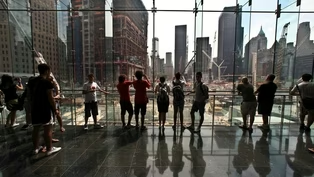
Rebuilding Ground Zero: How NYC Rose from the Ashes
Video has Closed Captions
Witness the decade-long rebuilding of Lower Manhattan after the September 11th attacks. (7m 30s)
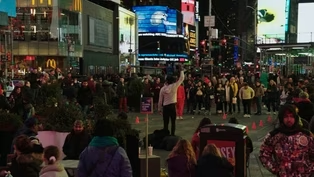
Video has Closed Captions
In this bonus scene, explore how a bold plan to pedestrianize Times Square transformed New York. (4m 45s)
Providing Support for PBS.org
Learn Moreabout PBS online sponsorship











Support for PBS provided by:
Corporate funding for NEW YORK: A DOCUMENTARY FILM "Shadows of the Past" and "The Future of Cities" was provided by Hudson River Trading. Major funding was provided by the American...